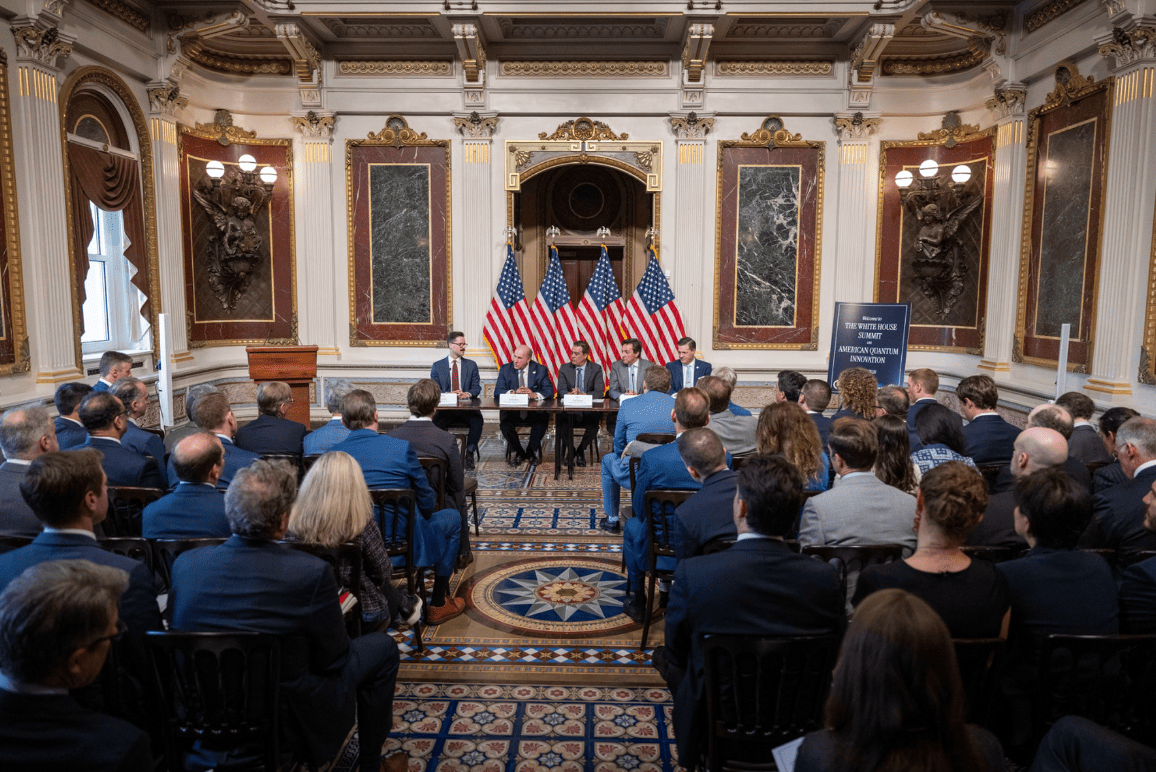
White House Quantum Summit Locks In $2B+ For 2028 Fault-Tolerant Push

Nearly 100 quantum executives and senior officials met at the White House on July 7-8 to align industry with a fresh Trump quantum strategy anchored by more than $2B in Commerce Department letters of intent and a 2028 fault-tolerant computer goal.

Key Takeaways

  • The White House convened nearly 100 quantum executives, academics and officials on July 7-8, 2026 to align industry with a national quantum strategy under Chatham House Rules.
  • The Commerce Department issued letters of intent for more than $2 billion in incentives to leading quantum companies, while the Defense Innovation Unit outlined up to $200 million for quantum sensing solicitations.
  • The Department of Energy will lead development of a fault-tolerant, scientifically relevant quantum computer by 2028, with NSF, NSA and NIST supporting research, supply chain and manufacturing.
  • Executives said near-term wins will come from quantum sensing, such as aircraft navigation in GPS-denied environments, while flagging gaps in hardware, certification standards and the cryogenics supply chain.
  • Officials positioned the federal government as the anchor customer for first-generation commercial quantum systems, echoing the U.S. playbook for radar, nuclear power and GPS.

White House Quantum Summit Locks In $2B+ For 2028 Fault-Tolerant Push

The Trump administration convened the CEOs and founders of nearly every major U.S. quantum company at the White House on July 7-8, 2026 to lock in industry support for a national quantum strategy anchored by more than $2 billion in Commerce Department letters of intent, a fresh sensing initiative and a national push for a fault-tolerant quantum computer by 2028.

Who was in the room

The summit convened in the Indian Treaty Room of the Eisenhower Executive Office Building next to the West Wing. Under Chatham House Rules, participants avoided single-company pitches and instead debated technology-wide milestones for computing, sensing and post-quantum cryptography. Roughly 100 executives, academics and officials attended over the two days.

New investment posture

The Commerce Department issued letters of intent for more than $2 billion in incentives across leading quantum companies, and the Defense Innovation Unit outlined up to $200 million for quantum sensing solicitations. The Department of Energy will lead development of a fault-tolerant, scientifically relevant quantum computer by 2028, with the National Science Foundation, National Security Agency and National Institute of Standards and Technology backing research, supply chain resilience and manufacturing programs.

Quantum computing hardware in a research lab

Sensing over computing, for now

Executives told officials that the near-term wins will come from quantum sensing, not general-purpose quantum computing. The example cited most often was a quantum sensor on an aircraft that could navigate through jammed or denied GPS environments. Participants also flagged three unresolved gaps: algorithms still ahead of hardware, no shared certification standards, and a fragile supplier base for cryogenics and enabling components.

Government as the first buyer

Officials framed the federal government as the anchor customer for the first generation of commercial quantum systems, echoing the U.S. playbook for radar, nuclear power and GPS. The message dovetails with June 22 executive orders on quantum innovation and post-quantum cryptography transition that set the strategy in motion, and with related industry pieces like QuantumDiamonds' EUR91M raise, Oratomic's $300M Series A and Pasqal's MegazoneCloud MoU in Korea.

China without the drama

Participants raised the China question but focused on redundancy rather than a single race. The consensus was to onshore what must be onshored, especially the cryogenic and photonic supply chain, and to align with allies on the rest. State-level ecosystems that combine universities, national labs and utilities were held up as the fastest-moving model, several tied to workforce plans that reach into trade schools rather than only doctoral programs.

Reporting based on coverage from The Quantum Insider, Nextgov/FCW, GovInfoSecurity and QuantumZeitgeist.

Category: AI & Technology

Tags: AI artificial intelligence AI Regulation

Related Articles

Frequently Asked Questions

What was announced at the White House quantum summit?

More than $2 billion in Commerce Department letters of intent for quantum companies, up to $200 million in Defense Innovation Unit quantum sensing solicitations, a new sensing initiative, and a national goal of a fault-tolerant quantum computer by 2028 led by the Department of Energy.

Why did executives prioritize quantum sensing over quantum computing?

Participants said near-term commercial and defense wins will come from sensing, citing quantum sensors that let aircraft navigate through jammed or GPS-denied environments, while general-purpose quantum computing still faces gaps in hardware, certification standards and supply chains.

What role will the U.S. government play in the quantum market?

Officials framed the federal government as the anchor customer for the first generation of commercial quantum systems, following the historical playbook used for radar, nuclear power and GPS.

How did the summit address competition with China?

Rather than framing it as a single race, participants focused on redundancy: onshoring critical elements like the cryogenic and photonic supply chain, aligning with allies on the rest, and building state-level ecosystems with workforce plans reaching into trade schools.