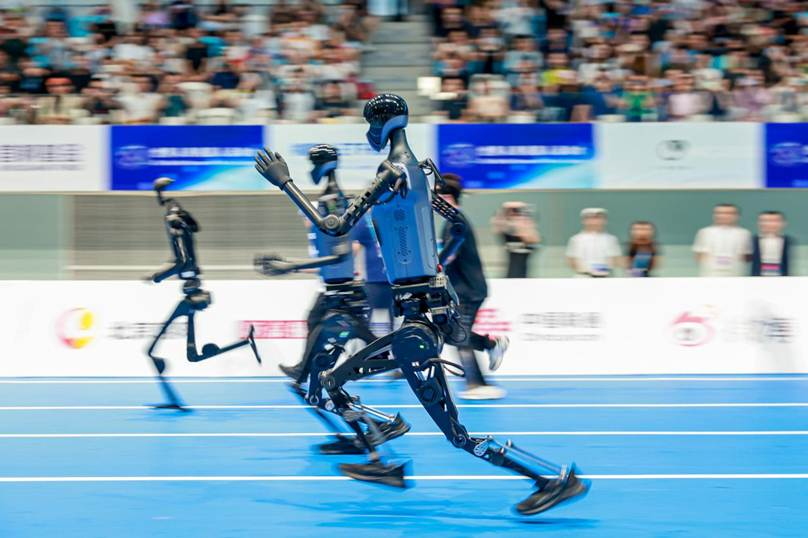
The 2nd World Humanoid Robot Games opens on Friday, August 22, 2026 at the National Speed Skating Oval in Beijing — better known as the “Ice Ribbon”, a legacy venue from the 2022 Winter Olympics — and runs through August 26. Organisers say 666 teams have registered 2,056 humanoid robots from 16 countries and regions across six continents, roughly quadrupling the 280 teams and 500-plus robots that appeared at the inaugural edition in Beijing last year.
From 26 events to 51, and out of the arena
Programme documents released by Beijing municipal authorities detail 30 competitive events across nine disciplines — athletics, football, gymnastics, martial arts, weightlifting, street dance, ballroom dance, tug-of-war and pitch-pot — plus 21 scenario-based events run in real hotels, factories and model homes rather than the staged sets of last year. The number of individual competition sessions has jumped from 487 to 1,301, and preliminary rounds have been scrapped to keep robots on the medal path.
Autonomy rules get tighter
Except for the 100-metre and 400-metre hurdles, every track event and other competitive discipline now requires robots to run fully autonomously, without wireless tele-operation. The 100 m time limit has been trimmed from three minutes to one; the 400 m from 15 minutes to five; the 1,500 m from 40 minutes to 15. Obstacle races now feature two lanes for head-to-head duels, and dexterous-hand events require robots to pick up beans and tighten screws under a stopwatch.

China's roster of humanoid makers takes centre stage
Roughly 96 % of entries are Chinese and the games have effectively become a live shop window for the country's humanoid industry. Expected competitors include Unitree Robotics, whose H1 dominated athletics events at the 2025 edition, and the Beijing Humanoid Robot Innovation Center's TianGong platform — already showcased by X-Humanoid at the World Robot Conference on 19 August. Freestyle fighting spans eight sessions, and the newly added weightlifting event awards two gold medals — lightweight and heavyweight — on the evening of 24 August. Dancesport participation has surged from 29 teams last year to 108 this year, spread across street dance, ballroom dance and cheerleading.
Referees, tickets and the shop-floor pivot
A 223-strong officiating team — 28 international-level, 75 national-level and 120 first-level referees — is 100 members larger than last year. Competition-day tickets start at 98 yuan and ceremony tickets at 128 yuan through Damai and other Chinese platforms, with a Damai International channel for overseas fans. City officials frame the shift toward scenario-based events — emergency response, hotel service, dexterous-hand precision work — as a deliberate push to move humanoids from “demonstration tools” to “practical productivity”, echoing the theme of this week's Beijing World Robot Conference.
Reporting based on coverage from Beijing municipal government (english.beijing.gov.cn), China Daily, RobotToday and RobotsBeat.