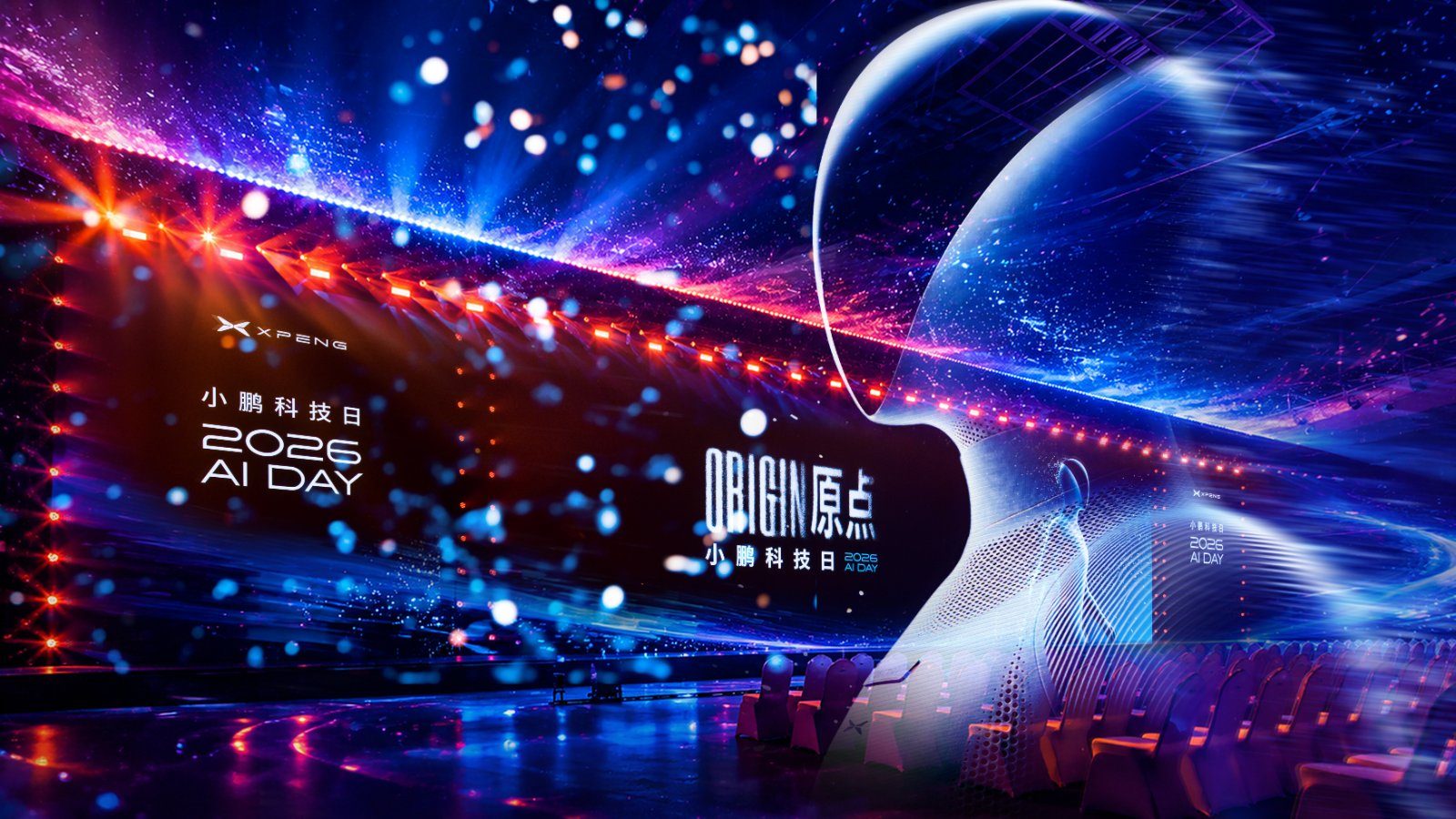
XPeng used its 2026 AI Day on November 25 to unveil the Yoyo-01, its first purpose-built robotaxi, alongside a new software architecture the company calls Turing Physical AI — a system designed to let cars, robotaxis, humanoid robots and even flying vehicles run on the same underlying AI brain, according to CnEVPost. The Yoyo-01 is slated for a 2027 debut, with demonstration operations in select areas planned before the end of 2026.
Unlike many robotaxi rivals, Yoyo-01 relies entirely on cameras and AI software to navigate — no lidar sensors, no pre-built high-definition maps of its operating streets. XPeng says it has already moved from staffed testing to driverless road trials in eight months and secured L4 demonstration-operation approval across all of Guangzhou in October.
How can one piece of software drive a car and control a robot?
XPeng's Turing Physical AI architecture is built in three layers. System 0 handles real-time hardware control — the low-level reflexes that keep a wheel turning or a joint moving smoothly. System 1 runs on what the company calls VLA 2.0, a vision-language-action model that turns camera footage and language-style reasoning directly into physical movement. System 2 sits on top, handling longer-horizon task planning, like deciding a multi-step driving route or a sequence of warehouse tasks for a robot.
Because all three layers are shared across product lines, the same vision-language-action core that lets Yoyo-01 read an intersection can, in principle, let XPeng's Iron humanoid robot read a factory floor. That shared foundation is also what lets the Yoyo-01 skip lidar: instead of building a 3D point-cloud map of its surroundings from laser sensors, it leans on the VLA model's ability to interpret raw camera images the way a human driver would.
Why is XPeng betting on one brain instead of separate systems?
CEO He Xiaopeng argued that scaling alone won't solve physical AI's hardest problems. “Physical AI faces multiple hard constraints — including regulations, safety, cost, hardware bodies, and power — that cannot be resolved through scaling alone,” he said at the event. In practice, that means XPeng is betting that building one shared software and safety stack across very different hardware — a four-wheeled robotaxi, a bipedal robot, a future flying vehicle — is cheaper and faster than building bespoke AI for each.
Sharing computing architecture also spreads R&D costs across more products. A safety improvement validated on millions of miles of car driving data can, in theory, transfer partially to a humanoid robot that has driven zero miles, shortening the path to deploying new hardware.
What's the competitive picture for driverless robotaxis?
XPeng's vision-only, lidar-free approach puts it in the same camp as Tesla's robotaxi program, while rivals including Waymo and Baidu's Apollo Go continue to rely on lidar-equipped sensor suites. XPeng says it plans to act as a technology and solution provider rather than operate robotaxis itself, partnering with operators for deployment both domestically and overseas. Paid Turing AI smart-driving subscriptions for new global buyers are set to begin in the second quarter of 2027, with early adopters of the system receiving lifetime access.