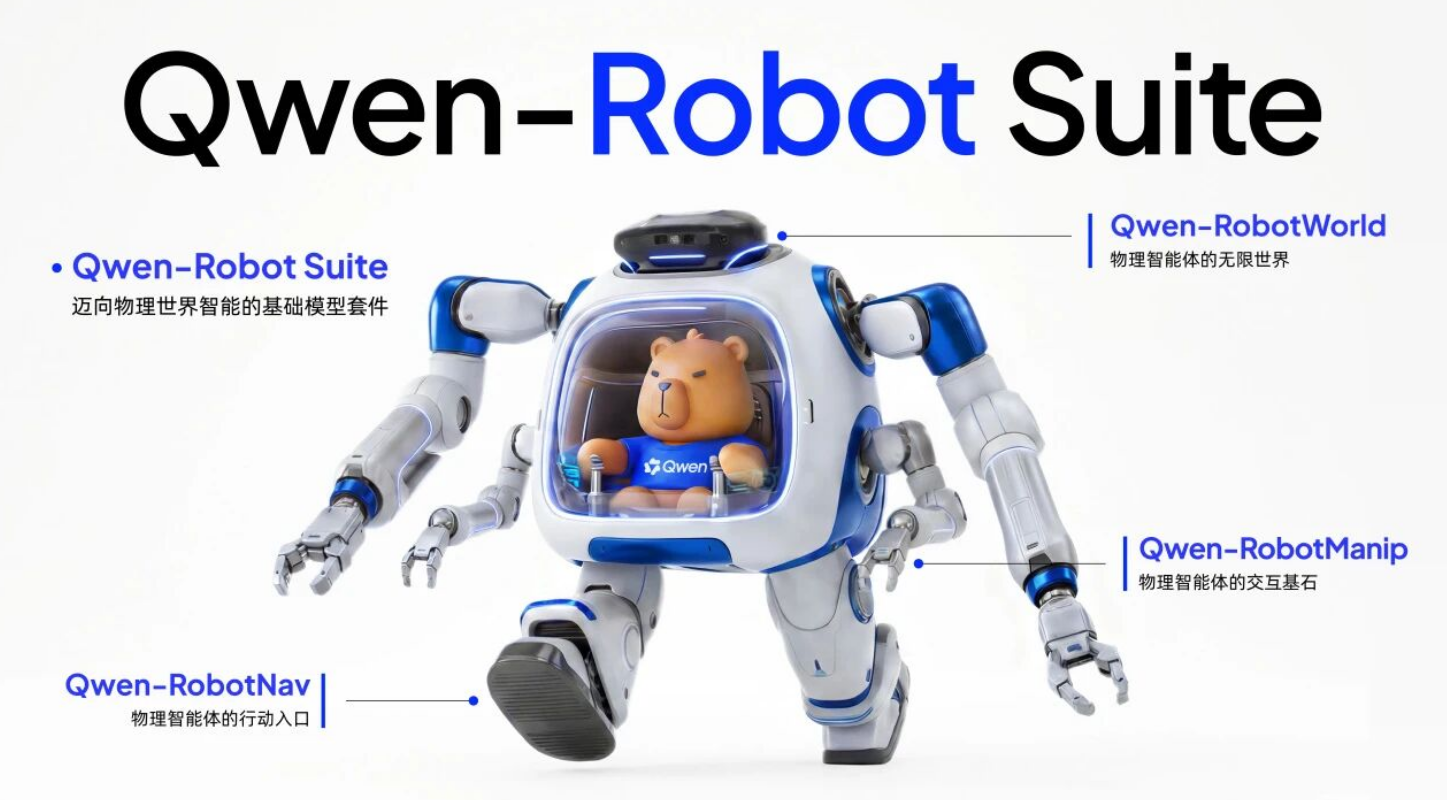
Alibaba has launched its first suite of artificial-intelligence models built specifically for physical robots, marking the Chinese technology giant's most direct move yet into embodied AI. Unveiled on June 16, 2026, the Qwen-Robot Series extends the company's Qwen foundation models beyond screens and into machines that navigate, reason about and manipulate the physical world.
Three Foundation Models
The suite is anchored by three models, each targeting a distinct robotics capability. Qwen-RobotNav unifies five navigation tasks — instruction following, point-goal navigation, object search, target tracking and autonomous driving — within a single system. Qwen-RobotManip, trained on more than 38,000 hours of open-source data, topped the RoboChallenge generalist track with a 45% task-success rate. Qwen-RobotWorld acts as a predictive world model, letting a robot simulate how a scene will change before it moves, adding a reasoning layer for embodied agents.

Cloud at the Center
Pilot deployments will run through Alibaba Cloud enterprise clients, placing the company's cloud infrastructure at the heart of its commercialization path. The strategy mirrors a broader industry race to bring large-model intelligence into hardware, a shift visible in efforts such as NVIDIA's Cosmos open world foundation model and Decart's Oasis 3 real-time world model.
China's Embodied AI Push
The release deepens Alibaba's bet on robotics following its Zhenwu M890 AI chip work and its support for lower-cost humanoids such as the Unitree platform launched on its marketplace. With domestic rivals and Western labs all chasing physical AI, the Qwen-Robot Series positions Alibaba as a software backbone for China's fast-growing robot economy.
Reporting based on coverage from TechNode, eWeek and Decrypt.