
Anthropic released Claude Sonnet 5 on June 30, positioning the new midsize model as its most agentic Sonnet yet. The model can make plans, drive tools like browsers and terminals, and run autonomously at a level that, just a few months ago, required larger and more expensive models.
Closing the Gap With Opus
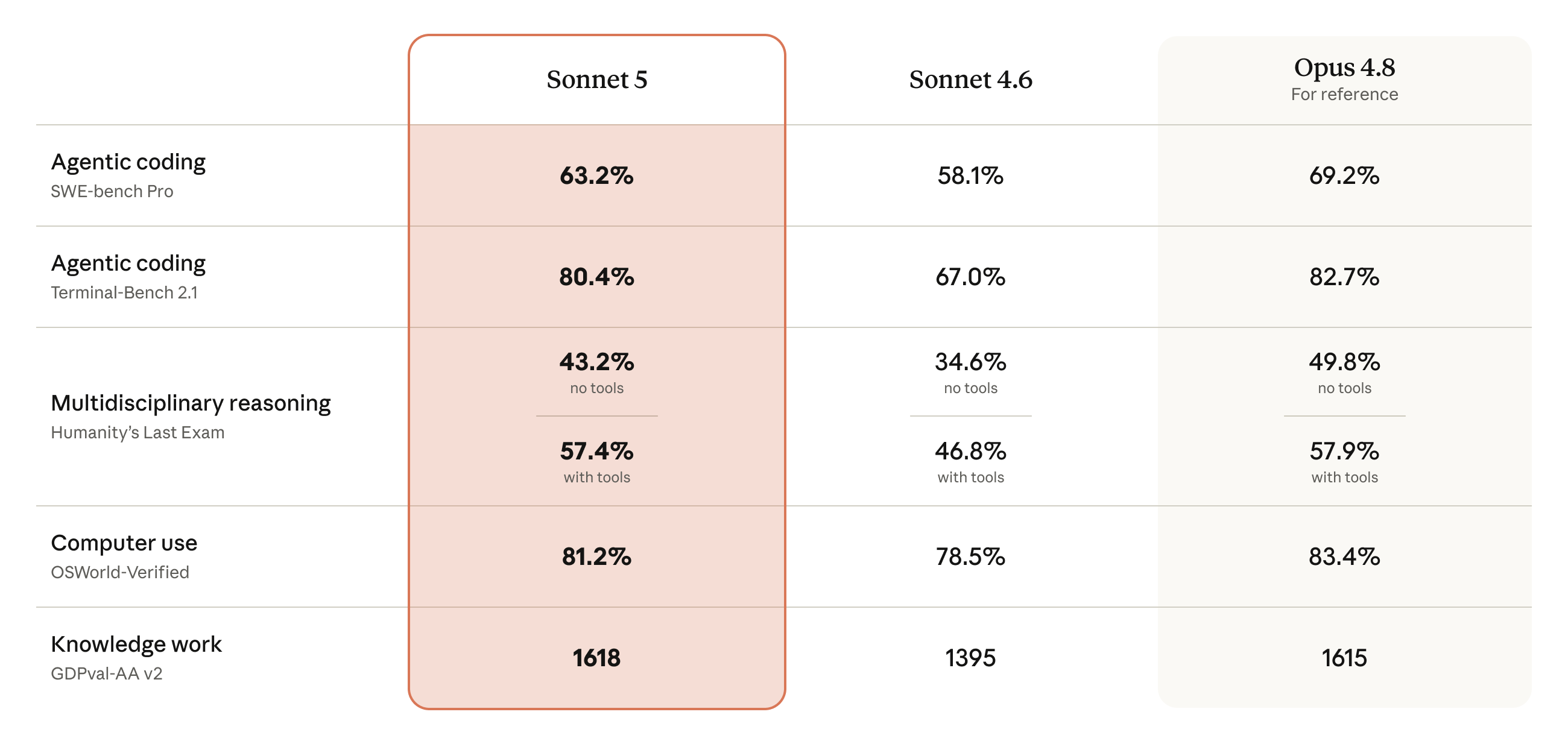
According to Anthropic, Sonnet 5's performance approaches that of Claude Opus 4.8 while remaining substantially cheaper. The company reports clear gains over its predecessor, Sonnet 4.6, across reasoning, tool use, coding and knowledge work, and says early-access partners found the model finishes complex multi-step tasks where previous Sonnet models stalled, even checking its own output without being asked. On agentic benchmarks such as BrowseComp and OSWorld-Verified, Sonnet 5 covers a wider range of cost-performance options than Sonnet 4.6 and can match Opus 4.8 on some tasks at higher effort levels.
Safety Profile and Cyber Safeguards
Anthropic's pre-deployment evaluations found Sonnet 5 shows lower rates of hallucination and sycophancy than Sonnet 4.6, better refusal of malicious requests, and stronger resistance to prompt-injection hijacking. Because the model is somewhat stronger than its predecessor on cybersecurity tasks, it launches with real-time cyber safeguards enabled by default, the same protections used for Opus 4.7 and 4.8. The release lands amid a busy stretch for the company, which recently brought its Mythos-class Fable 5 model to general availability and confidentially filed for a potential IPO.
Pricing Pressure in the Agent Era
Claude Sonnet 5 is available across all plans, becoming the default model for Free and Pro users. On the API it launches at an introductory $2 per million input tokens and $10 per million output tokens through August 31, 2026, before moving to $3 and $15. The aggressive pricing targets the fastest-growing segment of enterprise AI spending: long-running agents whose token bills scale with autonomy. Anthropic has been courting that market all year, from bundling monthly Agent SDK credits to overtaking OpenAI in business adoption on Ramp's AI Index in May. With Sonnet 5, the company is betting that near-frontier agentic capability at midsize prices will keep that momentum going into the second half of 2026.
Reporting based on coverage from Anthropic and TechCrunch.