
Zurich-based Flexion Robotics has released Reflect v1.0, the first production-grade version of its humanoid autonomy platform. In a demo published on June 29, a humanoid takes a single English instruction — retrieve a snack parcel, ride an elevator, unpack the box and place items on a shelf — and executes the multi-floor mission without any human operator in the loop.
A four-layer stack for humanoid work
Reflect v1.0 stacks four systems on top of the robot. A custom vision-language model acts as mission control, reading the egocentric camera feed and choosing the next action through structured tool calls. A motion layer built on vision-language-action policies and reinforcement-learned skills translates decisions into navigation and manipulation. A whole-body controller called Reflex keeps the humanoid balanced while it opens doors, presses elevator buttons and manipulates variable-weight boxes. Underneath it all, a new runtime named FlexComm handles inter-device communication with 40% less latency than ROS DDS and 30% lower CPU load than ROS 2 DDS.
RL cracks the compounding-failure problem
The team, spun out of ETH Zurich by former NVIDIA researchers, argues that long-horizon autonomy is unforgiving: a 95% navigation policy plus a 90% grasp plus an occasionally wrong planner compound into failure. Reflect v1.0 pushes reinforcement learning up every layer of the stack. On an internal 16-step evaluation, supervised fine-tuning alone reaches 38% end-to-end completion; adding RL fine-tuning takes that to 90%.
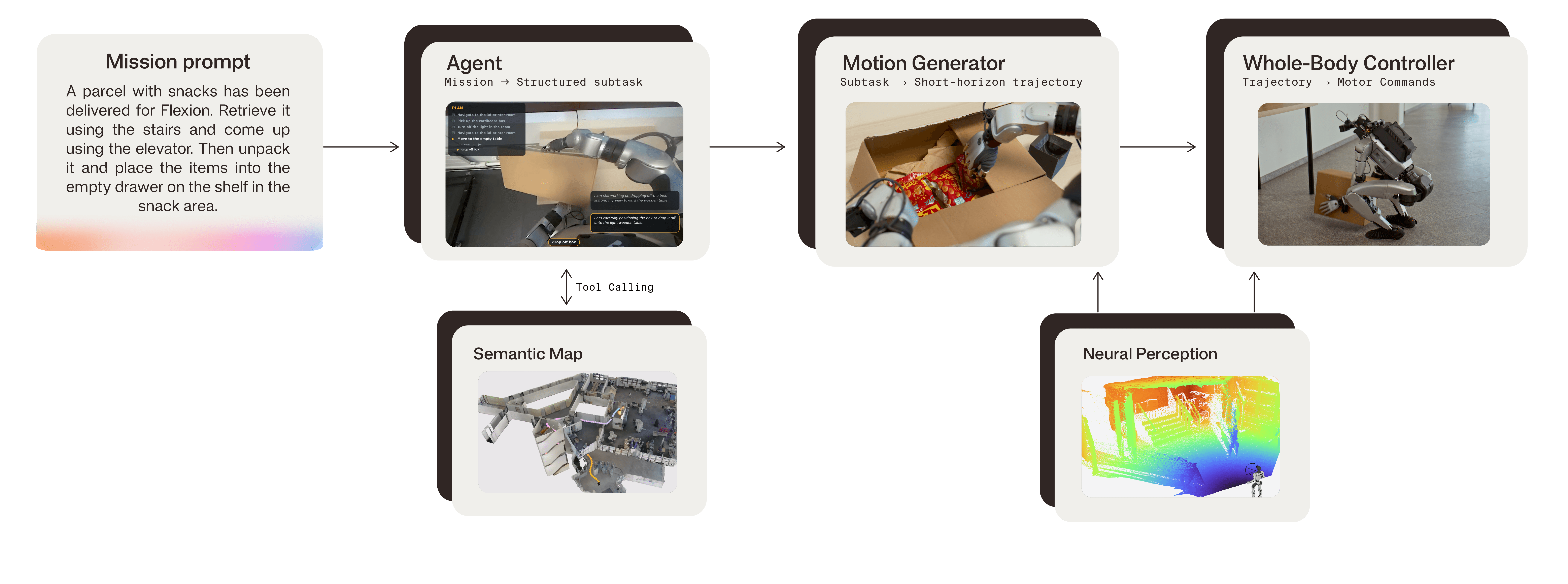
From lab clip to compounding system
Reflect trains most of its skills in simulation using NVIDIA Isaac Lab, then generalises across embodiments so new humanoid platforms plug in with minimal effort. A photorealistic simulator based on 3D Gaussian splatting lets Flexion regress every new mission against every prior skill before touching real hardware. The company launched Reflect v0 in November 2025 alongside a $50M Series A led by DST Global Partners and NVIDIA's NVentures. v1.0 keeps the architecture but tightens every layer — and, more importantly, is designed to compose into missions rather than isolated demos.
Flexion still concedes limits: skills are robust within a bounded task distribution, some grasps remain fragile, and recovery behaviours don't yet cover every failure mode. Even so, the release is one of the most complete public snapshots of a humanoid autonomy stack — landing as rivals such as Generalist AI and Rhoda AI chase the same problem with different bets.
Reporting based on coverage from Flexion Robotics, The Robot Report and eWeek.