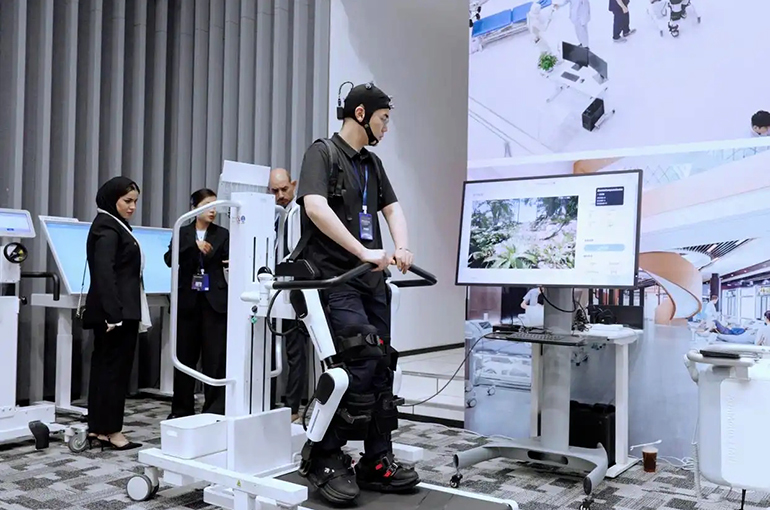
At its GReAT Summit 2026 in Shanghai on May 13-15, Fourier Rehab (the rehabilitation arm of Fourier Intelligence) signed three strategic memoranda of understanding aimed at building a global clinical evidence base for robotic neurorehabilitation, and unveiled a refreshed version of its ExoMotus M4 lower-limb exoskeleton.
Three MOUs anchor the GReAT network
Fourier signed clinical research and adoption MOUs with Brooks Rehabilitation, the Jacksonville-based US health system; with NHG Health, one of Singapore's largest public healthcare providers, serving roughly 1.5 million residents; and with Nagoya University in Japan. Together they form what Fourier calls the GReAT (Global Rehabilitation & Assistive Technology) Network — a multi-region scaffold for joint trials, clinician training, and co-developed robotic neurorehabilitation protocols.
What the deals do
The Brooks MOU centers on robotic neurorehabilitation research, leveraging Brooks' clinical research institute and its inpatient/outpatient program scale. The NHG agreement covers three pillars: a co-established RehabHub at NHG for adoption of personalized rehabilitation technologies, joint development and clinical validation of scalable robotics applications, and shared training programs for clinicians. Nagoya University brings advanced academic engineering research to the table, with co-development of next-generation rehabilitation devices.
ExoMotus M4: internal upgrades, same form factor
Alongside the deals, Fourier rolled out internal upgrades to ExoMotus M4, its lower-limb exoskeleton for stroke, spinal cord injury and other neurological conditions. The updates focus on improved actuators and control systems, targeting smoother motion, faster responsiveness and additional safety headroom when used with the balance frame and harness support. The form factor and clinical workflow are unchanged, easing rollout at existing customers like Saldo Rehab.
Why this matters for the rehab market
Rehabilitation robotics has lagged surgical robotics on commercial deployment, partly because evidence generation has stayed fragmented between single-site studies. A multi-region MOU framework with three serious clinical partners gives Fourier a faster path to multi-center trial data — the kind that drives both regulatory approvals and payer coverage decisions. The expansion lands as Chinese rehab-robot makers broadly accelerate their overseas push, often in partnership with established Western or Japanese clinical institutions.
Industry context
The push aligns with renewed interest in physical AI for healthcare — see the TechForce LIM-E rollout at Oncotelic and continued FDA traction for surgical robots such as CMR Surgical's Versius Plus. As payers move from coverage of acute surgical procedures to longitudinal recovery, scalable rehab robotics moves from nice-to-have to part of the standard care pathway.
Reporting based on coverage from Exoskeleton Report, Yicai Global, Brooks Rehabilitation and The Robot Report.