
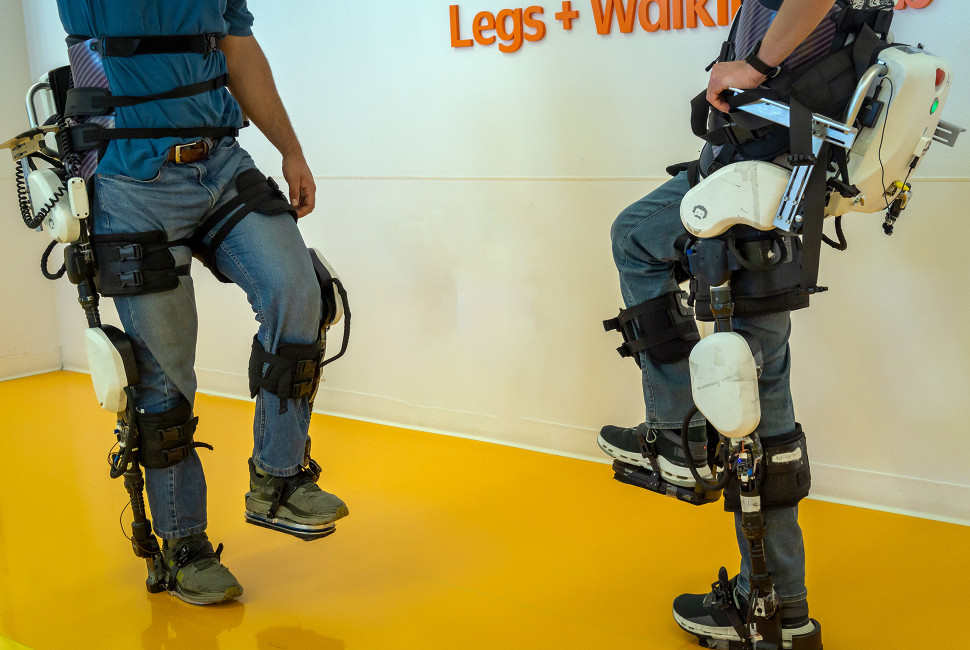
Scientists at Northwestern University and Shirley Ryan AbilityLab have developed a first-of-its-kind rehabilitation system that virtually connects therapists and stroke patients through robotic exoskeletons, allowing a therapist's own leg movements to guide a patient's gait in real time. The study was published in the journal Science Robotics.
Springs, Shock Absorbers and Shared Movement
In the new intervention, called therapist-exoskeleton-patient interaction (TEPI), a therapist and a stroke survivor each wear a lower-limb exoskeleton virtually connected at the hips and knees. The connection behaves like a combination of springs and shock absorbers, so the two wearers influence each other's movements continuously. That addresses a longstanding limitation of rehabilitation exoskeletons, which can extend training time but often rely on fixed movement patterns that do not adapt to a patient's performance from step to step.
"Therapist-led rehabilitation remains the foundation of recovery for many patients, and this research shows promise for complementing this standard of care," said Jose L. Pons, the Shirley Ryan AbilityLab scientific chair who led the research program.
Better Range of Motion Than Treadmill Training
In evaluations with eight stroke survivors, TEPI outperformed conventional therapist-guided treadmill training on several measures of walking performance. Participants moved their joints through a greater range of motion, took longer and higher steps, and activated their muscles at levels similar to conventional therapy, while reporting high motivation and enjoyment. The researchers say the approach could enable whole-body gait training without requiring multiple therapists, and reduce the physical strain that contributes to therapist fatigue and injury during hands-on sessions.
A Crowded Field Moving Toward the Home
Nearly 800,000 Americans survive a stroke each year, and robotic gait therapy is becoming one of rehabilitation's most active frontiers, from Fourier's expanding rehab robotics partnerships to hospital exoskeleton trials in Switzerland and consumer exoskeleton launches. The Northwestern and Shirley Ryan AbilityLab team plans to extend TEPI to overground walking, stair climbing and sit-to-stand transitions, and to explore more accessible systems that could bring therapist-guided rehabilitation into patients' homes through remote care. The work was supported by the National Science Foundation's National Robotics Initiative.
Reporting based on coverage from Northwestern Now and Science Robotics.