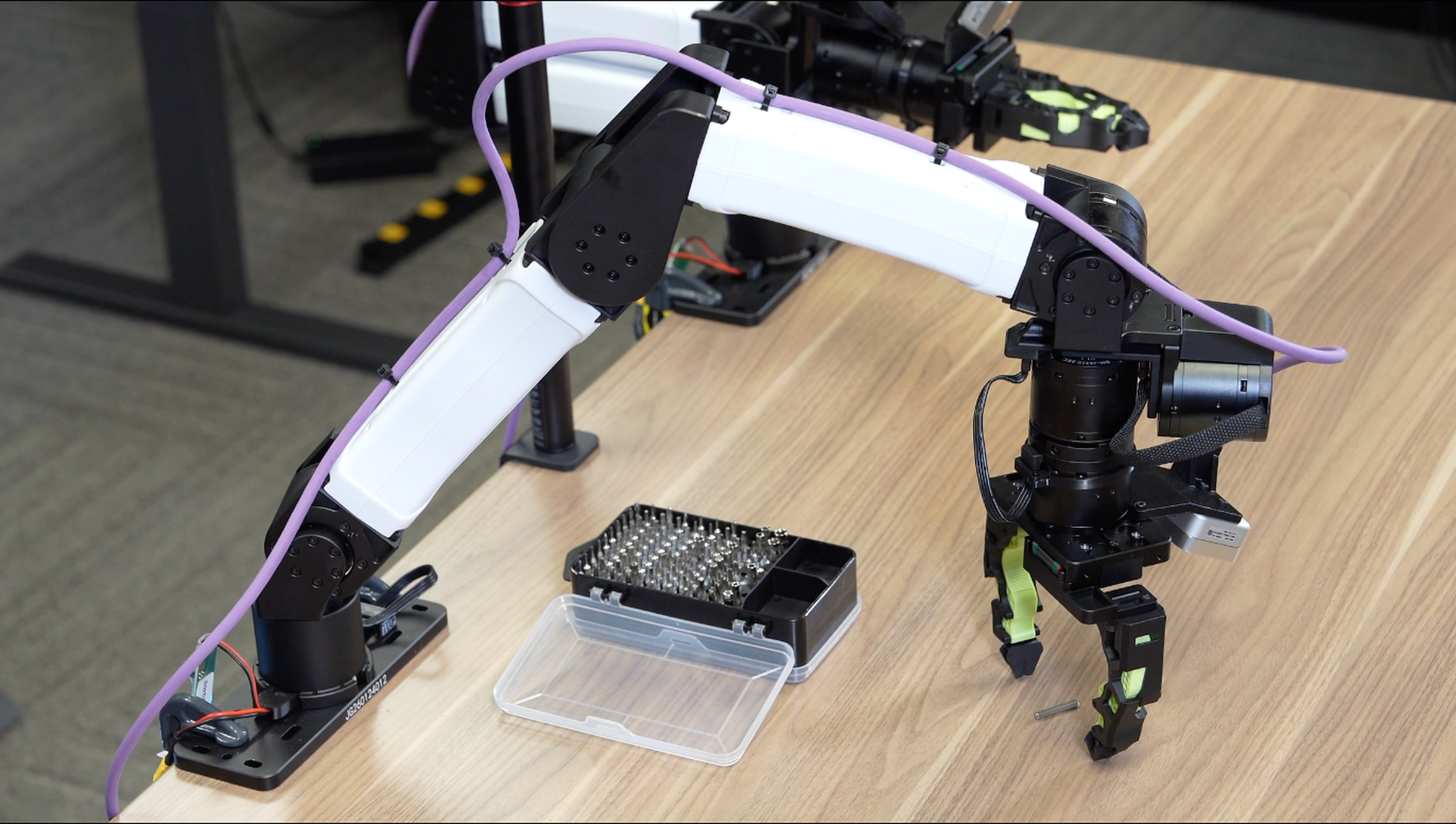
As Jensen Huang made physical AI the centerpiece of his VivaTech 2026 keynote in Paris, the NVIDIA research lab behind those claims published the most concrete evidence yet of what the thesis looks like on real hardware. On June 17, researchers from NVIDIA's GEAR Lab, Carnegie Mellon University and UC Berkeley released ENPIRE — a closed-loop framework that hands the entire robotics research cycle to AI coding agents, with no human required between iterations.
Physical Autoresearch
ENPIRE is the first documented system in which frontier coding agents conduct what the team calls "physical autoresearch" — running the full scientific loop not in simulation but on real robots. Agent teams achieved a 99% pass@8 success rate on demanding contact-rich tasks, including seating a graphics card into a motherboard and tying a zip tie with a cutter tool. The agents reset physical scenes, run hardware trials, verify outcomes and rewrite their own policy code until it works.

Breaking The Reset Bottleneck
Robotics research has long been throttled by a constraint with no equivalent in software: every failed trial must be physically cleaned up by a human technician. ENPIRE eliminates that step with four interlocking modules. The Environment module handles automatic scene reset and outcome verification; the Policy Improvement module lets agents generate, revise and test code; the Rollout module runs budgeted hardware trials; and the Evolution module compares experimental branches across a robot fleet. Coordination happens entirely through Git, so a breakthrough at one station propagates across the fleet without centralized orchestration.
Not A Cure For The Sim-To-Real Gap
The paper is candid about limits. On the Push-T task, all three frontier coding agents — Codex with GPT-5.5, Claude Code with Opus 4.7 and Kimi Code with Kimi K2.6 — solved it in simulation, but two of three failed on real hardware, defeated by friction, object movement and sensor noise no simulator fully replicates. ENPIRE makes the real world iterable at near-simulation speed, but it does not dissolve physics. Fleet scaling from one agent to eight cut Push-T research time from roughly five hours to two, though token consumption rose faster than the fleet-size multiplier.
Part Of A Broader Physical-AI Push
The release lands amid an intensifying race to make robots learn faster, from NVIDIA's Cosmos world models to its factory-floor alliance with Hyundai and Foxconn's NVIDIA-trained humanoids shown the same week. An open-source release of the full ENPIRE codebase is planned, though no date has been confirmed.
Reporting based on coverage from Tech Times and NVIDIA Research.