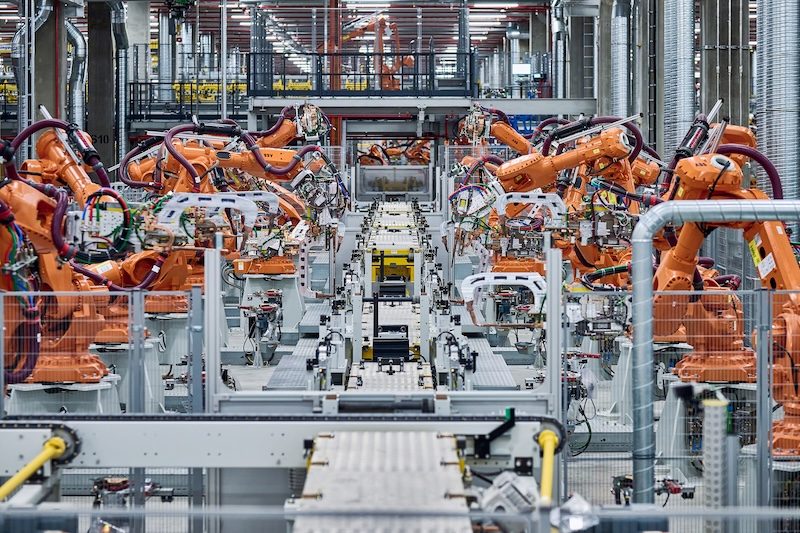
ABB Robotics is supplying more than 1,700 large industrial robots to BMW Group for production of the automaker's new "Neue Klasse" electric vehicle generation, with installations running at BMW's main plant in Munich, Germany, and its Tiexi plant in China. The order covers ABB's IRB 6720 to IRB 6740 line and the heavier IRB 7720, models built for car-body work and rated to handle payloads up to 620 kilograms. The robots weld, glue, rivet and assemble body panels, all running on ABB's latest OmniCore control platform.
On paper this reads like a routine automotive supply deal. In practice it signals where EV manufacturing money is actually going right now: not toward flashy humanoid pilots, but toward the unglamorous, high-payload robots that build car bodies at scale. BMW is not experimenting here. It is re-equipping two flagship plants on two continents at once, which says something about how much confidence the company has that Neue Klasse will hit volume targets.
Why Body Shops Remain the Real Automation Battleground
Welding and riveting body-in-white structures is one of the most capital-intensive, least forgiving steps in vehicle manufacturing. Tolerances are tight, cycle times are brutal, and a single misaligned joint can surface as a recall years later. That is why automakers have automated this stage since the 1980s, long before anyone talked about foundation models for robots. The Neue Klasse order shows that even as the industry chases humanoids for picking and kitting, the heavy lifting of structural assembly still belongs to fixed-base, high-payload arms with decades of refinement behind them.
ABB is also using the deal to make a point about energy. The company says OmniCore's newest generation cuts power draw and can recover braking energy during robot motion, a detail that matters more now that EV plants are judged partly on their own carbon footprint, not just the emissions of the cars rolling off the line. Joerg Reger, ABB Robotics' automotive business line manager, framed the order as a contribution to both precision and "the digitalization of manufacturing," language that reflects how automotive robot suppliers are trying to sell efficiency gains alongside raw throughput.
The Competitive Picture: ABB, Fanuc, KUKA and a Shrinking Pie
ABB has history with BMW. The two have signed robot orders before, including a prior 2,400-unit frame agreement, and BMW has long split its automation spending across ABB, Fanuc and KUKA to avoid single-supplier risk. What makes this order notable is the explicit tie to Neue Klasse, the platform BMW is counting on to prove it can build profitable EVs at the volumes Tesla and Chinese rivals already manage. Munich and Tiexi are not secondary lines; they are the plants meant to validate the architecture before it spreads across BMW's global network.
The broader industrial robot market is not growing the way it did a decade ago. Automotive has historically been the single largest buyer of industrial robots worldwide, and that demand has cooled as legacy combustion lines get retired rather than replaced one-for-one. Orders like this one are therefore less about market expansion and more about automakers concentrating fewer, larger robot purchases into the EV platforms they are betting their future on. For ABB, landing the Neue Klasse body-shop work ahead of rivals is a share-of-wallet win in a market where the number of major new car-body programs each year is shrinking, not growing.
Source: ABB