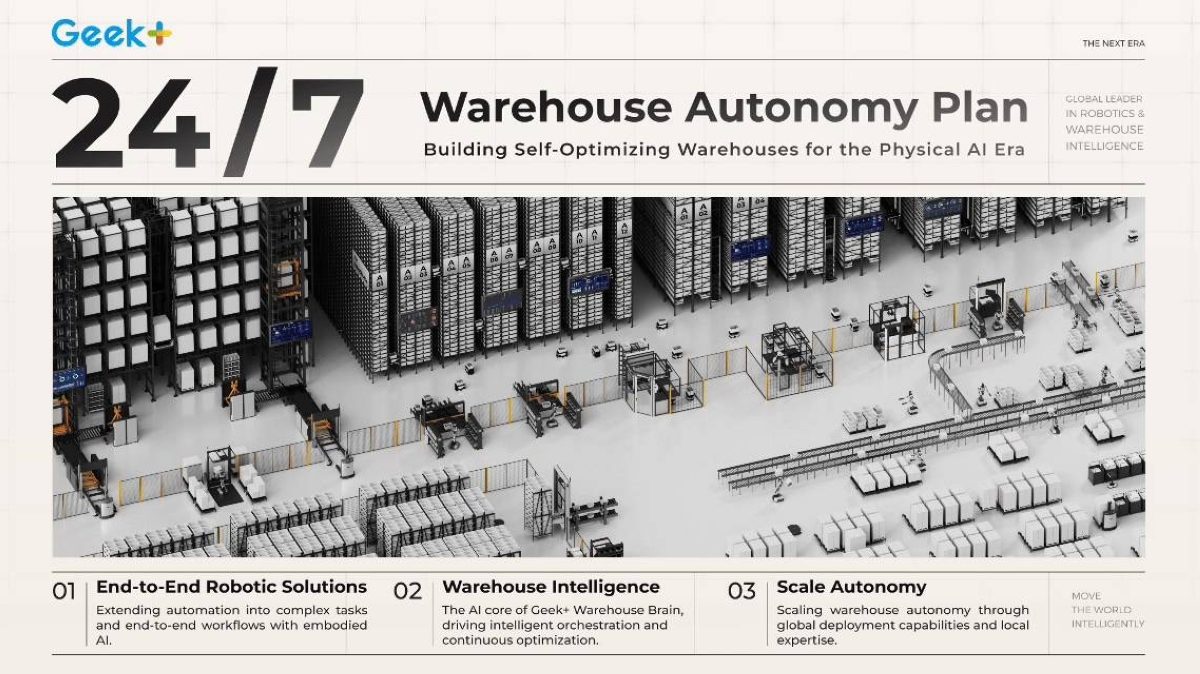
Geek+ unveiled its "24/7 Warehouse Autonomy Plan" on November 11, 2026, a roadmap aimed at moving warehouses from automating individual tasks toward facilities that run continuously with minimal human oversight. The Beijing-based company, which says it has held the No. 1 global market share in autonomous mobile robots (AMRs) for seven consecutive years and operates in more than 40 countries, is positioning the plan as the next phase after a decade of selling robots that handle discrete jobs like picking or transport.
The plan rests on three existing pillars: an end-to-end robotics portfolio spanning AMRs, humanoid robots and picking workstations; a software stack called the Geek+ Warehouse Brain, combining a Robot Management System, a Warehouse Execution System and an Intelligent Operations Platform; and a global deployment and service network. Layered on top is a proprietary Gravity unified embodied AI framework paired with a Gravity 4D embodied world model, intended to give robots multimodal perception and longer-horizon task reasoning rather than scripted responses. Founder and CEO Yong Zheng framed the goal plainly, saying the company's next target is enabling the warehouse as a whole to operate more autonomously and keep improving through real-world use.
Why Coordination, Not Hardware, Is the Hard Part
Individual robotic tasks, such as moving a pallet or picking an item, have been commercially solved for years. The harder, less-automated layer is coordination across an entire shift with no supervisor on the floor: what happens when a robot jams, an order spikes unexpectedly, or an exception needs handling at 3 a.m.
Geek+ structures its answer around three priorities it calls "Complete the Flow," which applies physical AI to picking, manipulation and exception handling that still often falls back to a human; "Strengthen the Intelligence Loop," a closed cycle of sensing, analysis, decision-making, execution, feedback and learning meant to let the system improve itself over time rather than needing manual retuning; and "Scale Autonomy," which covers expanding into new customers and use cases through localized R&D and manufacturing. None of these are new categories of robot. They are an attempt to make existing fleets act less like a collection of point solutions and more like a single system that notices when something is wrong and adjusts.
A Crowded Field Chasing the Same Endpoint
Geek+ is not alone in reaching for whole-facility autonomy. Competitors including Locus Robotics, inVia Robotics and Dexterity have all pushed orchestration software alongside their hardware, while Amazon Robotics has invested heavily in warehouse-wide coordination systems inside its own fulfillment centers. Chinese rival Cainiao has recently expanded its own climbing-robot network with denser storage and four-side retrieval, and GXO's move toward large-scale humanoid trials with Apptronik points to the same industry-wide push to get machines operating with less supervision.
What differentiates Geek+'s pitch is scale of existing deployment: a seven-year AMR market lead gives it a large installed base on which to test closed-loop learning, rather than building autonomy features for a greenfield rollout. The trade-off is that retrofitting intelligence onto an existing global fleet is slower and messier than designing it in from day one. Geek+ has not published a timeline for when customers might see lights-out operation in live facilities, and the announcement reads as a strategic framework rather than a product launch. The real test will be whether Geek+ can show measurable reductions in human intervention at specific customer sites, not just a roadmap of ambitions, in the coming quarters.
Source: GlobeNewswire