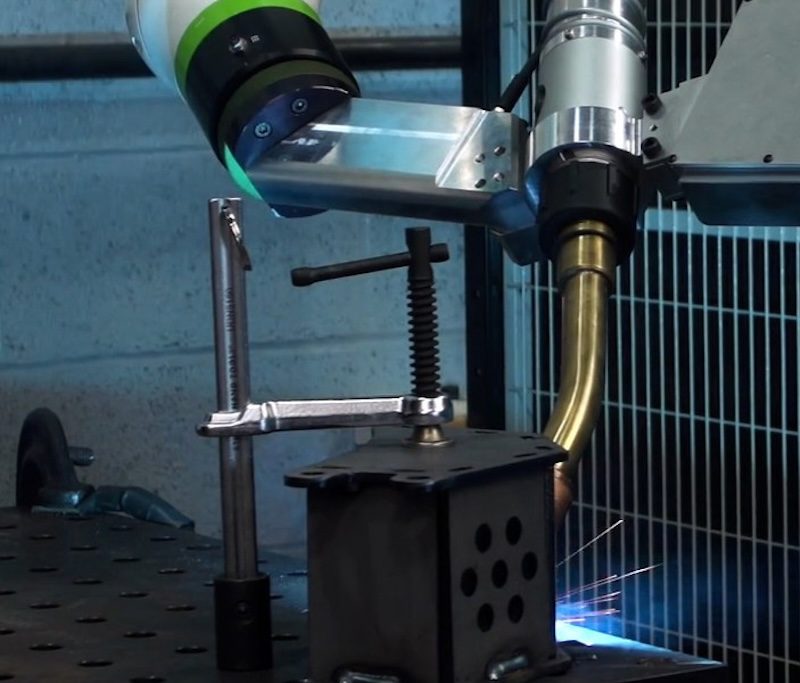
Lincoln Electric introduced XpertLINC, a physical AI technology platform that lets robotic welders scan a joint and set their own motion path and weld parameters without CAD files or manual programming. The platform is launching first on the company's Cooper welding cobots, with Lincoln Electric planning to extend it across its broader line of automated cutting and welding systems over time.
Under XpertLINC, an operator only needs to mark a weld's start and end points. The system then scans the joint geometry, assesses how well the parts fit together, and combines that data with Lincoln Electric's weld procedure specifications to calculate coordinated robot motion and welding settings in real time. The platform can keep adjusting mid-weld as it detects variation in the part and flags anything that falls outside specification for a human to review.
Targeting a Labor Gap Traditional Programming Can't Fix
Kevin Whaley, Lincoln Electric's executive vice president and president of global automation, said the platform "redefines state-of-the-art in fabrication and solves manufacturers' toughest challenges including labor availability, productivity and quality." That framing points to the core problem XpertLINC targets: traditional robotic welding cells require a programmer to write a fixed path for every part variant, which breaks down when incoming stock varies in fit-up, warpage or tolerance, as it often does with metal fabrication. Vision-guided adaptive welding has existed for years, but Lincoln Electric's pitch is that bundling sensing, motion planning and decades of weld-procedure knowledge into one system removes the programming step almost entirely rather than just assisting it.
The move puts Lincoln Electric alongside a wave of industrial automation vendors building what they call physical AI into robotic work cells. Companies such as Path Robotics and Nvidia's robotics partners have pushed similar adaptive-welding and vision-based manufacturing systems aimed at the same skilled-welder shortage that has squeezed metal fabrication shops for years. Lincoln Electric's advantage is its existing install base of Cooper cobots and decades of proprietary weld-procedure data, which the company is now using as training material for XpertLINC's parameter-setting logic rather than building that expertise from scratch.
Rollout and What's Next
Lincoln Electric has not disclosed pricing for XpertLINC or a specific timeline for expanding it beyond Cooper cobots to its other cutting and welding automation lines. The company also has not released independent data on cycle-time or defect-rate improvements from early deployments. Those figures, along with customer case studies from the first manufacturers to run XpertLINC on live production parts, will likely determine how quickly the platform spreads through Lincoln Electric's broader automation catalog.