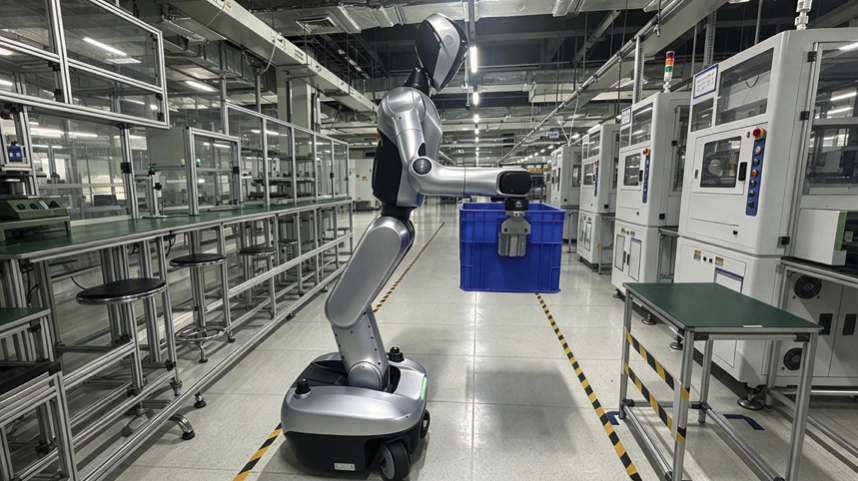
FMC³ Robotics introduced Doceo on November 11, 2026, a data platform built to let industrial robots learn manufacturing tasks by directly observing human workers rather than being manually programmed. The Germany-based company says the real bottleneck in deploying robot AI isn't data volume, but data that reflects exactly how a job gets done on a specific line.
The system has four parts. Doceo RealCap captures visual, depth, movement and tactile data using smart camera headsets, external cameras and optional touch-sensitive gloves worn by workers on the floor. Doceo Hub synchronizes those multiple data streams and gives engineers recording and annotation tools. Doceo Cloud handles ingestion, automatic labeling, model training and simulation. Doceo Driver then connects the trained skill to different robot hardware on the plant floor.
Why human demonstration data matters now
"The real shortage is not data in general. It is qualified physical-world data that reflect how a task is actually performed in a certain environment," said Dr. Joachim Fetzer, FMC³ Robotics' president of Europe. That framing echoes a problem the whole robot-AI field has been racing to solve: generic internet video and simulation can teach a model general concepts, but a specific pick-and-place motion on a specific battery line still needs footage from that exact environment to work reliably.
FMC³ has already run proof-of-concept projects built on Doceo at two plants. At a consumer electronics facility, a wheeled robot learned to pick and transport parts bins. At a battery cell production site, a robot learned to handle and position electrode sheets, a delicate task where misalignment can ruin a cell. The company also announced plans for a joint venture with Vector Informatik and PEM Motion, two firms with existing footholds in automotive software tooling and battery manufacturing engineering, respectively.
Where this fits in the robot-learning race
Doceo competes in the same broad category as Nvidia's GR00T models and various imitation-learning platforms from humanoid robot makers, all of which try to shrink the gap between watching a task and performing it autonomously. FMC³'s pitch is narrower and more industrial: rather than aiming for general-purpose humanoid dexterity, Doceo targets specific, high-value manufacturing tasks where a plant already has workers performing the exact motion a robot needs to learn. The planned joint venture with Vector Informatik and PEM Motion suggests FMC³ wants to pair its capture technology with partners who already sell into automotive and battery factories, rather than building a sales channel from zero. Whether Doceo scales beyond pilot projects will depend on how quickly captured demonstrations translate into robots that hold up on a full production shift, not just a proof-of-concept run.