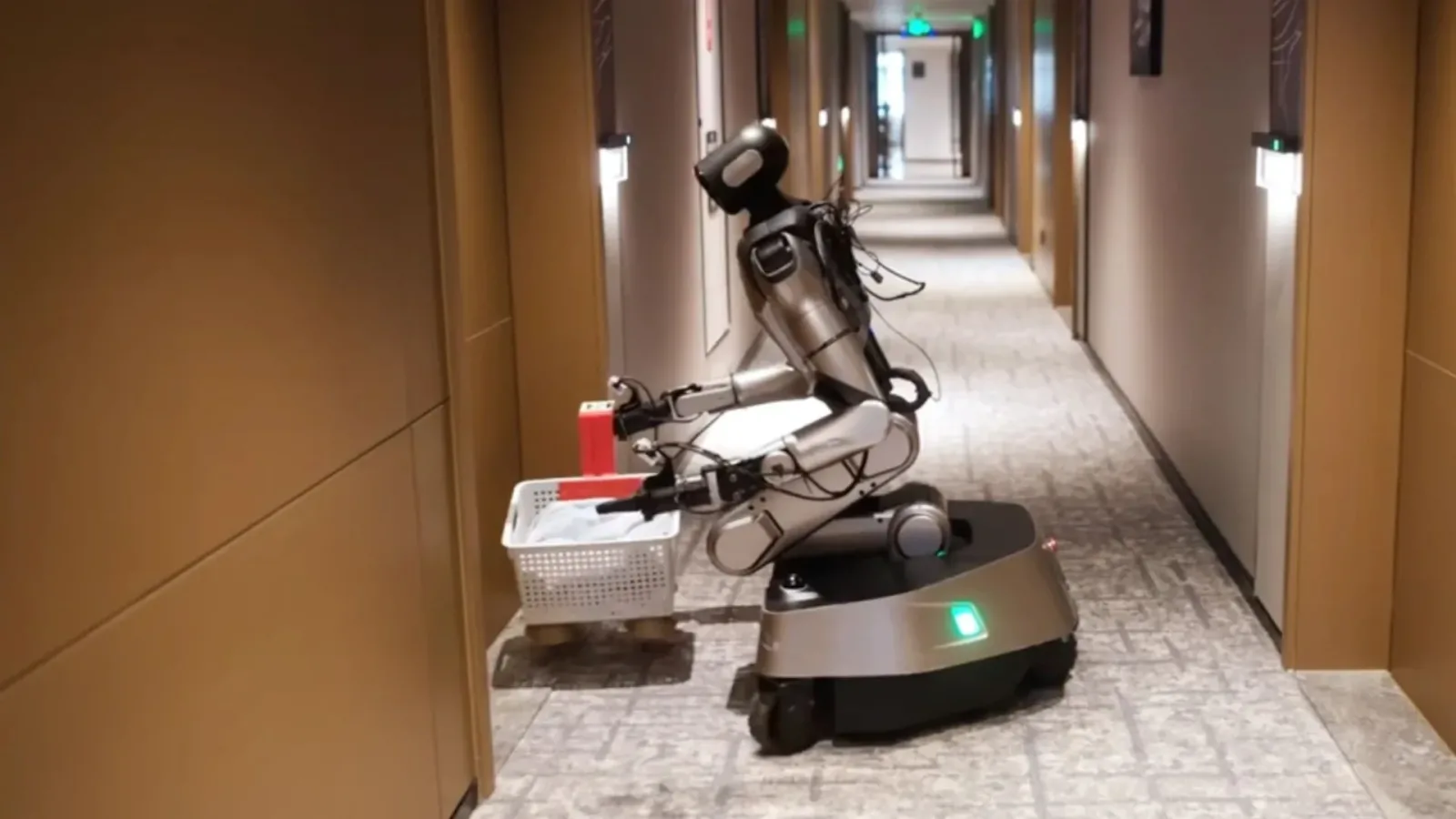
ACE Robotics has cut the time its hotel laundry robot takes to complete a full collection-to-delivery cycle to 18.6 seconds, down from more than 30 minutes when the same task relied purely on cloud-based planning, according to details the China-based company shared on November 13.
The system pairs a cloud AI planner, which the company has linked to a model it calls GPT-Astra for task decomposition, with skills that execute locally on the robot itself. Instead of sending every decision back to the cloud, the robot breaks the laundry job into 53 atomic actions and 14 higher-level steps, choosing from more than 200 possible action sequences depending on room locations, elevator availability and queues at the washing machines, according to Interesting Engineering.
The technology behind the jump is Mundo, a physics-aware digital twin that lets the robot rehearse hotel laundry tasks against a simulated version of the real environment before attempting them live. A self-improving skills loop then reviews footage from multiple cameras and sensor logs after each run, generates proposals for refining the approach, and rolls out new skill versions without a human rewriting code.
The unglamorous problem robots keep tripping over
Unloading a dryer sounds trivial next to welding a car chassis, but tangled, soft, unpredictable fabric has stumped robotics for years longer than rigid factory parts have. That bottleneck has slowed automation in exactly the settings — hotels, hospitals, commercial laundries — that most need relief from manual, repetitive labor. ACE Robotics ran 165 real-robot dryer-unloading trials over 57 hours to prove out its approach, generating 37 improvement proposals and roughly 80 skill versions in the process. Dryer cycles themselves still take 170 to 210 seconds, but the share of jeans left behind after a cycle fell from an average of 48% to 32%, with the best run hitting just 19%.
Those improvements matter more than they sound. Hotels have watched warehouse and factory robots mature for years while laundry, linen handling and other back-of-house tasks stayed stubbornly manual, largely because fabric behaves nothing like a rigid part on a conveyor. Hospitality operators facing persistent housekeeping and laundry staffing shortages have a direct financial reason to want this kind of task solved, not just automated for show.
Where this fits in China's physical AI race
ACE Robotics' approach echoes a pattern showing up across Chinese robotics firms this year: pair a large cloud model for reasoning with compact, fast, on-device skills for execution, rather than betting everything on one side. It is the same dual-layer logic behind recent moves from AgiBot and Zhiyuan, though ACE is applying it to a hospitality back-of-house task rather than factory manipulation or humanoid showcases.
The company has not named a hotel partner, disclosed pricing, or confirmed a commercial deployment timeline. Its results so far come from internal trials rather than a live hotel floor. The next test will be whether a system tuned over 57 hours of company-run trials holds up against the unpredictability of an actual hotel laundry room, with real guest schedules, real staff turnover and machines that do not always behave the way a digital twin predicts.