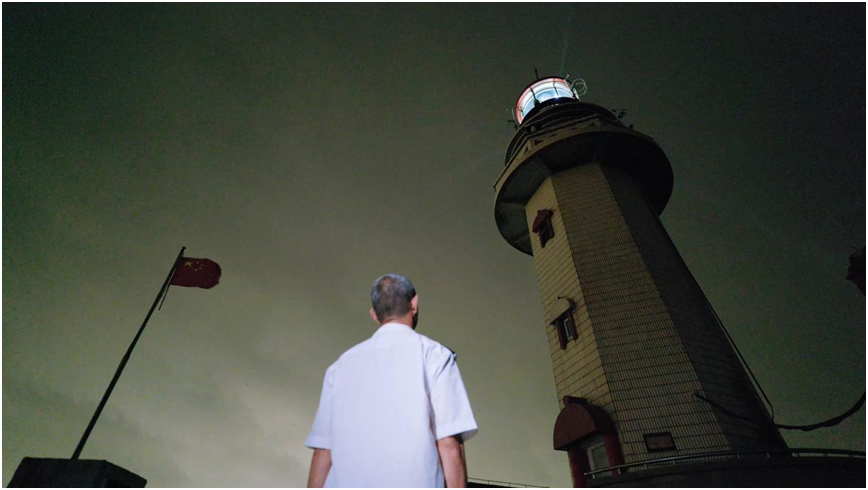
DEEP Robotics sent its LYNX M20 wheel-legged quadruped to a 160-year-old lighthouse on Qiliyu island in the East China Sea this week, where the robot carried a 15-kilogram load up 145 steps and 23 meters of elevation in a single climb. The Ningbo-based company published the field trial on November 14, framing it as proof that legged robots can take over inspection and supply work that currently falls to human keepers on isolated, hard-to-reach infrastructure.
The robot carried HD cameras, thermal imaging and acoustic sensors, and it accompanied night patrols using onboard lighting while checking a generator's oil pressure and pipe connections. A lighthouse keeper with 42 years on the job, Xu Miaoqi, was quoted saying the robot climbed stairs faster than the staff do. That is the kind of unscripted reaction vendors like to publish, but it also points to the actual pitch: coastal lighthouses, substations and offshore facilities are expensive and sometimes dangerous for people to reach regularly, and a machine that climbs stairs and carries gear removes a recurring staffing problem rather than just adding a camera feed.
Why remote infrastructure, not warehouses, is the real test
Quadruped and wheel-legged robots have spent the past few years competing mostly on flashy demonstrations: dancing, backflips, obstacle courses. The commercially interesting use case has quietly become something duller: checking on assets that are far from people. Utilities, oil and gas sites, mines and now maritime infrastructure share the same problem. Sending a technician out is slow, costly or risky, and a fixed camera cannot climb stairs, carry supplies, or adapt to a 160-year-old structure that was never built with sensors in mind.
That is a different bar than a warehouse floor. Warehouses are flat, indoor and climate-controlled, which is why Boston Dynamics' Spot and Unitree's Go2-class machines have found easy footing there. A lighthouse staircase, by contrast, is uneven, exposed to salt air, and often unreachable by boat in bad weather. If LYNX M20 can operate reliably in that setting, DEEP Robotics has a stronger claim to the inspection markets that actually pay well: power transmission, ports, and offshore energy, where downtime or missed faults are expensive.
The competitive field is getting crowded from both ends
DEEP Robotics is not alone in chasing industrial legged robots. ANYbotics has started shipping an explosion-rated quadruped for oil, gas and chemical sites, betting on certification as its edge. Chinese rivals like Unitree and Xiaomi's Cyberdog line compete more on price and volume than on hazardous-environment specialization. DEEP Robotics' bet with the lighthouse trial is narrower and more pointed: a wheel-legged hybrid that can switch between rolling on flat ground and climbing stairs, which matters for mixed terrain like a lighthouse's rocky approach and spiral stairwell.
The harder question is economics. A 15-kilogram payload capacity is useful for tools and small parts, but it will not replace heavier logistics runs. And a single demonstration, however well-documented, is not the same as a maintenance contract. DEEP Robotics will need repeat deployments with utilities or maritime authorities to turn this from a publicity exercise into a sales pipeline, and competitors with deeper certification work, like ANYbotics, are already ahead on that front for the highest-value hazardous sites.