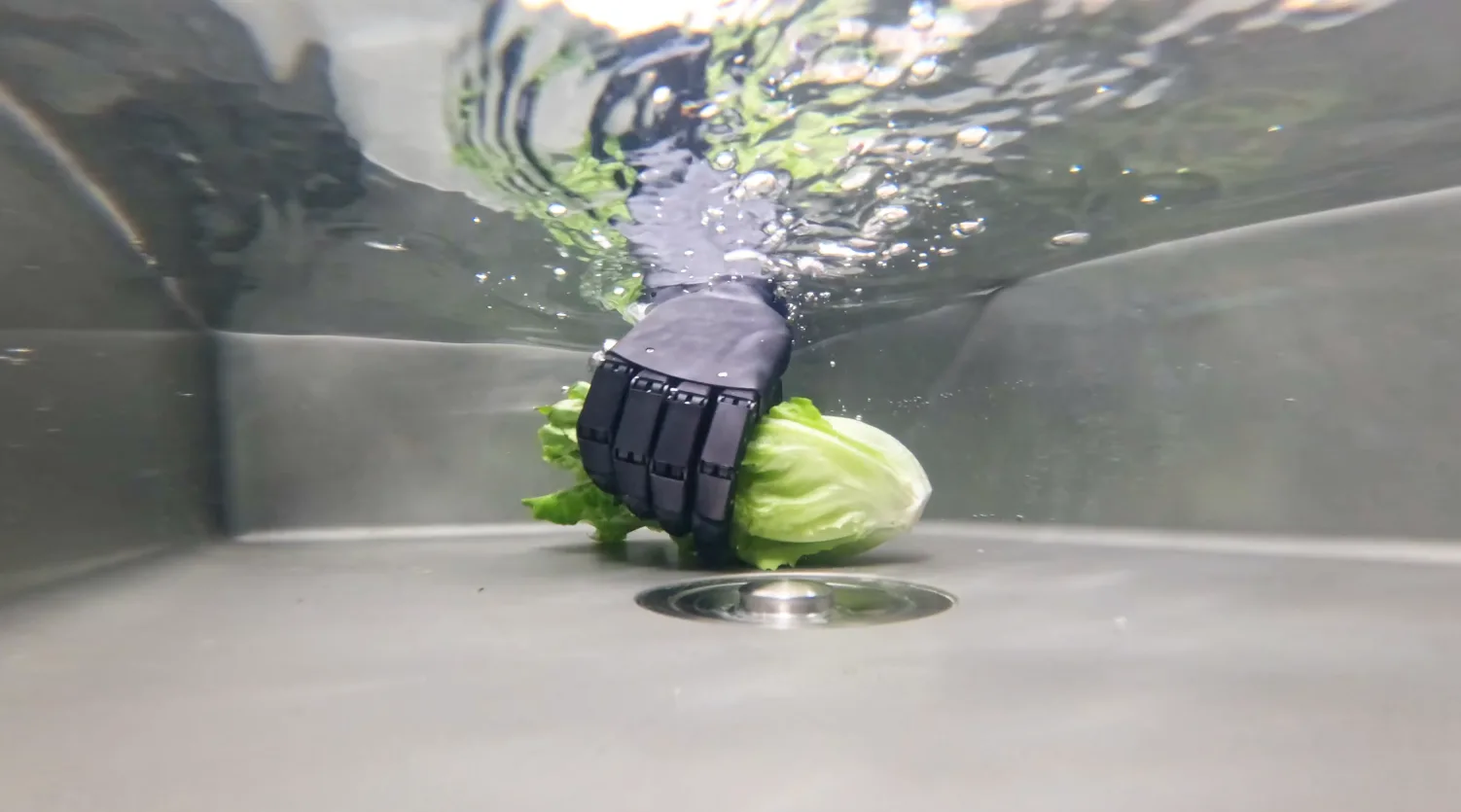
Most underwater robots still grab things the way they did decades ago: with a simple two-finger claw or a single-function gripper. Chinese startup HeymanDex is trying to change that with the WA100, a five-fingered dexterous hand built specifically for underwater robotic arms, ROVs and autonomous underwater vehicles, detailed in a report by TechNode.
The WA100 packs six active degrees of freedom across eleven linked joints into a five-finger structure weighing no more than 1,250 grams. Each finger outputs at least 10 newtons of force, with the whole hand capable of at least 5 kilograms of total pulling load. HeymanDex says the standard version is engineered for 300 meters of depth, while customizable variants extend from 100 to 10,000 meters, putting it in range of deep-sea applications far beyond typical commercial diving limits.
Built on deep-sea submersible experience
HeymanDex's core team previously worked on 8,000-meter deep-sea landers and China's Jiaolong manned submersible program, giving the company direct experience with the sealing and pressure problems that make underwater robotics harder than terrestrial automation. Its proprietary underwater dynamic sealing technology is rated for 4,000 hours of effective service life, and the company says the hand has completed 500,000 test movements without damage.
In operational testing, the WA100 reached an 80% success rate on underwater tasks, which HeymanDex frames as roughly five times the generalization capability of conventional two-finger grippers. That gap matters because most underwater work — inspecting pipelines, retrieving instruments, handling irregular debris or biological samples — involves objects that a rigid two-finger claw either crushes or drops.
A narrow but growing market for underwater dexterity
HeymanDex is positioning the WA100 for universities and research institutes, specialized marine operators, and manufacturers of underwater robots, robotic arms and ROVs, alongside more commercial uses such as pool-cleaning robots. The company has shown the product at IFA Berlin and the IROS robotics conference in the US, and says it is working with German robotics firms as it targets customers in the US, Europe and Japan.
The move reflects a broader trend in robotics: as dexterous hands modeled on human anatomy spread through humanoid and industrial robots on land, companies are now adapting the same five-finger approach to environments where conventional grippers have long been the default. Dry-land dexterous hands from companies building humanoid robots have pushed grip force and degrees of freedom higher over the past year, and HeymanDex is betting that underwater robotics — long treated as a niche with simpler tooling — is ready for the same upgrade. With ocean exploration, offshore energy inspection and marine research all expanding, a hand that can grasp as reliably underwater as it does in a lab could open categories of underwater work that remotely operated claws have never handled well.