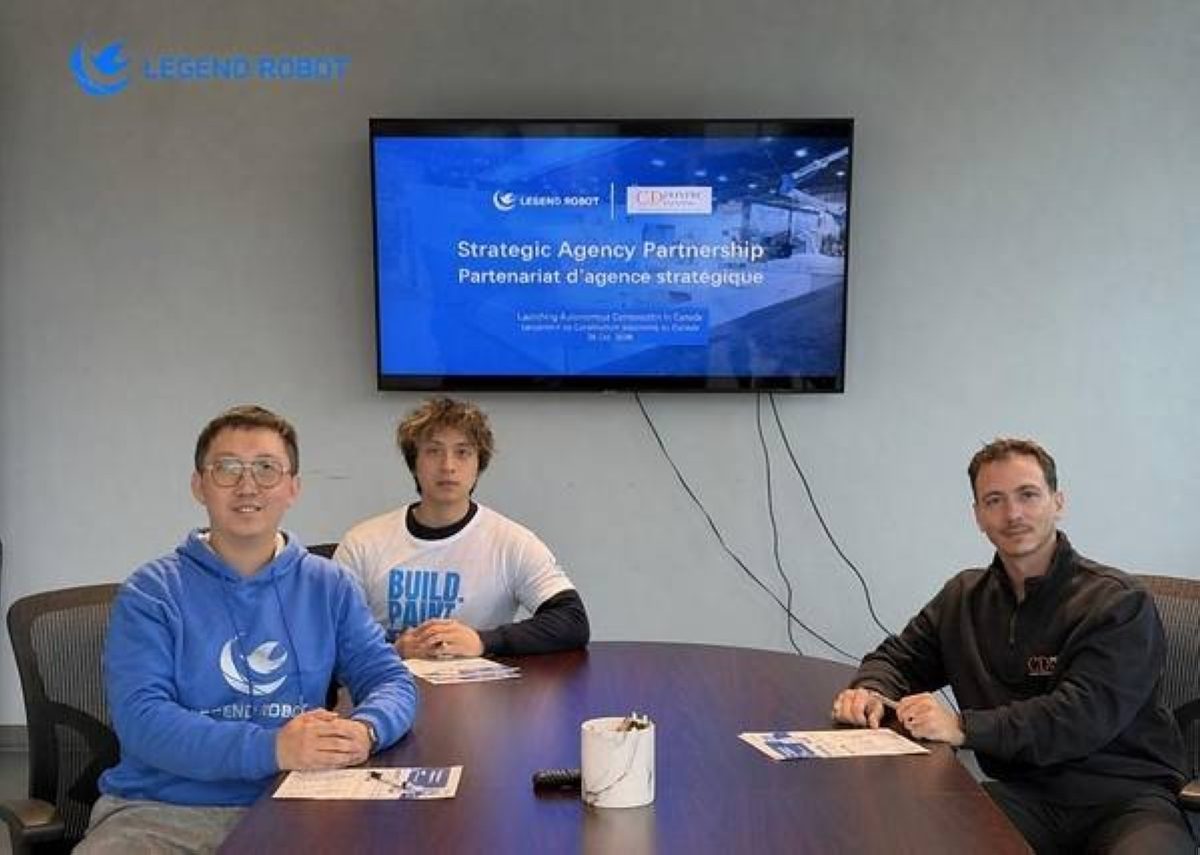
Legend Robot announced on November 12 that it has named CD Peintre, a 2025 "Prix Construire" Contractor of the Year, as its regional agent for Eastern Canada, backed by a real jobsite result: the company's 3.3-meter autonomous latex paint-spraying robot finished walls and ceilings at a residential project on Louisa Street in Ottawa in about an hour per room, covering roughly 221 square meters per hour with close to full surface coverage and zero sags or runs. The robot applied 15 liters of paint with no water dilution, meeting Level 4 finish standards, and worked with Sherwin-Williams, PPG and Benjamin Moore coatings.
Main contractor BurMont Construction and subcontractor CD Peintre ran the deployment, with Legend Robot providing onsite training and field support as part of the agent agreement. Marketing director Jason Liang called the partnership proof that "North America embraces robotic construction," which is standard press-release framing, but the underlying numbers — a named jobsite, a named general contractor, and a measurable coverage rate — give the claim more weight than most construction-robotics announcements.
Painting is a bigger opportunity than it looks
Construction robotics has mostly chased glamorous tasks — bricklaying, rebar tying, 3D-printed walls — that require heavy capital and custom site setup. Interior painting is unglamorous but ubiquitous: nearly every residential and commercial build needs it, the task is repetitive and physically taxing, and skilled painters are in short supply in many North American markets. A robot that hits Level 4 finish quality without runs or sags, while working with mainstream paint brands rather than proprietary coatings, removes the two biggest objections contractors raise about automation: quality risk and compatibility with existing supply chains.
Distribution, not technology, is the bottleneck for construction robots
The construction robotics sector's real challenge has never been proving a robot can do a task in a demo — it is getting general contractors to actually schedule the machine on a live site. That is why this announcement leans so heavily on the regional-agent structure rather than the robot's specs alone. Legend Robot is following a pattern used by companies like Fastbrick Robotics' Hadrian X and various drywall-finishing robots: pair the hardware with a local contractor who already has trust and relationships with developers, rather than trying to sell direct.
This matters because Groundworks 2026, a London summit held just a week earlier, had contractors from VINCI and Bouygues publicly stressing that construction robotics adoption lives or dies on fit with day-to-day site conditions, not raw capability. Legend Robot's Ottawa project and Eastern Canada agent deal look like a direct answer to that complaint — proven output on one real job, paired with a contractor positioned to sell the next one. The open question is scale: one house on one street is a proof point, not a business. Whether CD Peintre can turn this into repeat bookings across Eastern Canada's residential and commercial pipeline will decide if painting robots become a routine line item or stay a novelty subcontractor hires once for a press mention.