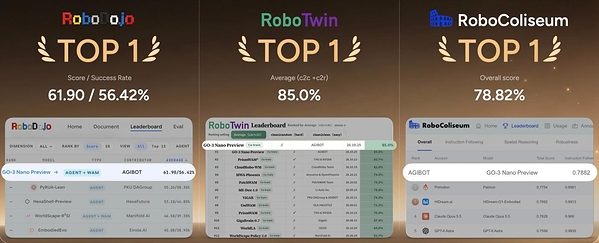
Shanghai-based AgiBot unveiled GO-3 Preview on November 3, an embodied AI foundation model the company says has taken first place on three separate robot-benchmark leaderboards: RoboDojo, RoboTwin and RoboColiseum. AgiBot plans to release the model fully open source by the end of 2026, according to its announcement.
The release lands roughly five weeks after AgiBot said it had shipped its 20,000th robot and introduced a metric called Worken to measure how much productive work a robot actually completes. GO-3 Preview answers a different question: not how many robots AgiBot can build, but how capable the software running inside them can get.
What is actually new about GO-3 Preview?
Most robot AI systems today are built by bolting robot-specific training data onto a language or vision model originally designed for text or images. AgiBot says GO-3 Preview instead runs on an architecture built from the ground up for physical tasks, called WRAM, short for World Reasoning Action Model. WRAM is designed to handle three jobs at once: understanding what a task requires, predicting what the world will look like a moment after an action, and generating the next action itself.
Inside WRAM, a component called CoAE converts camera footage into representations a robot's control system can act on, a module called SVP generates single-step predictions of what happens next, and a third piece called KASO filters those predictions down to the ones that are physically plausible and consistent with how the robot was trained to move. Taken together, AgiBot says the design lets a robot generalize to tasks it has not explicitly practiced, rather than only replaying patterns already seen in training data.
How do you train a model like this with only 100 robots?
Large language models learn from a scrape of most of the public internet. Physical robots can't do that, because there is no equivalent library of real-world force, friction and contact data sitting online. AgiBot's answer is a training system called Genie Evolver, which combines a fleet of 100 physical robots with physics simulation and separate world models, then pools what every robot learns through a process it calls Collective Experience Learning, so a skill picked up by one machine becomes available to the rest of the fleet. In demonstrations, AgiBot showed a robot improving at tabletop curling to the point of beating a typical human player after only a few hours of practice, and a separate unit operating inside a convenience store with what the company describes as autonomous improvement and no human correcting it in real time.
Why does an open-source release matter here?
China's robot makers have been pouring money into the software layer this year faster than into new hardware, with rivals such as RoboScience and GenRobot AI raising fresh funding specifically to build shared "brains" that can run across many robot bodies. By open-sourcing GO-3 Preview rather than keeping it proprietary, AgiBot is betting that wide adoption of its architecture, rather than licensing fees, is the faster route to becoming the default foundation model other hardware makers build on. That approach puts it on a different track than closed-model developers such as Physical Intelligence and Figure, which have kept their foundation models in-house as a competitive moat.