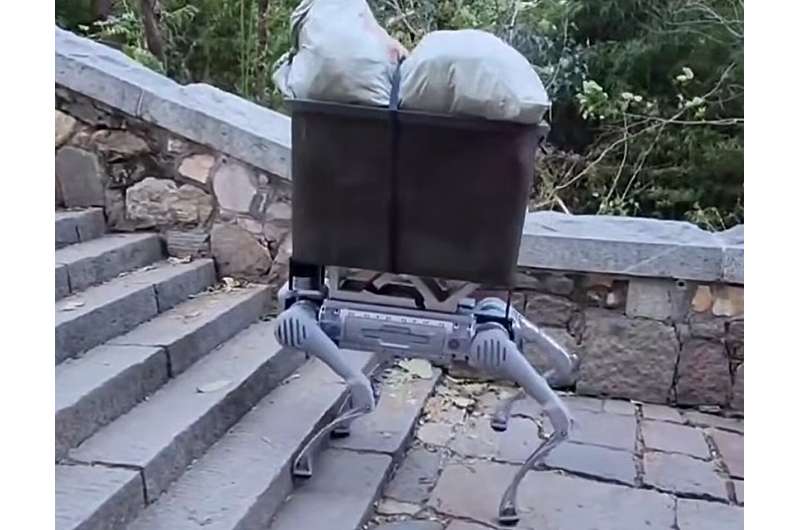
Around 90 robotics teams sent humanoid and quadruped machines up China's Mount Tai on November 2, 2026, in a state-organized endurance competition designed to stress-test robots on real, unstructured terrain rather than a lab floor. The World Mountain Robot Challenge covered a 3.9-kilometer route with more than 600 meters of ascent and over 3,000 cobbled stone steps, a course that typically takes a fit human more than two hours to complete.
A four-legged robot built by Beijing Lingyi Technology, a Unitree subsidiary, won the fastest four-legged category in 43 minutes and 41 seconds. In the humanoid speed category, run over a shorter stretch of the course, Beijing-based team Zhishen Lingyue won with a time of 27 minutes and 26 seconds. Other teams competed to carry fragile cargo, including eggs and watermelons, to the summit without breaking them.
Why stage a robot race on a mountain instead of a factory floor?
Organizer China Media Group, a state broadcaster, pitched Mount Tai's cobbled, uneven, multi-thousand-step terrain as a "natural extreme testing ground" that factory and warehouse settings cannot replicate. Humanoid and quadruped developers have increasingly turned to public endurance events, including marathons and obstacle courses, because stairs, loose stone and steep grades expose balance and locomotion failures that controlled demos hide.
The event was not purely ceremonial. Several robots failed publicly: one humanoid wearing a bandana collapsed mid-course and needed repairs, and another tumbled down a staircase and came to rest beside a trash can. Those failures are as informative to engineers as the winning times, since they reveal where battery life, actuator torque and balance algorithms break down under sustained, uneven loads.
How does this compare to other robot competitions this year?
Mount Tai joins a growing calendar of Chinese robot endurance events, including humanoid half-marathons held earlier in 2026, that have become informal benchmarks for the country's fast-growing humanoid and quadruped industry. Beijing Lingyi Technology's win extends Unitree's dominance in quadruped locomotion, an area where the company has built its commercial reputation through products sold to research labs, security firms and hobbyists worldwide.
The egg- and watermelon-carrying categories echo a broader industry push toward manipulation and payload-handling tasks that mirror warehouse, agriculture and last-mile delivery work, rather than pure athletic speed. Cash prizes were awarded across multiple categories, including fastest robot and best load-carrying performance, giving smaller teams incentive to compete alongside established players like Unitree's subsidiary.
What does this signal for robot deployment timelines?
Events like this are increasingly used by Chinese state media and local governments to showcase domestic robotics progress to a mass audience, ahead of planned commercial rollouts in security patrol, delivery and inspection roles on difficult terrain. The gap between the winning quadruped's 43-minute time and a typical human's two-hour-plus pace suggests legged robots are closing in on, and in controlled conditions beating, human performance on steep, stepped terrain, though the public stumbles underscore that reliability still lags raw speed.