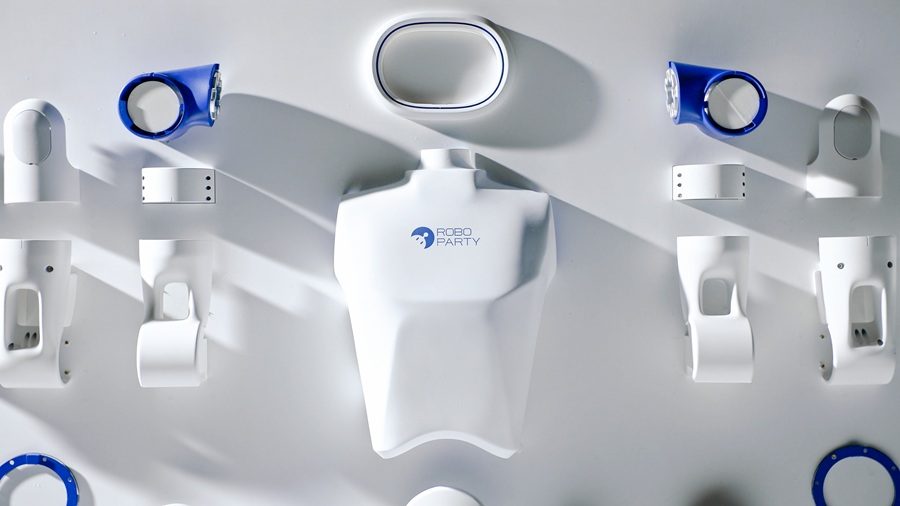
RoboParty announced the launch of RP1, a full-stack open-source humanoid robot, on November 2, 2026. The robot ships in two configurations: a standard version with 24 actuated degrees of freedom, built for gait research, balance control and sim-to-real transfer, and an RP1 Pro variant with 30 actuated degrees of freedom, including a 2-DOF neck and two 7-DOF arms, aimed at end-to-end policy learning, human-robot interaction and embodied AI data collection. Both figures exclude the robot's dexterous hands.
Unlike most commercial humanoid platforms, RoboParty is releasing the robot's mechanical design, technical specifications, ROMOMO joint actuator documentation, low-level drivers, control algorithms, firmware, development tools, simulation resources and robot-learning SDKs as open-source material.
What does "open-source" actually mean for a humanoid robot?
RoboParty is giving developers access to the full stack needed to build, modify and program the robot, rather than just publishing code on top of closed hardware. That includes the physical body design and joint actuator specifications alongside the software layer, letting research labs and startups fabricate or adapt the hardware themselves instead of buying a sealed unit from a single vendor.
The release extends RoboParty's earlier RPO open-source project, launched in January 2026, which the company says has drawn more than 2,600 stars on GitHub. RP1 is positioned as the hardware embodiment of that software ecosystem, giving the existing developer community an actual robot to run their code on.
Why does an open platform matter in a market dominated by closed systems?
Most commercial humanoid robots, from Boston Dynamics' Atlas to Chinese entrants like Unitree and AgiBot, ship as closed or partially closed platforms where outside developers can write high-level software but cannot modify actuators, firmware or low-level control loops. RoboParty founder Yi Huang framed the launch as a direct response to that model, saying "we believe the future of embodied AI should not be defined by just a handful of closed systems."
An open hardware-and-software stack lowers the barrier for university labs and smaller robotics startups that cannot afford to license a closed platform or build a humanoid from scratch. It also creates a common reference design that researchers across institutions can compare results against, something the closed humanoid market currently lacks.
What happens next for RoboParty and RP1?
RoboParty has not disclosed pricing or weight specifications for either RP1 configuration, and availability details beyond the announcement remain unpublished. The company's bet is that an open ecosystem built around RPO's existing GitHub community will drive faster adoption than a closed commercial launch, even without the funding or manufacturing scale of better-capitalized humanoid makers. Whether that community translates into real-world deployments, rather than research demos, will depend on how quickly RoboParty can turn its software following into hardware orders.