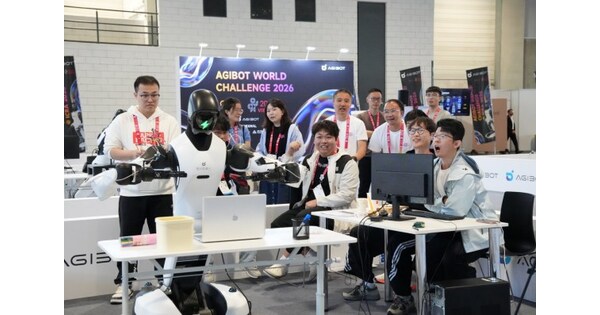
AGIBOT hosted the AGIBOT World Challenge 2026 alongside ICRA 2026 in Vienna on June 5, drawing 526 research and enterprise teams from 27 countries to compete across two embodied-AI tracks: Reasoning to Action and World Model. The Shanghai-based humanoid maker says the format marks a pivot in how embodied-AI systems are judged — away from sim-only leaderboards and toward closed-loop testing on real robots, real tasks and shared benchmarks.
Two Tracks Built On AGIBOT’s Own Benchmarks
The Reasoning to Action (R2A) track evaluated how robots parse natural-language instructions, plan multi-step sequences and execute them on a physical platform. The World Model (WM) track scored systems on how accurately they predict environmental changes from robot actions and sensor inputs — the foundation for any model that hopes to do planning-by-imagination. Both tracks were judged using AGIBOT’s in-house EWMBench and Genie Sim Benchmark suites, which combine automated online evaluation with an offline real-robot final.

Heavy Academic And Corporate Field
The line-up read like a who’s-who of Chinese and global embodied-AI research: the Chinese Academy of Sciences, Tsinghua University, the University of Science and Technology of China, the University of California, San Diego, and Russia’s Sber Robotics Center fielded research teams, while industry players Alibaba, Amap and vivo entered enterprise squads. The number of submissions roughly tripled from last year’s pilot edition, AGIBOT said, and a meaningful slice of teams ran on AGIBOT’s own hardware platforms.
From Demo To Standardized Evaluation
For an industry where every humanoid demo video is essentially marketing, the move to closed-loop, real-robot evaluation is the point. Embodied-AI models that look impressive in simulation routinely fail when transferred to physical platforms, and a lack of common benchmarks has made cross-paper comparisons close to meaningless. AGIBOT’s pitch — that EWMBench and Genie Sim can serve as community-wide yardsticks — lines up with similar moves we covered from AGIBOT’s Genie Envisioner 2.0 and Genie Studio Agent zero-code platform, as well as broader physical-AI infrastructure pushes from NVIDIA’s Cosmos 3 foundation model.
Why ICRA Matters
Pairing the competition with ICRA 2026 — the IEEE International Conference on Robotics and Automation — signals AGIBOT’s intent to ground its platform in the academic mainstream. With the AGIBOT WORLD CHALLENGE drawing teams from US, Chinese, European and Russian institutions in the same Vienna venue, the company is positioning itself as both a hardware vendor and an evaluation host for the embodied-AI race.
Reporting based on coverage from PR Newswire, RoboticsTomorrow, EQS News, TradingView and AGIBOT.