
Alloy Robotics has raised $8 million at an $80 million valuation to build a debugging layer for robotics fleets, giving engineers a way to interrogate failures across drones, humanoids, and autonomous vehicles in natural language rather than spelunking through log files for days.
Square Peg leads with three pre-seed backers returning
The round was led by Square Peg Capital, with Blackbird, Airtree, and Skip Capital — the three pre-seed investors from September 2025 — all coming back in. The angel list is the tell: leaders and engineers from OpenAI, Anthropic, Tesla, Waymo, Halter, and Carbon Robotics invested personally alongside several of Alloy's own customers. The Sydney-founded company has now raised A$16 million to date and is opening a San Francisco office, with founder and CEO Joe Harris relocating to lead the US push after previously scaling telehealth company Eucalyptus through to its $1 billion acquisition.
Fusing telemetry, video, Slack, and Jira into one investigation surface
Alloy's platform ingests everything a fleet records — logs, telemetry, video, and sensor data — and cross-references it with engineering context already living in Slack and Jira. The agents scan continuously for anomalies, regressions, and recurring patterns, then let engineers ask why a robot failed in plain language, with each finding linked back to the missions, timestamps, and signals that produced it. A native Model Context Protocol server exposes the same context to coding agents like Codex and Claude Code, so the investigation itself can increasingly be run by an engineer's own agents.
Customer proof points across drones, defense, and medical robotics
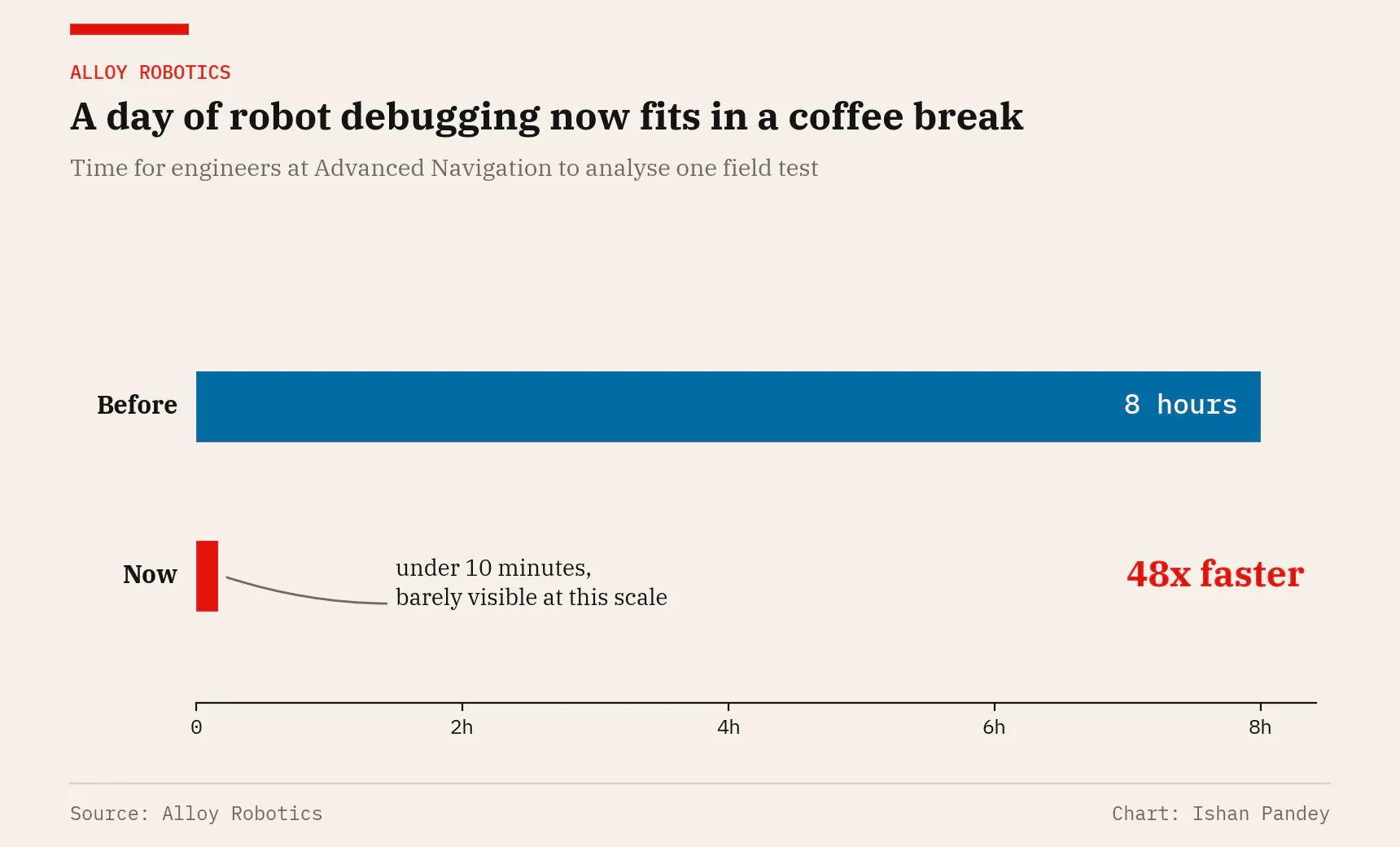
At Advanced Navigation, field-test analysis that took a full working day now completes in under ten minutes. At US drone startup DroneForge, engineer David Crabtree suspected the wrong component entirely until Alloy showed both state estimators functioning normally and pointed to the actual fault. Alloy's customer base now spans navigation, defence, drones, agriculture, maritime, humanoids, construction, and medical robotics, including Advanced Navigation, DroneForge, Breaker Industries, and Puralink.
Betting on shared infrastructure for fleet learning
Square Peg principal Jethro Cohen framed the thesis as operating leverage — the winners in robotics will be the teams that learn fastest from their own data. Tesla and Waymo answered that internally by building fleet-data infrastructure themselves; Alloy is betting the capability becomes shared infrastructure for everyone else, the way software observability became a purchase rather than an internal project. Since commercial launch the company reports more than 50% monthly customer growth, processing data from over 10,000 robot runs. Related coverage: Dyna Robotics' DYNA-2 world model, Neura Robotics' $1.4B Series C, and K2 Global's $200M AI and robotics fund.
Reporting based on coverage from Forbes, HackerNoon, and citybiz.