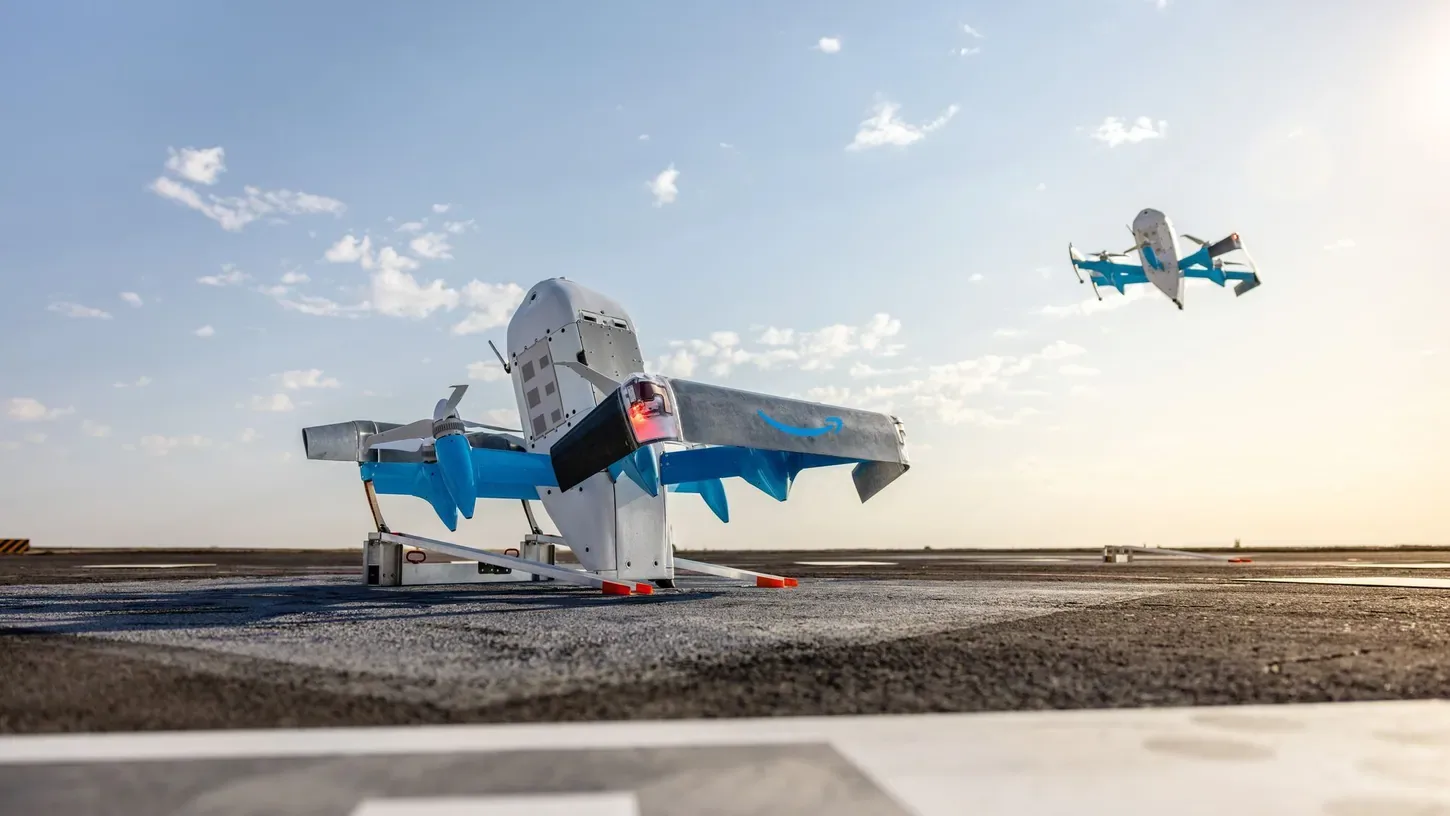
Residents in Spring, Texas, near Houston, are logging daily noise complaints about Amazon's Prime Air drones, with one homeowner, Theresa Gibson, reporting about a dozen flights a day over her house that she describes as sounding "like a large swarm of bees." Sound measurements reported November 13 put Amazon's MK30 drone at 92.1 dBA at hover from 25 feet away, compared with roughly 62 dBA for a hovering Wing drone operating from a nearby Walmart.
How loud are these drones compared to everyday sounds?
Amazon's MK30 measures 92.1 dBA sound exposure level in hover from 25 feet, dropping to 63.7 dBA in cruise at 200 feet of altitude. Wing's drone, by contrast, measures around 43 dBA in cruise and about 62 dBA on hover and delivery. The roughly 30-decibel gap between the two systems at hover is significant on a logarithmic decibel scale, where every 10-decibel increase represents a perceived doubling in loudness.
Amazon spokesperson Allie Payne said the noise lasts about 30 seconds per delivery and is "comparable to a passing car." Gibson's home sits near two Amazon facilities, one roughly 30 miles away in Richmond and an unlisted hub about 6.7 miles away on FM 1960, which the company can run at up to 1,000 flights a day between 7 a.m. and 10 p.m.
Why is the design gap between Amazon and Wing so large?
The difference traces to drone architecture rather than regulation. Amazon's MK30 is a heavier hexacopter-style vehicle designed to carry packages up to five pounds with a hover-and-lower delivery method, which demands more motor power and produces more low-frequency noise close to the ground. Wing's lighter, fixed-wing-hybrid drone instead winches packages down from altitude while continuing to fly, keeping the loudest part of the aircraft farther from the ground and reducing perceived noise for nearby residents.
Wing has operated in the Houston market since receiving FAA approval in August 2026 and now serves eight Walmart locations in the metro area, giving researchers and residents a direct side-by-side comparison with Amazon's service in overlapping neighborhoods.
What does this mean as Amazon scales toward 500 cities?
Amazon has said it plans to expand Prime Air to nearly 500 US cities and towns, a sixfold increase from its current coverage, with new hubs already opening in markets including Chicago, Atlanta, Cleveland and Boise. If the acoustic profile measured in Houston holds across new markets, noise complaints are likely to scale alongside the service rather than fade as the technology matures.
Amazon has said less than 1% of the feedback it receives mentions noise and that it is evaluating changes such as adjusting flight paths. But the side-by-side decibel gap with Wing gives regulators and city councils a concrete comparison point as both companies seek approval for new hubs, raising the stakes for Amazon to address the MK30's acoustic footprint before expansion reaches more densely packed suburbs.