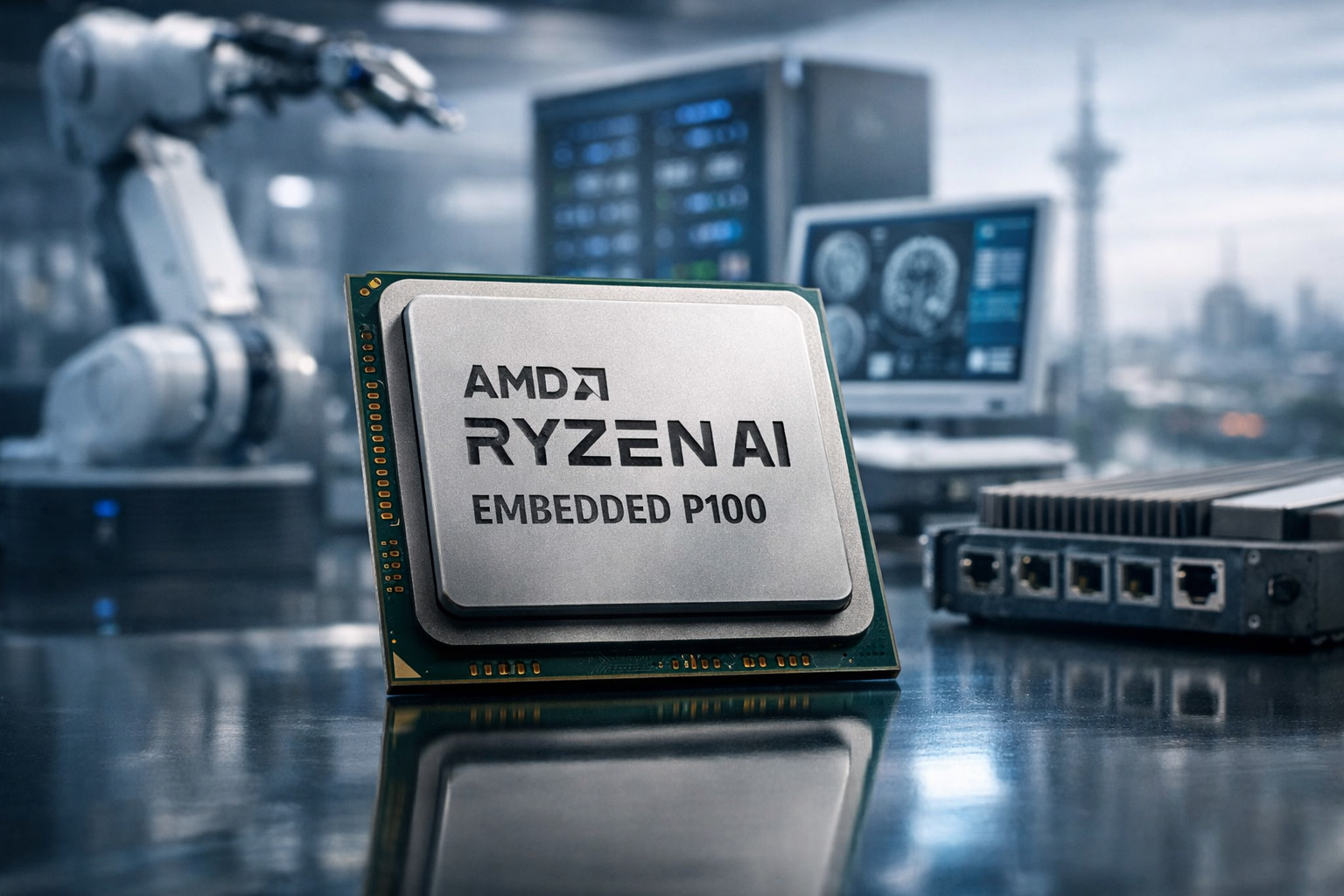

AMD has expanded its Ryzen AI Embedded P100 series of processors with new parts that scale up to 12 Zen 5 cores and 80 system TOPS of AI performance, positioning the family as a workhorse for factory automation, physical AI in mobile robotics and always-on edge workloads.
What's new in the P100 family
The expanded P100 portfolio adds higher-core-count SKUs alongside the four- to six-core entries that launched earlier in the year. Top parts pair up to 12 Zen 5 cores with AMD RDNA 3.5 graphics and an XDNA 2 NPU, delivering up to 80 system TOPS across CPU, GPU and NPU. Against the previous Ryzen Embedded 8000 generation, AMD claims up to 39% higher multithreaded performance, up to 2.1x higher total system TOPS and up to 8x higher GPU compute.
Where it lands
AMD is targeting the parts at industrial control, mobile manipulators, autonomous mobile robots and physical-AI gateways where a single SoC has to run perception, control and limited model inference under deterministic latency budgets. Production shipments for the new 8- to 12-core SKUs are slated to begin in July 2026, while the four- to six-core parts are already sampling with production in Q2 2026.
Early launch partners
Advantech is integrating the P100 into industrial PCs and embedded modules aimed at factory automation, while SolidRun has unveiled LPCAMM2-equipped edge AI modules built around the new processors for compact deployment in defence, industrial and robotics platforms. The two-vendor pattern — silicon plus board-level partner — mirrors AMD's strategy in robotics adjacencies like its Versal/Xilinx adaptive SoC roadmap.
Competitive picture
The P100 expansion intensifies a three-way fight at the edge alongside NVIDIA's Jetson and Thor lines and Qualcomm's Snapdragon embedded portfolio. AMD's pitch is a more PC-class compute envelope with x86 software compatibility and ROCm support, aimed at customers that want one chip to run vision pipelines, control stacks and on-device generative AI under one OS.
Reporting based on coverage from AMD, CNX Software, IgorsLAB and Embedded Computing Design.