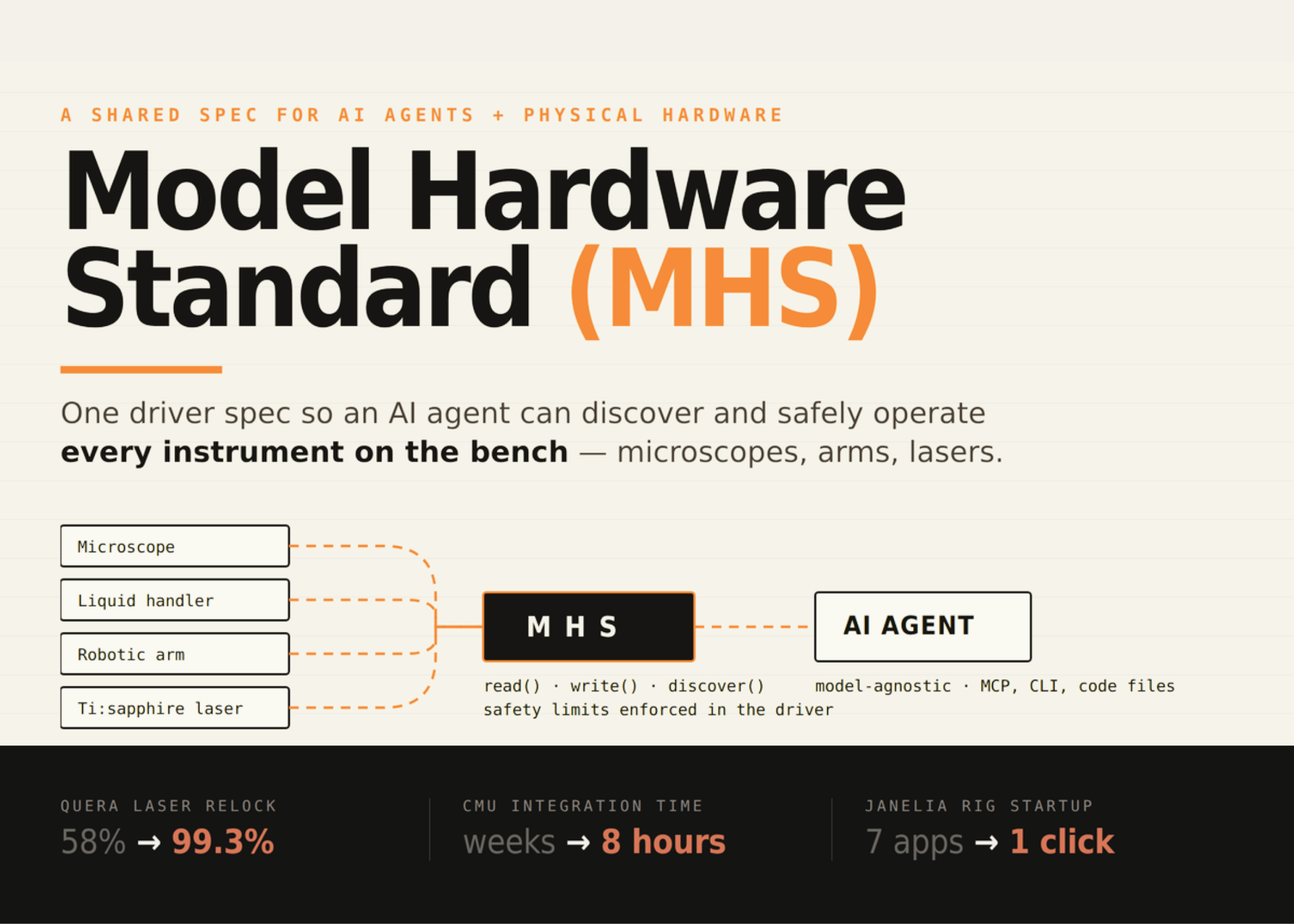
Anthropic on August 27, 2026 opened a research preview of its Model Hardware Standard (MHS), a shared driver specification that lets AI agents like Claude discover and safely operate physical devices — from microscopes and liquid handlers to robotic arms and quantum control lasers. The company says early partners including Genentech, Carnegie Mellon University, Amazon Web Services and QuEra Computing have already used MHS to compress integration timelines from weeks or months to hours or minutes.
Standardising the driver, not the model
The problem MHS targets is plumbing. Every lab or factory bench is stitched together from vendors that never planned to interoperate, forcing specialists to hand-write translators between each pair of instruments. MHS standardises the driver layer between an operating system and a device, exposing a small primitive set — read, write and discovery — so devices and agents can find each other across a network without a translator in between. Driver tags carry the physical knowledge code alone cannot encode, such as the weight of a robot arm or the safety envelope of a laser stage.
Model-agnostic and MCP-compatible
Control is exposed through three mechanisms: the Model Context Protocol, a command-line interface, and code files. MHS is model-agnostic — any agent harness can call it via standard protocols — and safety limits live inside the driver rather than the prompt, so an unsafe instruction is rejected before any actuator moves. Anthropic plans to open-source the specification once the research preview matures.

Partners report step-change results
Genentech automated the BCA protein assay across a liquid handler, robotic arm and plate reader, with Claude converging on 140 microlitres per second for water and 10 microlitres per second for viscous BSA. QuEra Computing handed Claude a laser-relock task that a four-person team had previously solved with a bespoke script working only 58% of the time; the MHS-driven agent produced a deterministic Python program that recovered the lock in 695 of 700 trials — a 99.3% success rate, with the hardest cases resolved in 10 to 14 seconds versus five to ten minutes for a human operator.
From foundation models to physical AI
Carnegie Mellon ran dose-response experiments roughly three times faster than a vendor setup, orchestrating a liquid handler, plate reader, robotic arm and cameras spanning three computers with incompatible interfaces. At the University of Washington, a PhD student in the Baker and Pinglay labs connected six instruments in under a week, driver-writing included. Anthropic frames MHS as the natural extension of its physical AI push, sitting alongside its earlier Model Context Protocol as the missing link between software agents and real-world hardware — a bet mirrored by Generalist AI and other embodied-model startups this summer. Anthropic cautions that MHS is still gated and still requires supervision because Claude's physical reasoning has real gaps, but partners say the integration tax has fallen dramatically.
Reporting based on coverage from Anthropic, Bloomberg, CNBC, Fortune and MarkTechPost.