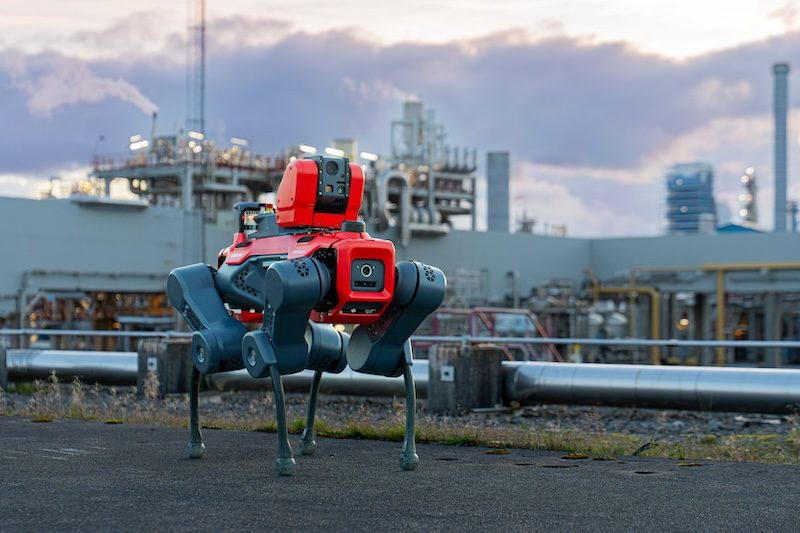
Inside an oil refinery, a spark from a frayed cable or an overheating valve can be enough to level a processing unit. That is precisely the environment ANYbotics built its newest machine to walk into without flinching. The Swiss robotics company has begun commercial deliveries of ANYmal X, a four-legged inspection robot certified for explosive atmospheres, with Norwegian energy major Equinor and Swiss chemicals group DSM-Firmenich named among its first customers, according to Robotics & Automation News.
ANYmal X packs twelve leg actuators in flameproof casings, while its onboard computer and inspection sensors sit inside sealed, nitrogen-filled chambers that starve any stray spark of the oxygen it would need to ignite. Its battery carries the same flameproof protection, and its feet are conductive, grounding static charge before it can touch off flammable vapor. The robot is certified to ATEX Zones 1 and 2 and meets IECEx explosion-protection requirements, the two certifications that decide whether a machine is even allowed onto a working oil, gas, or chemical site.
Four Years and Ten Patents to Get Here
Getting a legged robot cleared for hazardous zones took ANYbotics four years of engineering and produced more than ten patents, chief executive Péter Fankhauser said in comments reported by the outlet. The company spent that time running industrial trials dating back to 2023 with BP, Shell, Petronas, Petrobras, BASF, and SLB, using the feedback to harden the robot before offering it for sale. That trial list reads like a roster of companies with the most to lose from an uninspected leak, which is exactly the sales pitch: ANYmal X carries visual, thermal, acoustic, and gas sensors so it can flag overheating equipment, pipeline leaks, or abnormal sounds during routine rounds, then hand operators a consistent record of equipment condition over time rather than a one-off reading.
The robot runs on ANYbotics' Shift software platform, which plugs into plant systems already in use at many of these sites, including SAP, Yokogawa, and SLB. That integration matters more than the hardware specs for a buyer deciding whether to add a legged robot to an existing control room, since the output needs to land somewhere inspectors and engineers already look. ANYbotics has not disclosed unit counts or pricing for the initial Equinor and DSM-Firmenich orders.
A Narrow but Lucrative Niche
Legged robots for hazardous-site inspection remain a small corner of industrial robotics, but it is one where the payoff for reliability is unusually high: a missed leak or an undetected hot spot can shut down a unit or worse. ANYbotics says its broader ANYmal platform already performs more than 120,000 autonomous inspections a month across more than 50 customers, giving the company a base of operational data that rivals in the space have had less time to accumulate.
The explosion-proof variant extends that track record into sites the standard ANYmal was never cleared to enter, which is where much of the oil and gas industry's highest-value inspection work happens. With deliveries now underway rather than trials, ANYbotics is betting that certified safety, not raw mobility, is what turns a lab demo into a repeat industrial customer. Energy and chemical operators spend heavily on inspection regardless of the tool used, so the real test for ANYmal X is whether plant operators trust a four-legged robot with a job currently done by human inspectors walking the same rounds in flame-resistant suits.