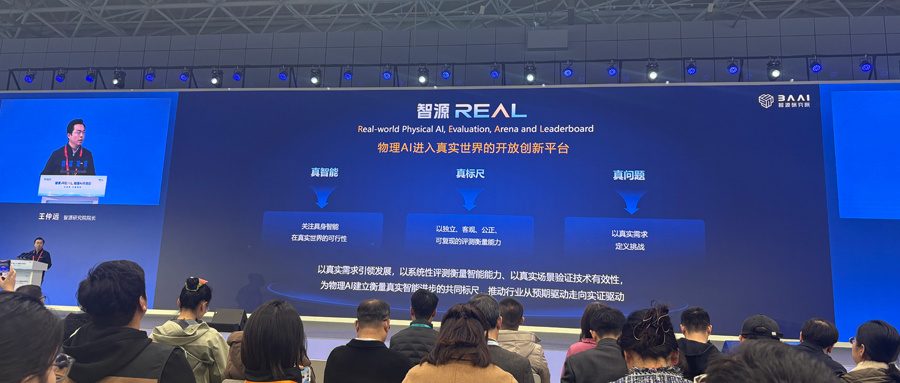
The Beijing Academy of Artificial Intelligence (BAAI) formally launched REAL, an open evaluation platform for physical AI, on November 24 at the Zhongguancun International Technology Exchange Center. The system scores models across five capability domains, 14 dimensions, 55 capabilities and 158 specific metrics, and published its first results across four leaderboards covering world models, embodied reasoning, and robot manipulation in both simulation and on real hardware, according to ifeng Tech.
BAAI director Wang Zhongyuan said the goal is to move the industry \"beyond model capability limits to include deployment costs, operational efficiency, and safety in complex environments,\" and described REAL as the \"largest, most comprehensive, most detailed, and objective evaluation system\" of its kind so far.
What do the leaderboards actually measure?
The world model leaderboard tested 16 video-generation models, the kind of systems that predict how a scene will physically evolve, across 1,113 test items. Kling 4.0, a closed-source model, topped the list with 53.32 points, while closed-source models averaged 48.7 points against 30.3 for open-source entrants, a gap that suggests proprietary labs still have a meaningful edge in simulating physical plausibility.
The embodied reasoning leaderboard, which checks whether a model can work out the right sequence of actions for a task, ran 30 models through 13,262 questions pulled from 27 existing public benchmarks. Google's Gemini 4 Argon led with 75 points, with Kimi K.3.1 Pro the top open-source entry at 65.8.
The two manipulation leaderboards are where things get more concrete: one scores models purely in simulation across 98 tasks, where Physical Intelligence's Pi0.5 VLA model led with 59.83 points, and the other runs models on 50 tasks with actual robot hardware, where InternVLA-A1.5 topped the field at 66.56 points. Pairing a sim leaderboard with a real-robot leaderboard lets BAAI flag models that look strong in simulation but struggle once friction, lighting and sensor noise enter the picture.
Why does a safety benchmark matter here?
Alongside REAL, BAAI published a white paper arguing embodied AI safety needs to expand from \"machine-perceived safety,\" meaning whether a robot avoids damaging itself or crashing, to \"human-perceived safety,\" meaning whether its behavior around people feels safe even when it is technically functioning correctly. The accompanying Embodied-SafeWorld benchmark tests four types of models against 21,600 samples spanning nine risk categories and six evaluation dimensions.
BAAI also ran a hands-on competition called the REAL Olympics, built with 17 industry partners including SF Express, Geely Auto, Haier and TCL, covering tasks like multi-SKU package sorting, vehicle feature guidance, garment classification and component handling. As humanoid and robot-arm vendors increasingly claim benchmark-topping performance, an independent, hardware-tested scoring system gives buyers and researchers a harder basis for comparison than vendor demo reels.