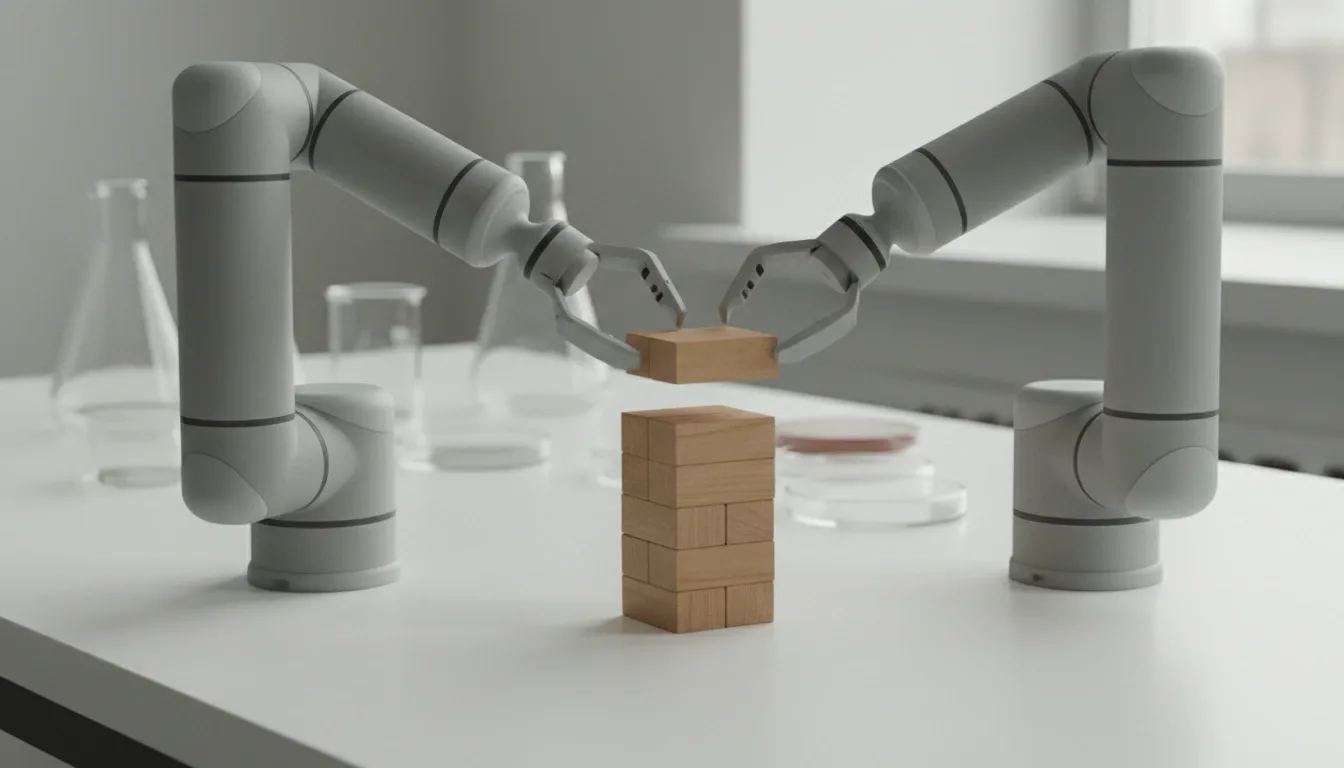
SenseTime has open-sourced what it calls the largest open-weights robot model released to date, a 27-billion-parameter system named SenseNova-RoboRSI-27B, and the company says it never trained on a single real robot before running on physical hardware.
The model was released this week under the permissive Apache 2.0 license, according to the project's GitHub repository. On the RoboDojo benchmark, SenseNova-RoboRSI-27B posted an average score of 60.08, a 54.17% task success rate, well ahead of comparably sized rivals. On real hardware, it hit 90% success on block-stacking trials with a Piper X arm and 60% success on pick-and-place trials with a standard Piper arm, using the exact same weights for both.
What makes this model different from other robot AI?
Most robot foundation models commit to one control method: either a learned vision-language-action policy that predicts motion directly, or a code-generation approach that writes explicit instructions for a gripper. SenseNova-RoboRSI-27B does both. It can request motion from a trained policy, review how a trajectory played out, or write its own code to compute a gripper's target pose, switching between the two approaches as a task demands.
That flexibility shows up in its scores elsewhere too: the model reports a 94.50% success rate on the LIBERO-PRO benchmark and 64.60% on RoboCasa365, two widely used tests for robot manipulation and household-style tasks.
Why does sim-only training matter here?
The embodied training phase used zero real-robot data, relying instead on simulation before the same weights were deployed on two physical arms by adapting only the camera, state and control interfaces. That is a meaningful claim because collecting real-robot demonstration data is slow and expensive, often requiring a human to physically guide a robot arm through thousands of repetitions.
If a sim-trained model genuinely transfers to new hardware with only interface tweaks, it lowers the cost of deploying the same brain across different robot arms, a problem that has forced many robotics companies to retrain or fine-tune separately for every new chassis they support.
How does it stack up against other open robot models?
At 27 billion parameters, SenseNova-RoboRSI-27B dwarfs the field: OpenVLA, one of the most widely cited open robot models, runs at 7 billion parameters, and Nvidia's Isaac GR00T N1.7 sits at 3 billion. SenseTime also says the model beat GPT-6 Astra's RoboDojo score of 27.6 and edged out GPT-6.1 Sol's 33.7 in shared-harness testing, putting it ahead of general-purpose models adapted for robotics rather than built for it.
What comes next for this model?
SenseTime says a smaller 9-billion-parameter version is coming, which would make the architecture easier to run on lower-cost edge hardware inside warehouses or factories rather than requiring a server-grade GPU nearby. For now, the 27B release gives robotics developers outside SenseTime a free, commercially licensed model that claims real-arm performance without the usual real-robot data collection bill.