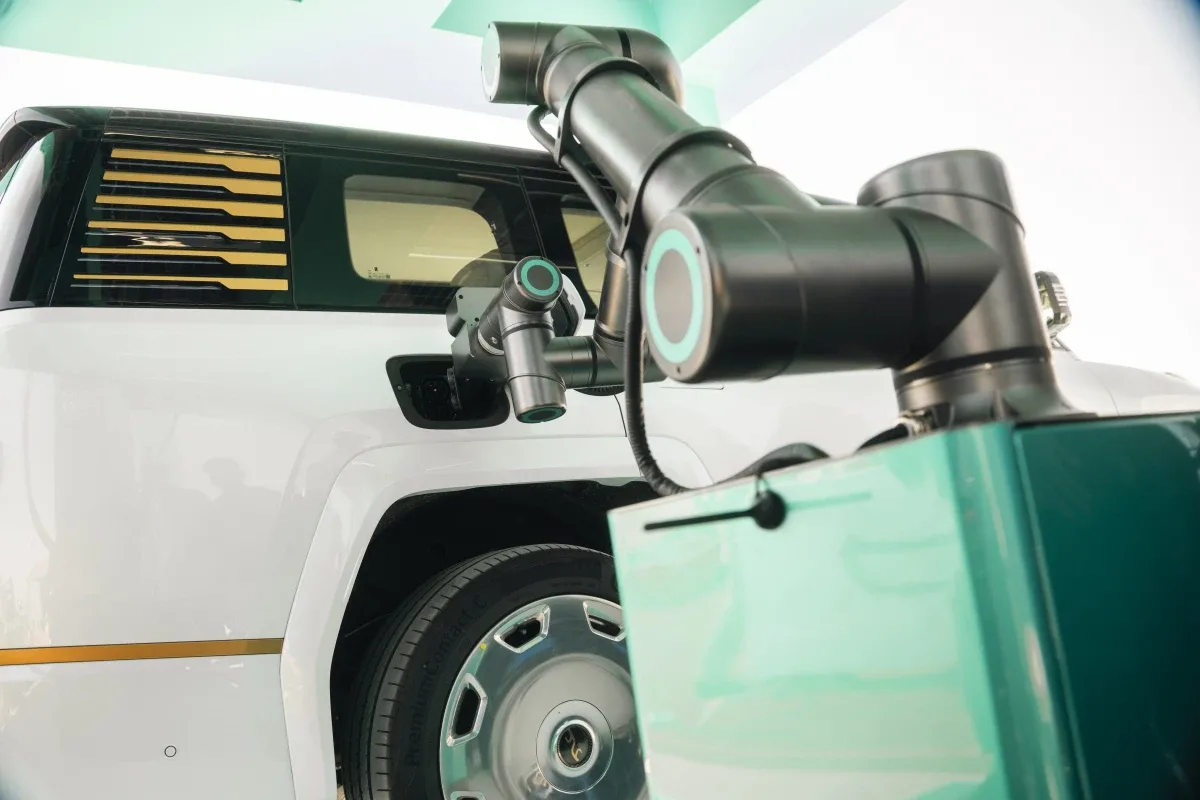
BYD unveiled what it calls the world's first fully integrated solar, battery-storage, ultra-fast charging and robotic charging system on November 10, 2026, at a desert test site near Abu Dhabi. The headline number: a demonstration vehicle charged from 10% to 70% in five minutes and 17 seconds, with the system delivering roughly 1,000 kilowatts of power during the test, according to BYD.
The twist is that no one touched the charging cable. A robotic arm found the car's charging port, opened its cover, lined up the connector and plugged it in, then unplugged it automatically once the car was full.
How does a robot arm plug in a car without help?
The arm combines two things most industrial robots already use separately: machine vision and force feedback. Cameras and sensors on the arm locate the vehicle's charging port, which can sit in different places and at different angles depending on the model and how the driver parked. Once the arm's gripper nears the port, force sensors in its wrist take over, feeling for resistance as the connector seats into place, the same basic principle warehouse robots use to insert parts into fixtures without crushing them. BYD says this lets the system handle the full plug-in and unplug cycle with no person present, pairing naturally with the company's existing Automated Valet Parking feature so a car can park itself and get charged without a driver doing either.
BYD calls the fast-charging piece of this "FLASH Charging." The company says it can take a compatible vehicle from 10% to 97% battery in nine minutes, speeds that start to approach the time it takes to fill a gas tank. That speed is the whole point of adding a robot in the first place: plugging and unplugging a cable by hand is a trivial task at normal charging speeds, but at charging rates near 1,000 kilowatts, cables get heavy, hot and awkward, and removing the human from that step cuts both labor and the risk of a rushed, improper connection.
Why bolt a charging robot onto solar panels and batteries?
The Abu Dhabi site stacks solar generation, battery storage and the fast-charging hardware into one installation, which BYD says lets it run with limited or no reliance on the local power grid. That matters because ultra-fast charging stations draw enormous, spiky loads that most local grids weren't built to handle. A battery buffer absorbs solar power across the day and releases it in the short, intense bursts fast charging needs, letting BYD deploy the system in locations — like a desert test site — where grid capacity would otherwise be the limiting factor.
BYD Executive Vice President Stella Li said the installation marks the first time the company has brought this combined technology to "the global stage," framing it as a showcase rather than a finished commercial product. By BYD's own account, the robotic arm remains a prototype with no confirmed commercial launch date, even as the company pushes ahead with its wider FLASH Charging rollout, targeting 6,000 stations worldwide by the end of 2027.
What happens next?
The gap between this demo and an actual charging station near you is likely measured in years, not months. Robotic connectors have to work reliably across every charging-port design on the road, survive sand, rain and temperature swings, and clear safety certification before any regulator lets them operate unattended at scale. BYD's own admission that it hasn't finalized whether the Abu Dhabi site runs fully off-grid suggests the company is still working out basic operational details.
Still, the demonstration puts a concrete number behind a question automakers have circled for years: can charging become as automatic as the driving itself is supposed to be. For now, BYD has shown that a robot can plug in a car faster than most drivers can find their wallet. Turning that into a product people actually use is the next, much harder step.