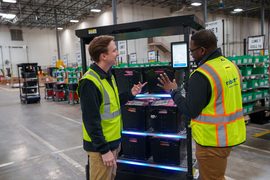
Robust AI, the robotics startup co-founded by former iRobot veteran Anthony Jules and MIT roboticist Rodney Brooks, is pitching a different kind of warehouse robot: one shaped like a shopping cart, built to be grabbed and shoved off course by a human at any moment, and designed around a simple number — warehouse workers walk an average of 30,000 steps a day, according to MIT News.
What does Carter actually do on a warehouse floor?
Carter is an autonomous cart that can move items across distances of up to 400 feet without a human pushing it, following workers to loading points or guiding them to a specific retrieval location. It's steered by a force-sensitive handlebar, a touch screen, and gestures, and it runs on holonomic wheels that let it move instantly in any direction rather than needing to turn first.
The design choice that sets Carter apart is what happens when it's wrong: a worker can cut the robot off, grab the handlebar, and push or pull it one-handed in a different direction without fighting the machine's own motors or waiting for it to replan.
Why build a robot that lets itself be overridden?
Robust AI's argument, built on years of customer interviews across logistics and manufacturing, is that robots which rigidly insist on their own path create friction with the people around them instead of removing it. Leila Takayama, the company's VP of human-robot interaction, frames the goal as splitting work three ways: "the robot does some of the work, the people do some of the work, and the backend systems do some of the work," rather than trying to automate humans out of the loop entirely.
Brooks, who co-founded iRobot decades before starting Robust AI in 2019, has long argued that robots succeed commercially when they adapt to how people already work rather than forcing people to adapt to the robot. Carter's cart-like form factor is a direct application of that idea: it looks familiar enough that workers don't need training to interact with it safely on day one.
How does this compare to other warehouse robots on the market?
Most of the recent attention in warehouse robotics has gone to humanoids and autonomous mobile robots built to replace specific tasks outright — picking, sorting, or hauling pallets without any human involvement. Carter takes the opposite bet: it assumes a human will always be nearby and optimizes for how easily that human can step in, rather than for how rarely they'd need to.
That positions Robust AI closer to companies selling collaborative tools than to firms selling full automation — a narrower pitch, but one that sidesteps the near-perfect, unsupervised accuracy bar that has slowed humanoid and fully autonomous systems from moving past pilots in many facilities.
What's next for the company?
Brooks discussed Carter and Robust AI's broader philosophy at RoboBusiness 2026, where he delivered the opening keynote on what robotics looks like over the next 20 years. The company hasn't disclosed specific customer names or total deployment counts, but describes Carter as already running on live logistics and manufacturing floors rather than sitting in pilot-only trials.
With labor shortages pushing more warehouses toward automation, Robust AI's bet is that the winning robots won't be the ones that work completely alone, but the ones that make it easiest for a tired, 30,000-steps-in worker to hand off a task mid-shift without slowing down.