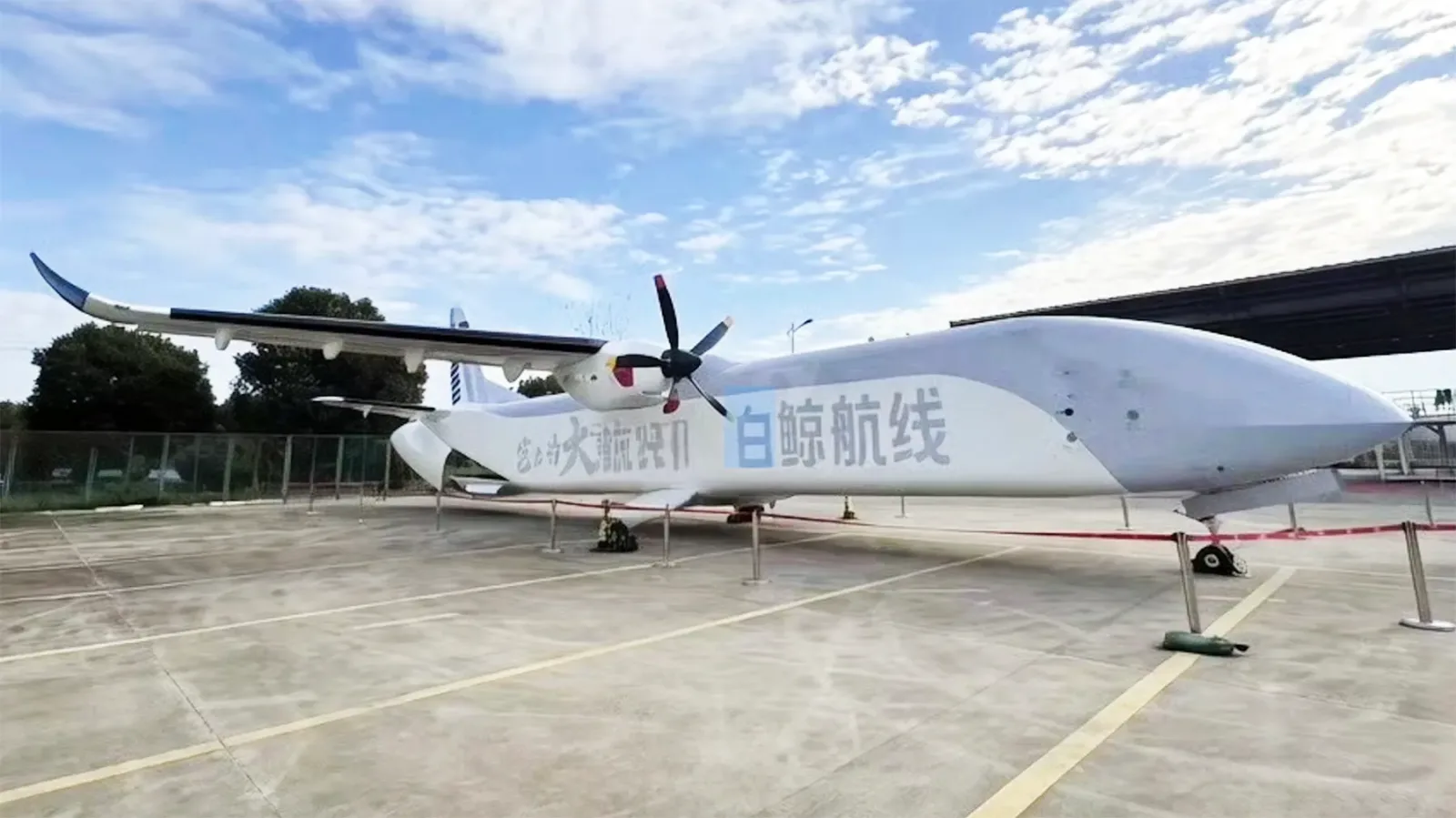
Chinese aviation firm Air White Whale has unveiled a mock-up of the W8000, a twin-turboprop cargo drone designed to carry up to 8 metric tons, roughly 17,600 pounds, ahead of Airshow China, which opens in Zhuhai on December 7. The reveal comes just 11 days after the company's smaller W5000 model completed its maiden flight on November 14, a roughly 30-minute test that the company is using to build momentum toward the bigger aircraft, according to The War Zone.
An 8-ton payload would put the W8000 in roughly the same weight class as the DHC-5 Buffalo, a twin-engine turboprop transport long used for short-runway military and cargo hauling. That comparison matters because it signals Air White Whale isn't just scaling up a delivery drone, it's targeting a payload class that overlaps with crewed regional freighters, just without a pilot on board.
How big is an 8-ton payload, really?
Most delivery drones making headlines, think Amazon's or Walmart's package-dropping aircraft, carry a few pounds at most. The W8000 is a different category of machine entirely: cargo is loaded and unloaded through a rear ramp, much like a military transport plane, rather than lowered on a cable or dropped by parachute. At 8 tons, a single W8000 flight could theoretically move the equivalent of a fully loaded box truck.
The catch is that the W8000 remains a developmental concept rather than a flying aircraft. Its payload figure is described as a design target, and Air White Whale hasn't disclosed range, maximum takeoff weight or other performance specifications. The company's track record with its smaller sibling offers a clearer picture of what's realistic in the near term: the W5000 is rated for a 5-metric-ton payload, a 10.8-ton maximum takeoff weight, a 2,600-kilometer range and more than 65 cubic meters of cargo volume, and the company says it has already collected 835 claimed order commitments from logistics firms ahead of planned commercial operations at the end of 2027.
Why is China building ever-larger autonomous cargo planes?
Large uncrewed cargo aircraft solve a problem that smaller delivery drones can't touch: long-haul freight between cities or regions with underdeveloped road and rail links, without the cost of a pilot, co-pilot and the crew-rest rules that come with manned flights. China has been pushing hard on this category throughout 2026, with several domestic firms racing to field cargo drones at increasing scale for both commercial logistics and, eventually, military resupply.
The rapid-fire unveiling pattern, flying a smaller model, then immediately showing off a larger concept before the smaller one even has commercial customers, is also a deliberate signal ahead of Airshow China, where buyers from logistics firms to defense ministries will be watching. Whether the W8000 ever leaves the mock-up stage will depend on whether Air White Whale can actually certify and scale the W5000 first; an 835-order pipeline is a strong indicator of demand, but it's still just a pipeline until the smaller aircraft is flying revenue routes. For now, the W8000 is best understood as a statement of intent: China's cargo-drone makers aren't satisfied competing on small parcels, and they're willing to show off aircraft years before they're ready to fly a real cargo run.