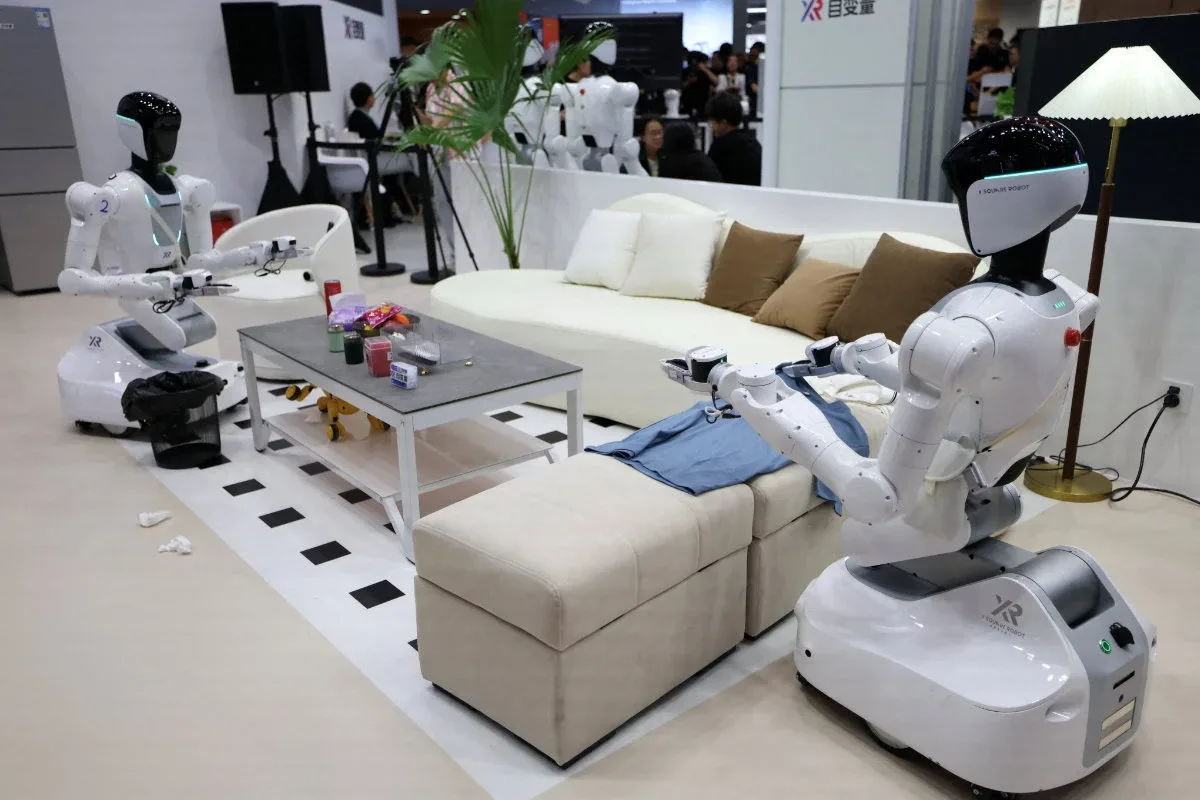
Chinese humanoid robot makers have spent the past three years proving their machines can walk, run and even throw a punch. Now the contest has moved inside the machine's head. Companies including Spirit AI, X Square and Galaxea have each reached roughly $3 billion valuations while pouring money into the software that lets a robot decide what to do with its hands, not just how to move its legs, according to Bloomberg.
Hangzhou-based Unitree, already one of the world's largest humanoid shippers by volume, now runs a team of about 30 researchers focused solely on predicting how objects behave when a robot touches them. Hong Kong-listed UBTech has gone further, advertising a chief scientist role with pay of up to 124 million yuan, or roughly $18 million, to lead model development. The message from the industry is consistent: hardware margins are collapsing as competition pushes prices down, so future profit has to come from software instead.
Why the brain became the hard part
Teaching a robot to walk turned out to be a faster problem to crack than almost anyone expected. Teaching it to generalize, to pick up an unfamiliar object, connect a wire it has never seen, or adapt to a cluttered shelf, has not been nearly as simple. Spirit AI's co-founder put it plainly: "The brain is indeed the weakest link in the complete robotics stack." Unlike chatbots, which train on effectively unlimited internet text, robots need physical demonstration data that is scarce and expensive to collect. Spirit AI has hired roughly 1,000 people just to record humans performing tasks for its models to study.
Other firms are trying shortcuts. ACE Robotics straps wearable sensors onto retail and hotel workers to capture grip force and movement. Ant Group's Robbyant division trained a model on 160,000 hours of material, including 50,000 hours of human-guided robot movement, then tested it across 20 robot configurations from 17 different brands to see whether the resulting skills would transfer. DexForce instead leans on computer-generated simulation, reporting 6-to-8-hour deployment times for industrial tasks and success rates above 99.9%, according to the company's own figures cited by Bloomberg.
The money and the competition behind the shift
The scale of capital chasing this problem is enormous. Chinese embodied-AI companies raised 93.5 billion yuan, or about $13 billion, across 322 deals in the first half of 2026 alone, five times what the same companies raised a year earlier. That is pouring into a sector where China already dominates physical shipments: Chinese firms accounted for the overwhelming majority of global humanoid shipments in the first half of 2026, led by manufacturing muscle and government-backed demand.
Software is a different contest, though, and the leaderboard looks less one-sided. American startups Physical Intelligence, Skild AI and Generalist are all building general-purpose robot foundation models designed to transfer skills across hardware platforms without retraining from scratch. Generalist's GEN-1.5 reportedly completes about 60% of simple tasks after watching demonstrations as short as three to twelve seconds, a benchmark Chinese rivals are still chasing. Unitree founder Wang Xingxing has said his team tested OpenAI's GPT-6 on robots with encouraging results, and speculated that a future GPT-7 could deliver robotics its own "ChatGPT moment," pushing task completion in unfamiliar environments toward 80%.
That dependence on American foundation models is an uncomfortable irony for an industry trying to build a homegrown edge. If the brain really is where the margin lives, China's manufacturing advantage in bodies may matter less than who controls the model running inside them. Whether domestic labs like Unitree and UBTech can close that gap before 2030, the year much of the industry has set as its target for shipping robots in the hundreds of thousands, will decide who actually profits from the hardware lead China has already built.