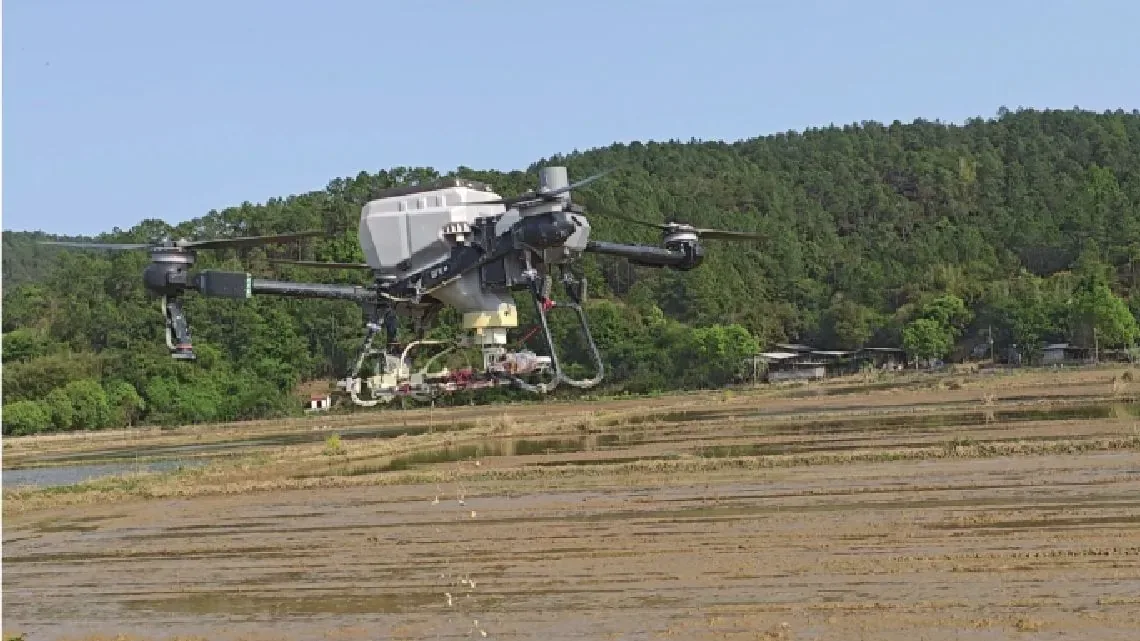
A team at South China Agricultural University in Guangzhou has built a drone seeding system that fires germinated rice into paddy mud in rows, rather than scattering it from the air, and found in a year-long field trial that the method lifted yields by 11% over conventional broadcast seeding.
How does a drone shoot rice seeds into mud without being blown off course?
The system, described by DroneXL, mixes germinated rice with cellulose powder, bentonite clay and water into a slurry, then pressurizes it through a semi-open impeller pump — 76 millimeters in diameter with 22-millimeter blades — and fires it in pulses at 10 hertz. That pulsing is the key detail: a continuous stream would get scattered sideways by the drone's own rotor downwash, but short, rapid bursts punch through the airflow and land where aimed.
Flying at 4.5 mph and just 6.6 feet above the mud, the system pushes out seed at 1.12 kilograms per second while keeping the seed crack rate at 0.74% — below China's 0.8% national standard for acceptable seed damage during mechanical planting.
What did the yield numbers actually show?
Researchers led by Professor Zhou Zhiyan seeded test plots on August 9, 2025 and harvested them on November 22, 2025, comparing three 1-square-meter plots per method in Guangzhou's Zengcheng district. The pulsed-jet plots yielded 6,731 kilograms per hectare, against 6,040 kilograms per hectare for plots seeded with a conventional broadcasting drone — an 11% improvement, published this month in Transactions of the Chinese Society of Agricultural Engineering.
The gain came specifically from placing seeds in consistent rows rather than letting them scatter randomly across the paddy, which the researchers argue reduces competition between neighboring seedlings and improves how evenly the crop uses sunlight and nutrients as it matures.
Why does precise seed placement matter for rice specifically?
Direct seeding into flooded paddies is already common in parts of China and Southeast Asia because it skips the labor-intensive step of growing and transplanting seedlings by hand. But broadcast seeding from a drone, while fast, tends to produce uneven stands — clumps in some spots, gaps in others — that cap how much yield a field can realistically produce no matter how good the soil is.
Row seeding solves that unevenness on dry land using mechanical planters, but paddies are flooded and too soft for wheeled equipment to cross without sinking. A drone that can replicate row spacing from the air, without a machine ever touching the mud, closes that gap for wet rice farming specifically.
Is this ready for farmers to use, or still a lab result?
The trial so far covers a handful of 1-square-meter plots, not commercial-scale paddies, so the 11% figure is an early signal rather than a field-proven number. The next test for the system is whether the pulsed-jet pump and its yield advantage hold up at the scale of a full farm, flying continuous passes over tens of hectares rather than isolated test squares.
If it does, the economics are straightforward: drone seeding already cuts labor costs compared to hand transplanting, and a reliable yield bump on top of that would make the case for adoption even stronger among China's rice growers, who face rising labor costs and a shrinking rural workforce.