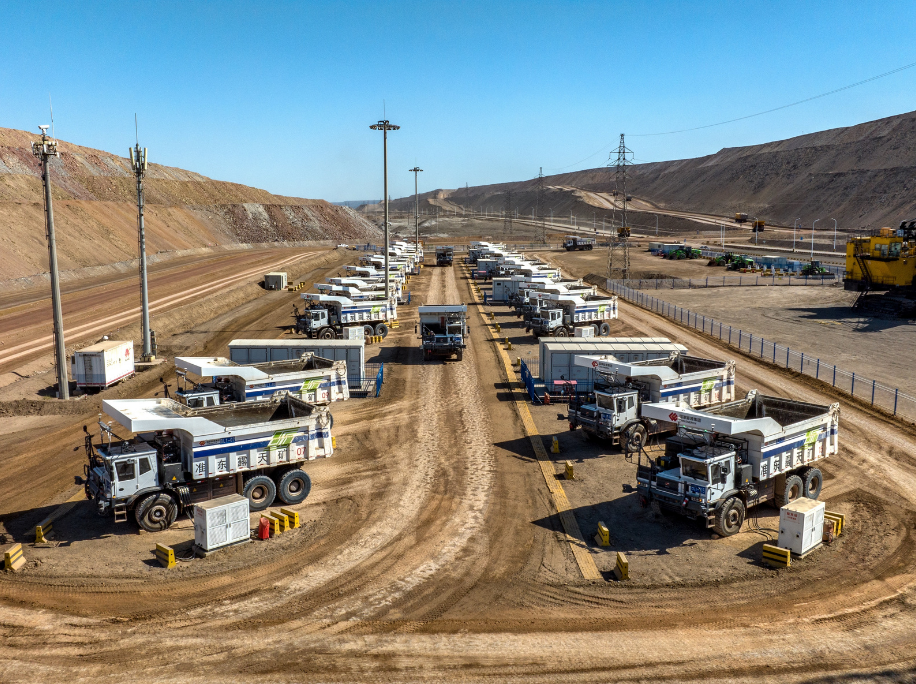
EACON's autonomous haulage system, ORCASTRA, has surpassed 4,000 trucks in active commercial operation, according to International Mining. The company's fleet has roughly doubled every year since 2024, when it ran 1,000 trucks, rising to 2,000 in 2025 and now topping 4,000 in 2026. The trucks have logged more than 200 million cumulative autonomous kilometers, with the most recent 100 million added in a single year after the first 100 million took seven years to accumulate.
The largest single site is Guanghui Mining's Baishihu operation in China, where more than 700 EACON-equipped trucks now run without drivers. EACON has also moved outside China, running a trial with six Komatsu HD1500 trucks at Norton Gold Fields in Western Australia. Of the fleet, battery-electric trucks make up about 47%, hybrids about 53%, and diesel trucks less than 1%, a split that shows how closely autonomy and electrification are now paired in Chinese mining operations. An EACON representative said the growth is supported by \"a highly adaptable autonomous haulage solution that integrates across truck manufacturers, powertrains and configurations, through both retrofit and factory-fit.\"
Why Scale Changes the Autonomous Haulage Market
EACON's deployed fleet is now more than double the combined totals of Caterpillar's Command for Hauling and Komatsu's FrontRunner, the two systems that built the autonomous haulage category over the past decade. That reversal matters because Caterpillar and Komatsu grew their businesses selling factory-fit autonomy bundled with new ultra-class trucks at a handful of giant Pilbara and Atacama pits. EACON's approach leans on retrofitting existing fleets and supporting multiple truck brands and powertrains at once, which lowers the switching cost for mines that already own trucks and do not want to replace them to go autonomous.
That retrofit-first model also explains why China has pulled ahead on raw unit count even though it entered the category later. Chinese mining groups have been willing to automate mid-size and domestic truck fleets rather than wait for purpose-built autonomous trucks, and EACON has scaled alongside that demand. The powertrain mix, nearly evenly split between hybrid and battery-electric with almost no diesel, also signals that Chinese operators are automating as part of a broader electrification push rather than treating autonomy as a separate upgrade.
What Happens Next for Western Suppliers
Caterpillar and Komatsu still dominate the largest, highest-value iron ore and copper operations in Australia, Chile and Canada, where truck size, payload and uptime guarantees matter more than unit count. EACON's Norton Gold Fields trial is an early test of whether its retrofit model can win business in that market, where trucks are typically larger and mines are more cautious about unproven autonomy vendors. If EACON can show the same reliability record outside China that it has built domestically, the next phase of competition will be less about who invented autonomous haulage and more about who can retrofit the most trucks the fastest. For now, the numbers suggest China's mining sector has quietly become the largest proving ground for driverless haulage anywhere in the world.