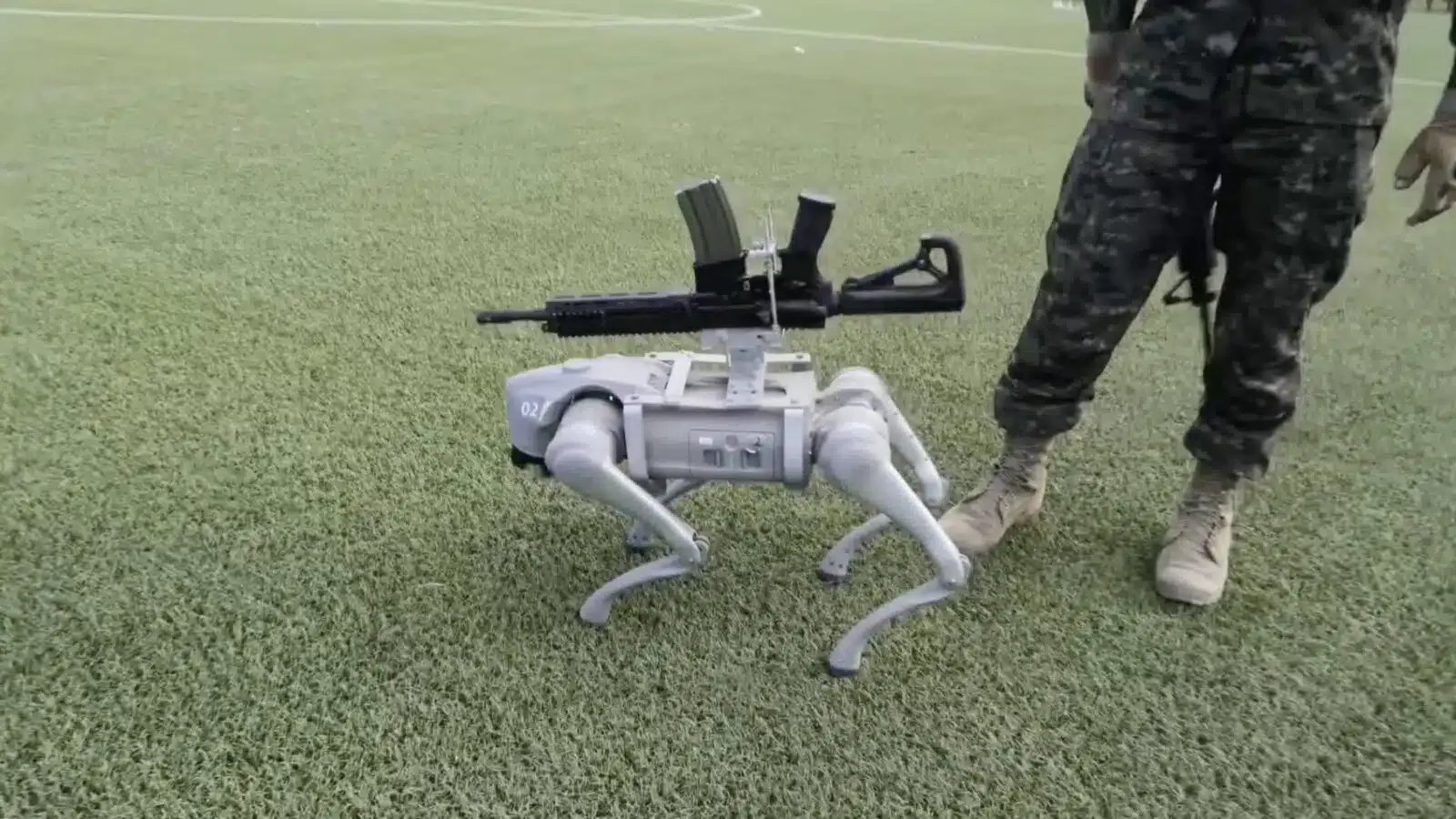
Salvadoran and Haitian forces retook Port-au-Prince's Stade Sylvio Cator on November 12, 2026, ending more than two and a half years of gang control over Haiti's national soccer stadium. The operation's most striking detail wasn't the troop count. It was four white robot dogs, rifles bolted to their backs, trotting across the pitch alongside soldiers.
The robots are Unitree Go2 quadrupeds, a commercial model that sells for roughly $1,600 and is normally marketed for inspection, filming and hobbyist use. Salvadoran troops mounted Israeli-made IWI ARAD-5 assault rifles on them upside-down, using bolted metal brackets and trigger rods rigged to fire the weapon remotely. President Nayib Bukele posted a 76-second video of soldiers fitting the rifles inside the stadium before the advance, according to SOFX. Over 2,000 Salvadoran troops took part in the broader operation, a sharp escalation from the roughly 200 personnel El Salvador had previously stationed in Haiti, mostly for medical support.
How does a $1,600 robot become a weapons platform?
The Go2 is designed for autonomous walking over rough terrain using onboard lidar and cameras, not for combat. Turning it into a gun platform here looks like a mechanical hack rather than a software one. Soldiers bolt a rigid mount to the robot's chassis, flip the rifle so its barrel clears the four legs, and run a rod or cable from the trigger to an actuator a handler can pull from a safe distance. There's no evidence in the footage of autonomous targeting. A human appears to decide when the gun fires; the robot's job is to carry the weapon and walk point into a space where mines, booby traps or ambushes might be waiting, trading a machine for a soldier's body in the riskiest seconds of an advance.
That distinction matters. Export-controlled military robots go through years of testing and weapons-integration review. A $1,600 consumer quadruped bought off a retail site and modified in the field skips all of that, which is exactly why this operation drew attention beyond Haiti. It's a preview of how cheap, mass-produced robots can be weaponized by any force with a welding kit and a rifle, not just defense contractors running multimillion-dollar programs.
Why did troops need robots to retake a stadium?
Sylvio Cator has been under gang control since February 2024, long enough that Haiti's national soccer team has had to play World Cup qualifying matches abroad. The immediate trigger for the latest offensive was an October 18 ambush near Port-au-Prince that left four Salvadoran personnel missing; Bukele said they were trained for medical evacuation work, not combat. El Salvador has steadily built up its Haiti footprint since then, from roughly 200 troops to more than 2,500, under a bilateral security agreement between the two governments.
Bukele said forces would use the retaken stadium as a base to push into surrounding gang-held neighborhoods, and that searchers found "several human skulls" inside the grounds during the clearing operation. He had a blunt message for the gangs holding the missing Salvadorans: "Those who choose to remain and fight our forces will have to assume the consequences."
What does this mean for robotics in conflict zones?
Militaries and militias have experimented with armed quadrupeds for a few years now, from Chinese manufacturers showing missile-carrying robot dogs at defense expos to the US Marine Corps testing robots that carry anti-armor rockets. What's different about Port-au-Prince is the hardware: a mass-market robot anyone can buy online, not a purpose-built military system. Unitree has sold its Go-series robots to thousands of hobbyists, researchers and companies worldwide, with no expectation that buyers would strap rifles to them.
That gap between consumer intent and battlefield reality is likely to draw scrutiny from arms-control advocates and from Unitree itself, which has previously said its robots are not designed or sold for weaponization. For now, the four robot dogs at Sylvio Cator stand as a real-world data point in a debate that, until this week, had mostly played out in demo videos and defense-show booths.