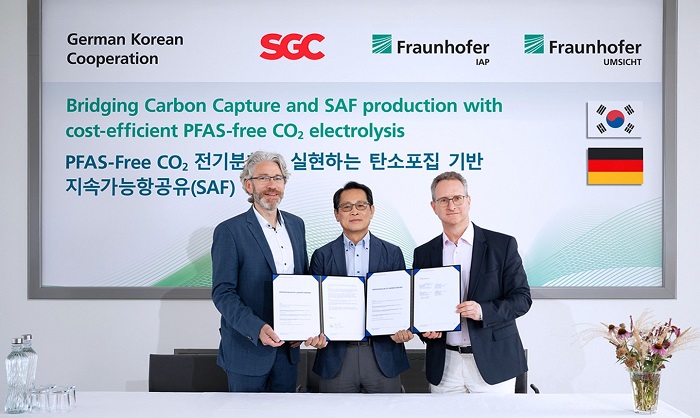
Two Fraunhofer institutes and South Korean industrial energy company SGC Energy have signed a Memorandum of Understanding to jointly develop CO2 electrolysis, hydrogen, fuel cell and battery technologies aimed at climate-neutral industrial production.
Three Institutions, One Framework
The MoU brings together the Fraunhofer Institute for Applied Polymer Research (IAP), the Fraunhofer Institute for Environmental, Safety and Energy Technology (UMSICHT) and SGC Energy. Under the deal, the three partners will define joint research and development projects in the coming months across CO2 utilisation, hydrogen applications, fuel cell systems and advanced batteries. The MoU was signed by Fraunhofer UMSICHT director Christian Doetsch, Fraunhofer IAP director Alexander Böker and SGC Energy chief strategy officer Ken Yoon.
Turning CO2 Into A Feedstock
A core workstream will focus on the electrochemical conversion of CO2 into feedstocks for chemicals and synthetic fuels, including sustainable aviation fuels (SAF). SGC Energy plans to plug in its carbon-capture facilities to technology developed by Fraunhofer IAP and UMSICHT to lay the groundwork for industrial-scale CO2 utilisation in South Korea. Fraunhofer IAP will contribute polymeric energy materials, including PFAS-free high-performance membranes for electrolysers plus polymer solid electrolytes and binders for batteries. Fraunhofer UMSICHT will focus on cost-competitive CO2 electrolysis cells, stack concepts and industrial-scale system integration.
Why It Matters
“A climate-neutral industry requires high-performance materials, robust components, and partners who consistently drive research toward practical application,” Prof. Böker said. Prof. Doetsch added that industrial-energy transformation “can only succeed when new materials, electrochemical processes, and scalable plant concepts work hand in hand.” SGC Energy’s Yoon called the partnership “an important strategic step” toward the technologies South Korea needs to decarbonise its heavy industry.
For related coverage, see Enel’s 100 MW grid-forming battery build in Chile and EDF and NV Energy’s 400 MW Winston solar-plus-storage PPA.
Reporting based on coverage from Fraunhofer UMSICHT, Chemical Industry Digest, Fuel Cells Works and AlchemPro.