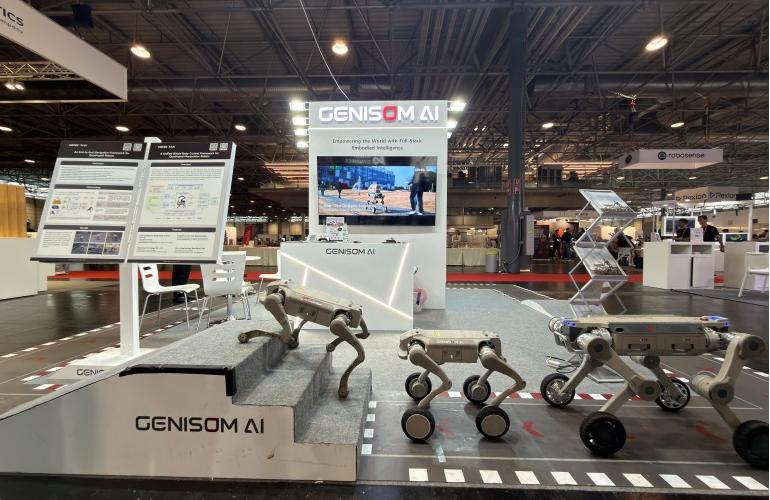
Chinese embodied AI company GENISOM AI used ICRA 2026 in Vienna last week to make its first major appearance on the international robotics stage, presenting its M1 and L1 series quadruped robots, in-house joint actuators, simulation infrastructure and SomaMind agent system as a single full-stack platform aimed at field deployment.
10,000 Robots Already Built
Founded in December 2023, GENISOM AI said it has already produced and delivered more than 10,000 robot units across its quadruped platforms — a production claim that puts it in a different category from most of the seed-stage humanoid and quadruped startups crowding ICRA's exhibition hall. The Beijing company's pitch is industry deployment, not lab demos: customers in research and education, security patrols, energy operations and emergency response.
M1 Industrial Quadruped Sets The Headline Numbers
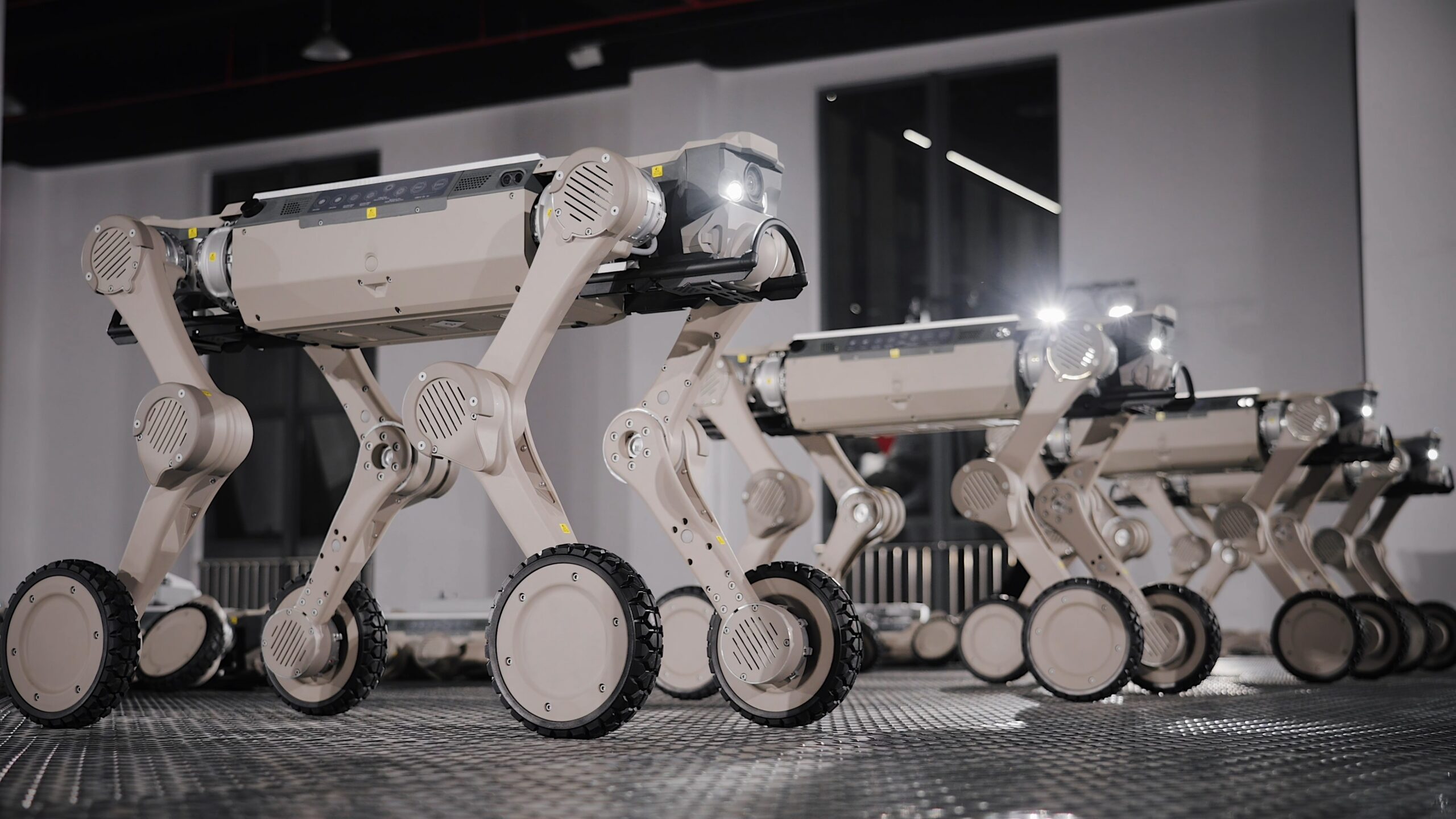
The flagship GENISOM M1 is rated for a 30 kg (66.1 lb) continuous walking payload — a payload-to-weight ratio close to 1:1 — with IP67 ingress protection, an operating range of −20°C to 55°C, an 8 m/s top wheeled speed, an 80 cm obstacle clearance and a 45° maximum climb angle. Battery runtime tops out at five hours depending on load. The M1 Ultra adds an Omni-Panorama 720° spatial awareness stack built on BEV temporal fusion and occupancy networks borrowed from autonomous-driving perception.
In-House Actuators Are The Quiet Story
The payload numbers rest on GENISOM's in-house P85MAX-S joint actuator module, which delivers up to 180 N·m peak torque in an 86 mm diameter package weighing about 1 kg. Owning the actuator gives the company direct control over the hardware-software integration that determines locomotion stability, payload capacity and reliability — the same vertical integration argument that helped Unitree and Boston Dynamics build sustainable quadruped businesses.
Software Stack: MATRiX, RoamerX, Real2Sim2Real, SomaMind
Behind the robots is an open-source-friendly software stack. MATRiX couples MuJoCo physics with Unreal Engine 5 rendering for reinforcement-learning training and sensor simulation across RGB, depth, lidar, IMU and panoramic inputs. The Real2Sim2Real Data Flywheel converts real-world environments captured with consumer cameras into training-ready simulation assets. RoamerX handles mapping, localization, planning and cross-floor navigation, while SomaMind, GENISOM's Physical AI Agent System, connects high-level task understanding with physical execution modules.
L1 EDU Has Already Won ICRA-Adjacent Competitions
The L1 EDU research platform pairs NVIDIA Jetson Orin NX compute with Livox Mid-360 lidar, RealSense depth cameras, GNSS and 5G, targeting SLAM, 3D reconstruction and autonomous-navigation research. A University of Manchester team won first place at the 2025 IROS Quadruped Robot Challenge using L1 EDU — a hard third-party validation for what is otherwise a young company's claims. ICRA 2026 itself doubled as a launch pad for the AGIBOT World Challenge, and quadruped competitors from Unitree, Deep Robotics and now GENISOM are all using Vienna to argue they have the most production-ready dog.
Reporting based on coverage from The Robot Report and Genisom AI.