A task that used to tie up a Hyundai field engineer for nearly three weeks now takes roughly eight days. That is the headline number HD Hyundai Robotics shared on November 1 after months of testing AI agents built in partnership with Palantir Technologies: average troubleshooting time on deployed robot programs dropped from 21.5 days to 7.9 days, a 63 percent reduction.
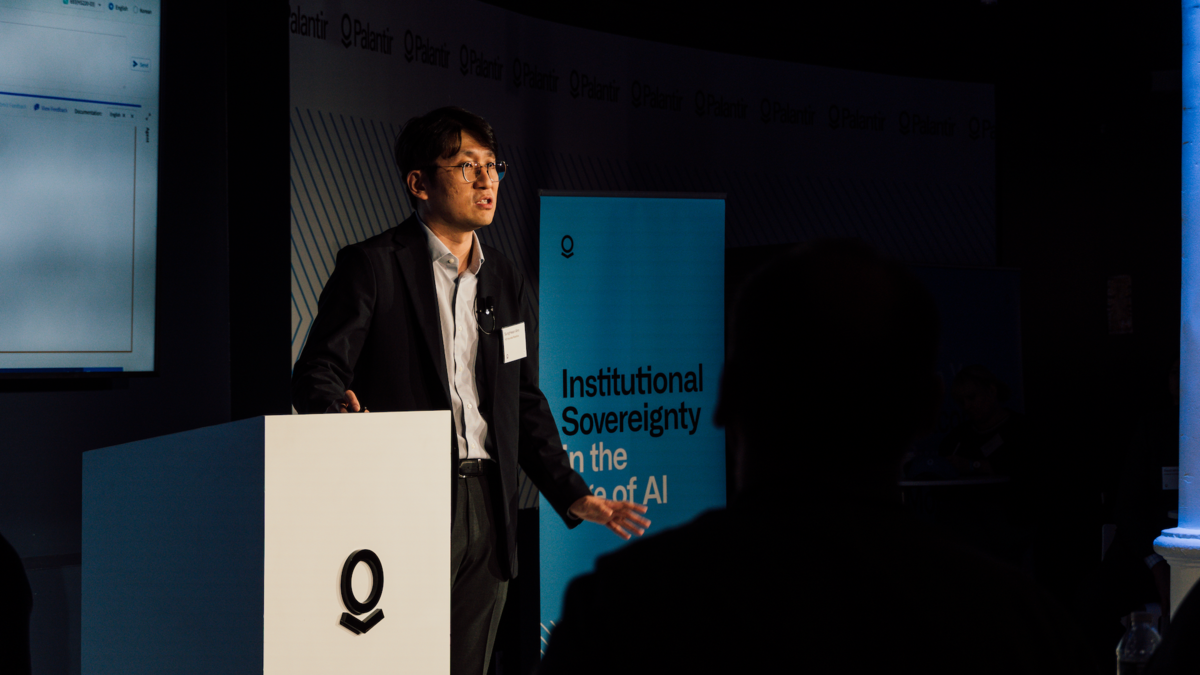
The companies disclosed the results at Palantir's Sovereignty Bootcamp in New York, an event that has drawn roughly 450 executives from 250 organizations since launching in July 2026. HD Hyundai Robotics said it expects the approach to eventually cut robot programming costs by more than 50 percent, according to The Korea Times.
Why programming, not hardware, is the bottleneck
Industrial robot arms rarely fail because the hardware is wrong. They underperform because the program governing movement paths, sequencing and speed was tuned for conditions that have since changed on the factory floor. Fixing that has traditionally required an experienced engineer to observe the robot on-site, diagnose the mismatch, and manually rewrite the sequence through repeated trial runs.
That process is slow and resistant to standardization because it depends on individual expertise that is difficult to transfer between engineers or sites. HD Hyundai Robotics began testing AI agents against this problem in August 2026. The agents analyze an existing robot program, flag likely causes of underperformance, and propose revised sequences. Engineers then review and refine those suggestions using field experience before deploying the update.
HD Hyundai Robotics CTO Ahn Seong-hwan said the company plans to push the technology further: "We are continuing to expand cooperation with global companies to further strengthen our physical AI capabilities." Palantir chief revenue officer Ryan Taylor framed the deal as evidence that HD Hyundai Robotics is "transitioning into a physical AI company."
What changes for engineers and for the industry
The companies say the point is not to remove engineers from the loop but to change what they do. HD Hyundai Robotics plans to retrain field engineers away from manual programming and test runs and toward roles defining on-site problems for the AI agents to solve, plus running regular steering-committee reviews between senior executives at both companies.
The deal also plugs HD Hyundai Robotics into Palantir's AIP platform, giving it a path to apply the same agent-assisted workflow to other physical AI products beyond robot arms. For an industrial robot maker, cutting programming costs in half addresses one of the least visible but most persistent expenses in automation: the labor of keeping deployed robots tuned as production lines change.
The announcement lands as rival automation suppliers race to attach AI software layers to robot hardware rather than compete purely on mechanical specifications. Simulation-driven programming tools from companies such as Siemens and Fanuc already promise to shorten commissioning time, but HD Hyundai Robotics and Palantir's figures, drawn from a live industrial pilot rather than a lab demo, give the approach a concrete benchmark: a 63 percent cut in troubleshooting time after a single quarter of deployment.