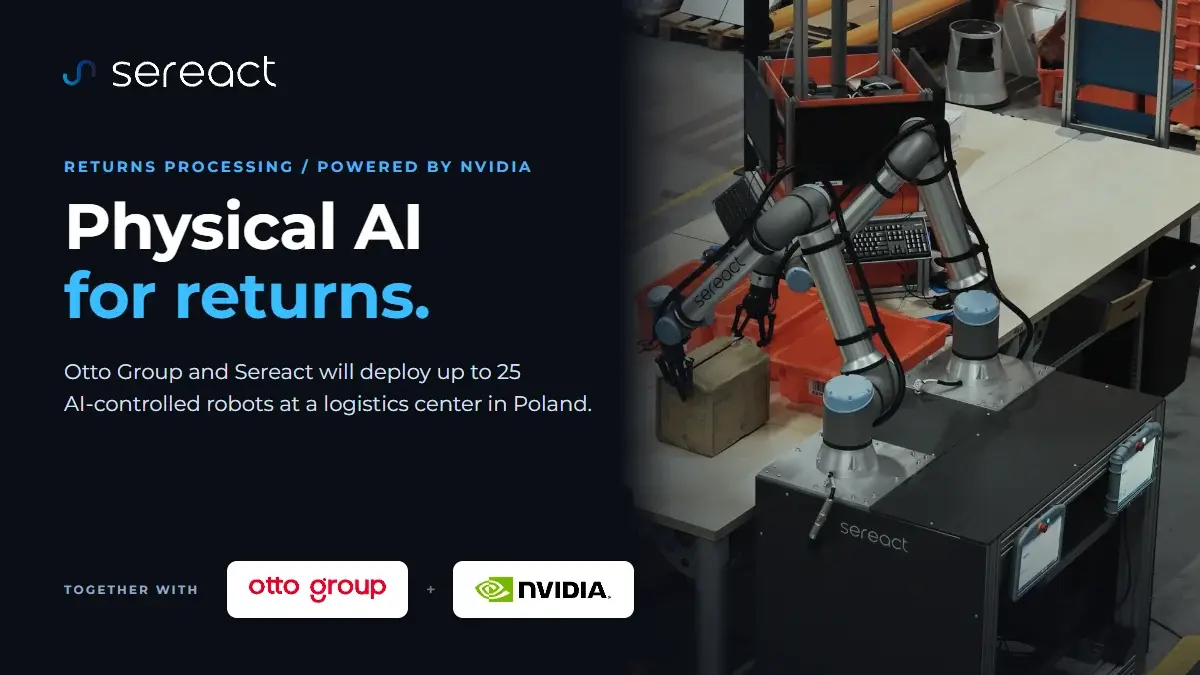
Otto Group will deploy up to 25 AI-controlled robots at a logistics center in Poland to grasp, identify and sort returned items, in a project with German robotics software firm Sereact announced October 28.
The rollout happens in two phases: ten dual-arm robots first, followed by fifteen more once the initial batch proves out. The robots run on Cortex, Sereact's physical AI model, which the company says can recognize and manipulate items it has never encountered before — no fixed product catalog, no item-by-item training. "A robot that only knows yesterday's catalog is of little use in a returns center," Sereact's Dr. Ralf Gulde said, according to the Sereact announcement. The stack runs on NVIDIA Isaac Sim, Isaac Lab and Cosmos tools, powered by NVIDIA Blackwell GPUs.
Returns are the ugly side of e-commerce logistics
Returns processing is one of warehouse automation's hardest unsolved problems because, unlike inbound stock, returned items arrive damaged, mislabeled, repackaged or simply unidentifiable at scale. Most warehouse robots today are trained against a known SKU catalog; Otto Group's bet is that a foundation model trained to generalize across unknown objects can finally make returns sorting profitable to automate rather than a pure labor cost.
Sereact will own and operate the robots under a service contract rather than selling hardware outright, with Otto Group employees supervising, handling exceptions and signing off on final quality decisions. That human-in-the-loop structure mirrors how most current warehouse robot deployments — including Amazon's million-plus robot fleet and GXO's humanoid pilots with Agility Robotics — still rely on people for edge cases the AI can't resolve.
Part of a bigger spending wave
The Poland project is one piece of Otto Group's committed €350 million medium-term investment in technology and AI across its logistics operations, according to Otto executive Martin Umland. It also lands amid a broader surge of warehouse robotics spending: Amazon crossed one million deployed warehouse robots in October, and rivals including Ocado and DHL have all expanded automated sorting trials this year.
Sereact has not disclosed pricing or a timeline for the second phase of ten additional robots. If the Poland pilot hits Otto Group's efficiency targets, the company has signaled it plans to extend Cortex-based sorting to other logistics centers in its network.