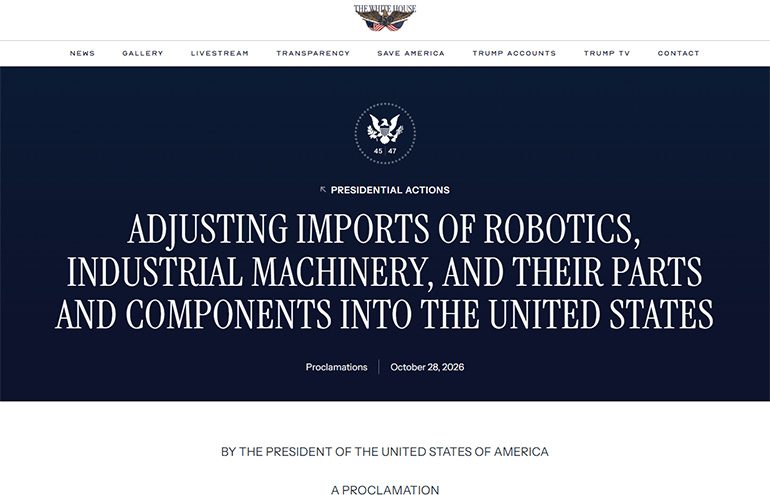
President Trump signed a proclamation on October 28 declaring that imports of industrial robots, machinery and related components "threaten to impair" U.S. national security, opening the door to future tariffs on an industry worth roughly $86 billion in annual American production.
The proclamation follows a Commerce Department Section 232 investigation, the same legal mechanism used for prior tariffs on steel and semiconductors. It orders officials to begin negotiations with trading partners over the next six months to adjust import flows, but it does not impose any tariff immediately. The administration's reasoning leans heavily on defense logic: robotics and industrial machinery are "critical to virtually all modern manufacturing processes, including for defense, commercial, and dual-use purposes," according to the proclamation, as reported by The Robot Report.
Who gets caught in the crossfire
The determination names foreign suppliers whose arms dominate U.S. factory floors, including Japan's FANUC and Yaskawa, Switzerland's ABB and Germany's KUKA. It also flags components from unspecified "certain foreign entities" over cybersecurity vulnerabilities — language that echoes prior restrictions on Chinese-made drones and telecom equipment, and signals China-linked suppliers are a particular target even though the order's language is broader.
U.S.-based robotics names surfaced in coverage of the determination, including Boston Dynamics, Teradyne Robotics and Novanta, stand to benefit if domestic production is favored under any eventual trade remedy. Analysts at Interact Analysis, cited alongside the proclamation, have tracked how dependent American manufacturers remain on imported arms and components, a dependency the White House is now treating as a vulnerability rather than a cost-saving arrangement.
What changes, and when
Nothing changes for buyers of industrial robots this week. The proclamation sets a 180-day clock for negotiations, after which the administration can choose tariffs, quotas, fees or no action at all. The six-month window gives FANUC, Yaskawa, ABB and KUKA time to lobby against restrictions that could raise costs for the very U.S. factories the order claims to protect, since American robot makers do not yet match the volume or price points of their Japanese, European, and increasingly Chinese rivals.
The bigger question is whether this becomes the opening move in a broader decoupling of robotics supply chains, following the same path as chips and EV batteries. Manufacturers placing large robot orders now have a reason to watch Washington as closely as their own production lines.