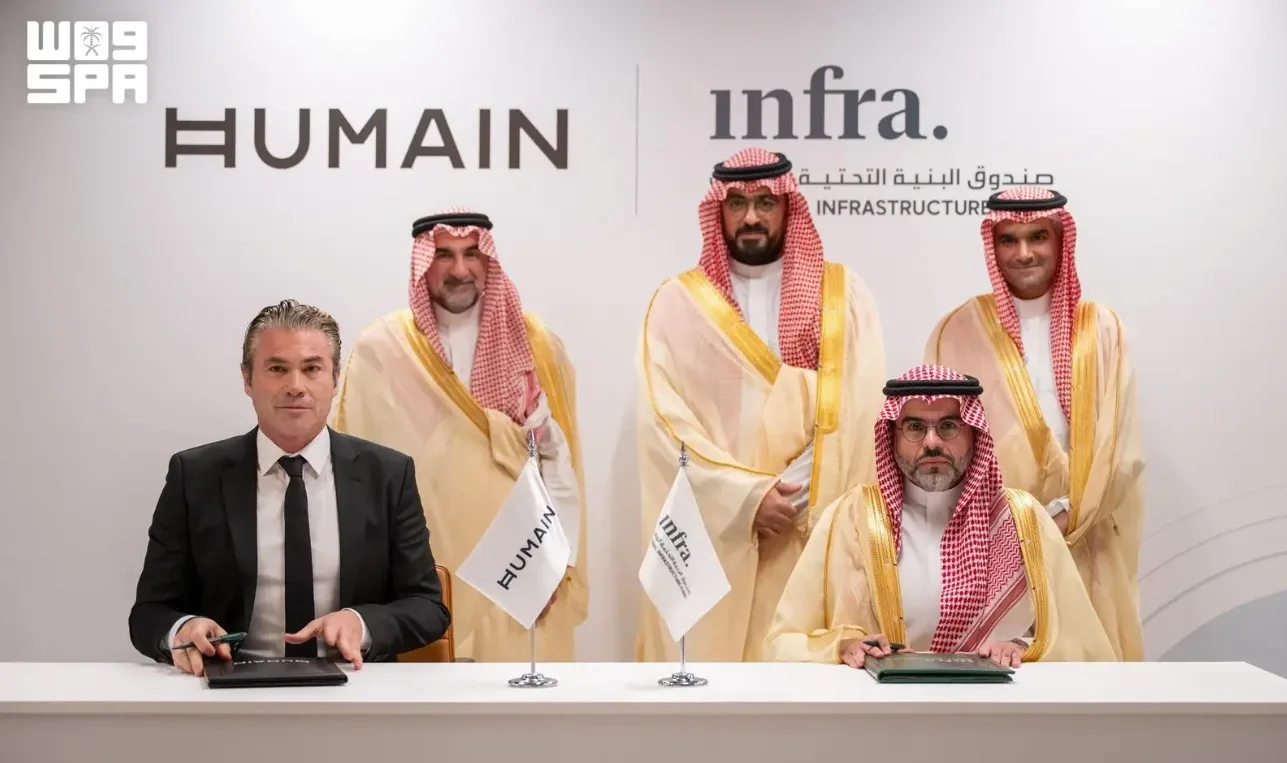
HUMAIN, Saudi Arabia's state-backed AI company, has signed financing agreements worth SR2.5 billion ($667 million) with the National Infrastructure Fund, known as Infra, to fund GPU purchases and power infrastructure for its AI data center buildout. The deals were announced November 9, 2026.
What exactly did HUMAIN just sign?
The $667 million splits into two facilities. The first, worth SR1.1 billion, covers GPU purchases and deployment supporting roughly 25 megawatts of IT load. The second, worth SR1.4 billion, funds power infrastructure, including substations, transmission lines and grid connections, designed to support up to 1 gigawatt of eventual capacity, according to Arab News. That split matters: one check buys chips, the other buys the electrical backbone those chips need to actually run.
Who is HUMAIN, and why does Aramco own half of it?
HUMAIN is majority owned by Saudi Arabia's Public Investment Fund, which holds a 51% stake, with Saudi Aramco taking the remaining 49% in a transaction that closed November 1, 2026. Aramco's involvement brings both capital, it contributed billions of riyals in cash as part of that deal, and a direct line to the kind of industrial power generation and project-financing experience that large-scale data center buildouts require.
This financing builds on a January 2026 framework that had outlined non-binding terms for up to $1.2 billion in support, meaning Infra's involvement has been building for most of the year before converting into signed, binding agreements this month.
Where is a gigawatt of power actually going?
HUMAIN's stated goal is to deploy 3 gigawatts of AI data center capacity by 2030. For context, a single gigawatt is roughly enough to power hundreds of thousands of homes, and most AI data center campuses announced globally this year have targeted capacities in the hundreds of megawatts rather than full gigawatts. Securing grid infrastructure financing years ahead of full build-out is a sign HUMAIN is trying to avoid the power bottleneck that has slowed AI infrastructure projects elsewhere, including in the US market.
What does this mean for Saudi Arabia's AI ambitions?
The financing is part of a broader push by Riyadh to position itself as a regional AI hub, competing with similar sovereign AI infrastructure bets from the UAE. Unlike many AI infrastructure deals that rely primarily on private venture capital, HUMAIN's financing comes from a state infrastructure fund and a state-linked oil major, giving the buildout a different risk profile and timeline than venture-backed AI data center operators in the US. The next milestones to watch are whether HUMAIN discloses which GPU vendors it's buying from and whether the 25 MW facility comes online on a stated timeline.