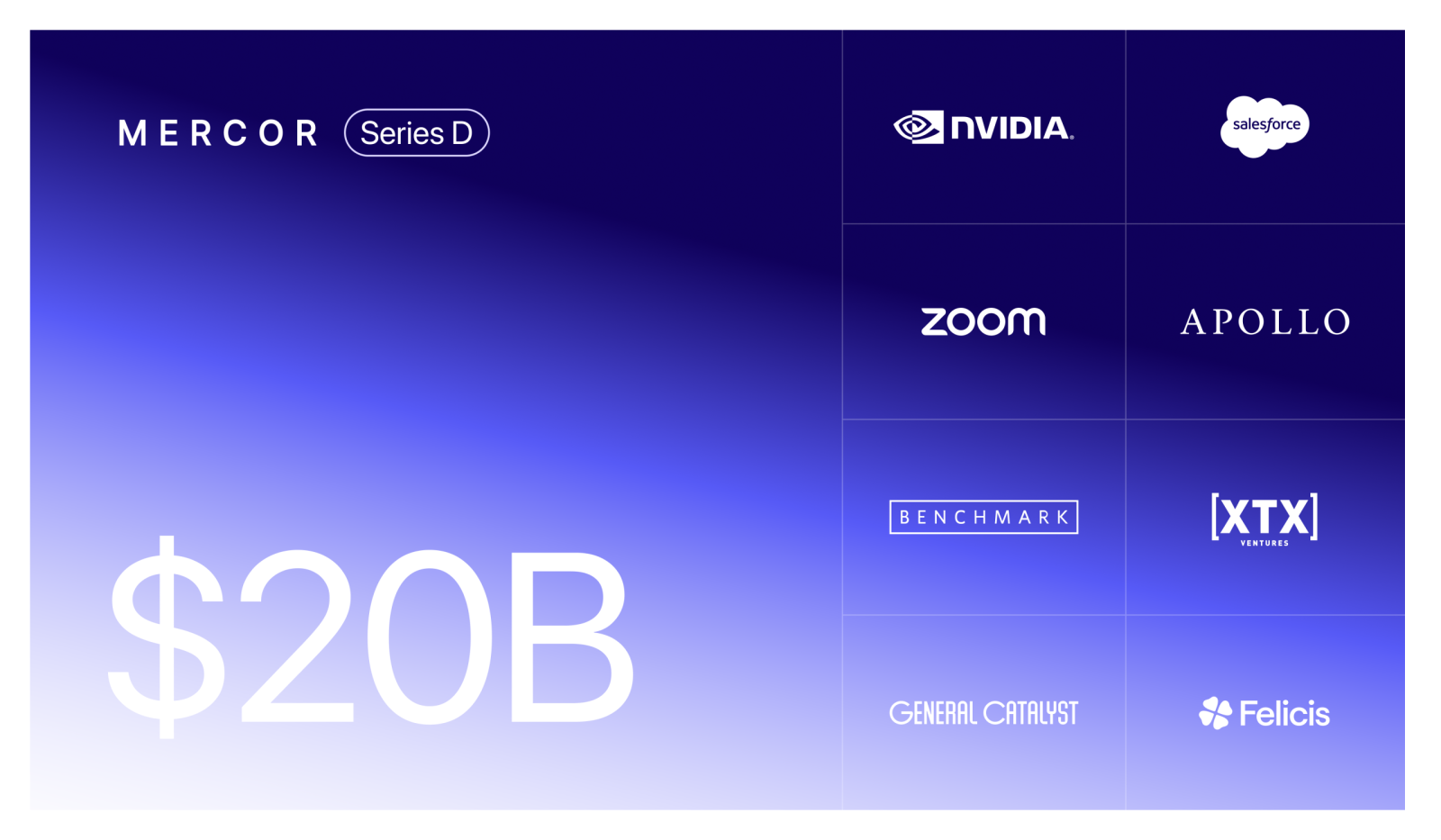
Mercor has raised $750 million in a Series D round that pushes its valuation to $20 billion, roughly double where it stood a year ago. The round, announced November 10, 2026, drew participation from Nvidia, Salesforce, Zoom, Benchmark, Felicis Ventures, General Catalyst and several other firms, though Mercor has not named a single lead investor.
How big is this round, really?
At $750 million, this is one of the largest AI infrastructure rounds of the week, and it lands just over a year after Mercor's $350 million Series C in October 2025 valued the company at $10 billion. Total disclosed funding now sits around $1.1 billion, according to SiliconANGLE. The doubling of valuation in roughly 13 months signals investors are treating AI evaluation infrastructure as a scarce, high-margin layer of the AI stack rather than a commodity service.
What does Mercor actually sell?
Mercor runs a network of more than 5 million domain experts, from doctors to lawyers to engineers, who help train and evaluate AI models. Its newer product line builds custom benchmarks that let enterprises test AI agents against recreations of their own internal software and business processes, rather than generic public benchmarks. That matters because a model that scores well on a public leaderboard can still fail badly on a company's actual CRM, ticketing system or compliance workflow.
The company's July 2026 acquisition of Deeptune brought in a team that had already rebuilt hundreds of enterprise applications for this exact purpose, giving Mercor a head start on the application-environment side of the business.
How fast is Mercor actually growing?
Mercor's annualized revenue exceeded $2 billion as of June 2026, driven largely by contracts with frontier AI labs that need human expertise to train and grade their models. That revenue figure, reached in a company founded only a few years ago, is a large part of why investors like Nvidia and Salesforce are willing to write checks into a vendor rather than building the capability in-house.
How does this compare to rivals, and what's next?
Mercor competes most directly with Scale AI and Surge AI, both of which also sell human-in-the-loop data and evaluation services to AI labs. Mercor's bet is that enterprise-grade, company-specific benchmarking is a distinct and defensible market from general-purpose data labeling, and its investor list, stacked with enterprise software players like Salesforce and Zoom rather than pure AI labs, suggests it's trying to own the enterprise side of that split. The next things to watch are whether Mercor discloses specific enterprise customer names, and whether its benchmark products get adopted as an industry standard the way some data-labeling formats did in earlier AI cycles.