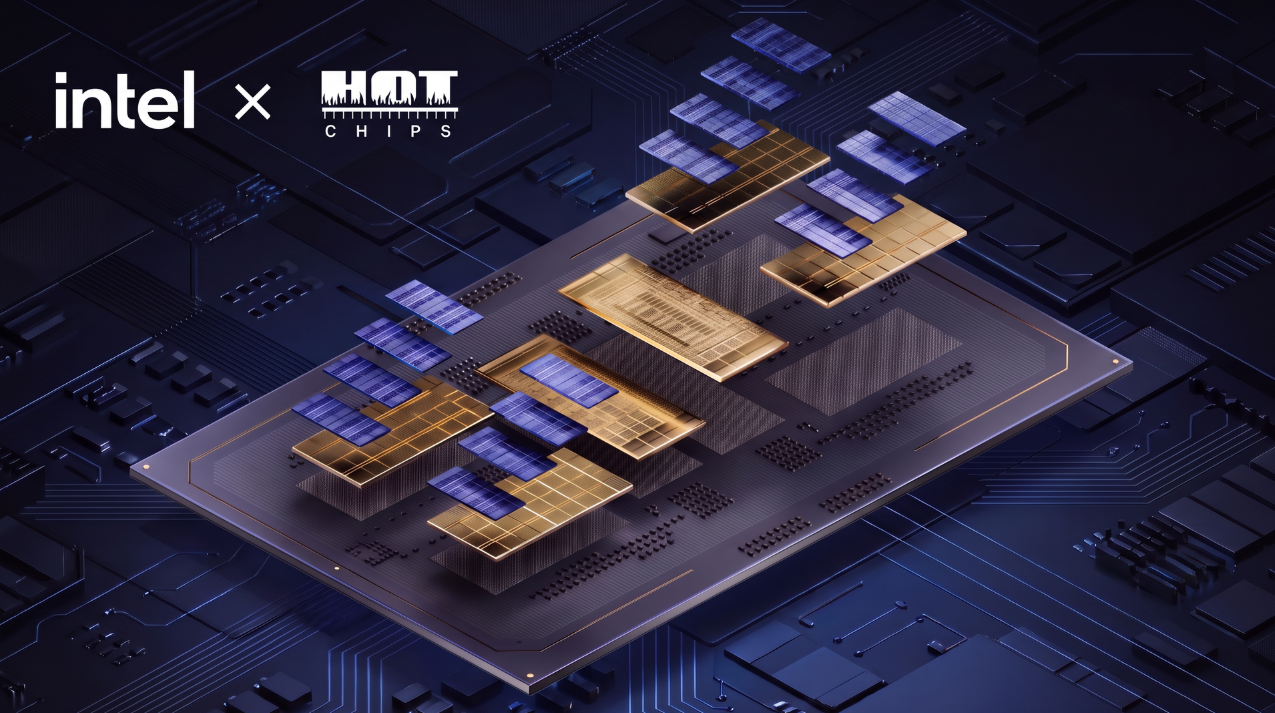
Intel used its keynote at Hot Chips 2026 in Palo Alto to lay out three chips it says will define its agentic AI stack: the next-gen Diamond Rapids Xeon for orchestration, the Crescent Island GPU for inference and the low-power Wildcat Lake SoC for intelligent edge devices.
Diamond Rapids: 256 cores, 1.28 GB cache, PCIe Gen6
Diamond Rapids is a full architectural reset for Intel's Xeon line, built exclusively on the power-and-performance-enhanced Intel 18A-P process. The design scales up to 256 all-performance cores spread across 16 CPU tiles, backed by a 1.28 GB pool of last-level cache. It runs 16 memory channels at 12,800 MT/s and offers 128 lanes of PCIe Gen6 and CXL 3.0. Intel is switching from EMIB to Foveros Direct 3D packaging and UCIe-S interconnects, adds new Advanced Performance Extensions (APX) and enhanced Advanced Matrix Extensions (AMX), and is targeting a 2027 launch as the follow-on to Granite Rapids.
Crescent Island: air-cooled inference at 480 GB LPDDR5X
Crescent Island reprises the low-power datacenter GPU role Intel first sketched at Computex 2026. The Hot Chips deep dive fills in silicon detail: 32 Xe cores and 256 XMX engines built on Xe3P, up to 480 GB of LPDDR5X, and a 350-watt air-cooled PCIe form factor engineered to slide into existing enterprise racks. Intel is pitching the chip at real-time inference economics, arguing that memory capacity and token throughput matter more than peak FLOPS as agentic workloads stretch context windows.

Wildcat Lake: Intel Core Series 3 for the edge
Wildcat Lake launches commercially as the Intel Core Series 3 processor family for price-sensitive laptops and intelligent edge platforms. The SoC combines two performance cores, four efficiency cores, integrated Xe3 graphics with XMX and a 17 TOPS NPU on the Intel 18A node. It is the first Intel client chip to use the UCIe open chiplet interconnect, and supports LPDDR5X-7467 memory alongside Wi-Fi 7 and Bluetooth 6.0.
Why the stack matters
Intel CTO Pushkar Ranade framed agentic AI as reshaping design from "the transistor and package up through the full system architecture." Diamond Rapids is the compute anchor, Crescent Island targets deployment cost, and Wildcat Lake extends the same tooling into mainstream client devices. The pitch lands as Intel Foundry chases external customers with 18A-P, and as rivals accelerate their own agentic AI silicon roadmaps – including Samsung and Broadcom's $200 billion memory and foundry MOU and the wave of custom hyperscaler chips like Waymo's 5nm robotaxi ASIC.
Reporting based on coverage from Intel Newsroom, ServeTheHome, Tom's Hardware and StorageReview.