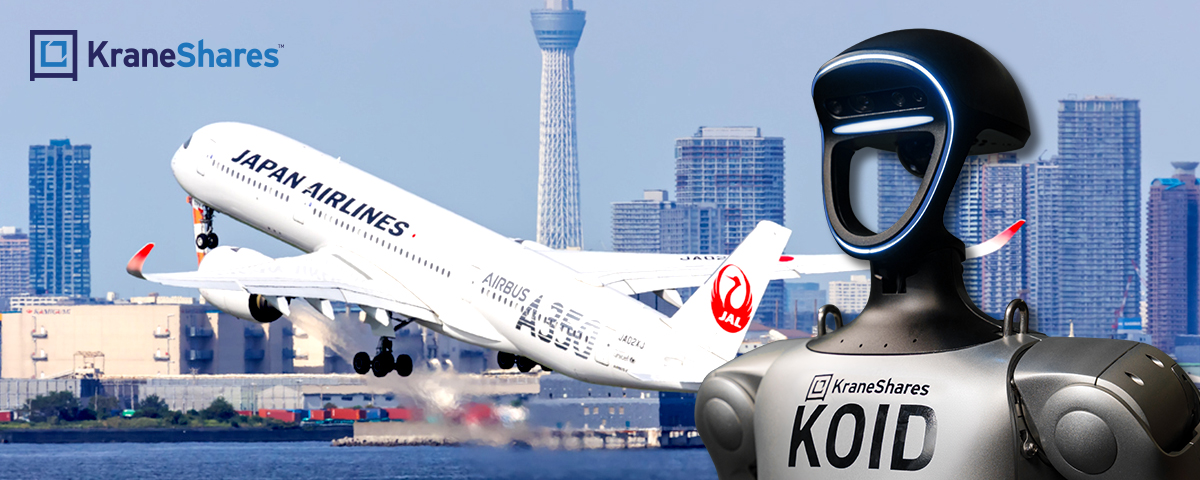
Japan Airlines (JAL) has begun deploying humanoid robots at Tokyo's Haneda Airport, marking one of the most concrete signals yet that humanoid robotics is moving from staged demonstrations into real, day-to-day operations. Rather than a one-off publicity event, the rollout is structured as a multi-year operational commitment in one of the world's most safety-conscious aviation environments.
Why an airline turned to humanoids
The move is driven by a hard demographic reality. Japan's working-age population is projected to shrink by roughly 31% between 2023 and 2060, while Haneda handles on the order of 85.9 million passengers a year and the country targets 60 million inbound tourists by 2030. With demand rising and the labor pool contracting, JAL — which runs around 4,000 ground-handling workers — is betting that humanoids can absorb some of the most repetitive and physically punishing tasks.
What the robots will actually do
JAL partnered with GMO AI & Robotics to launch the trial, deploying two Unitree Robotics-based humanoid platforms priced at roughly US$15,400 per unit. The machines are assigned to baggage loading, container transport, and aircraft cabin cleaning. The humanoid form factor was a deliberate choice: airports were built for people, not wheeled machines, so a human-shaped robot can slot into existing infrastructure without costly redesigns.
Part of a much larger deployment wave
JAL's trial does not stand alone. BMW recently validated Figure AI's Figure 02 humanoids through roughly 1,250 operational hours on an active assembly line, and Amazon is scaling Agility Robotics' Digit inside fulfilment operations. Boston Dynamics' electric Atlas has begun commercial deployments, while Chinese manufacturer AgiBot reportedly produced its 10,000th humanoid in early 2026. As we covered in our report on humanoid robot mass production signalling an industry shift from prototypes, the center of gravity is moving decisively toward fielded fleets.
The intelligence behind the hardware
The leap enabling these deployments is the rise of Vision-Language-Action (VLA) models, which let a robot interpret a plain-language instruction, read its surroundings, and act without being hand-programmed for every scenario. Analysts increasingly describe the field as being at a "GPT-2.5 moment" — capabilities are real and scaling laws are emerging, but the 99.9% reliability that mass deployment demands is still being built.
What comes next
Bank of America projects roughly 90,000 humanoid shipments in 2026, climbing toward 1.2 million by 2030. Commercial momentum is also visible in capital markets, with Unitree filing for a major Shanghai IPO. The competitive picture stretches from industrial lines into the home, as seen in China's push toward the first household humanoid robot and large-scale factory agreements such as the Schaeffler humanoid deployment deal. JAL's Haneda program adds aviation to a rapidly lengthening list of industries putting humanoids to work.
Reporting based on coverage from CNBC and analysis published by KraneShares (May 2026).