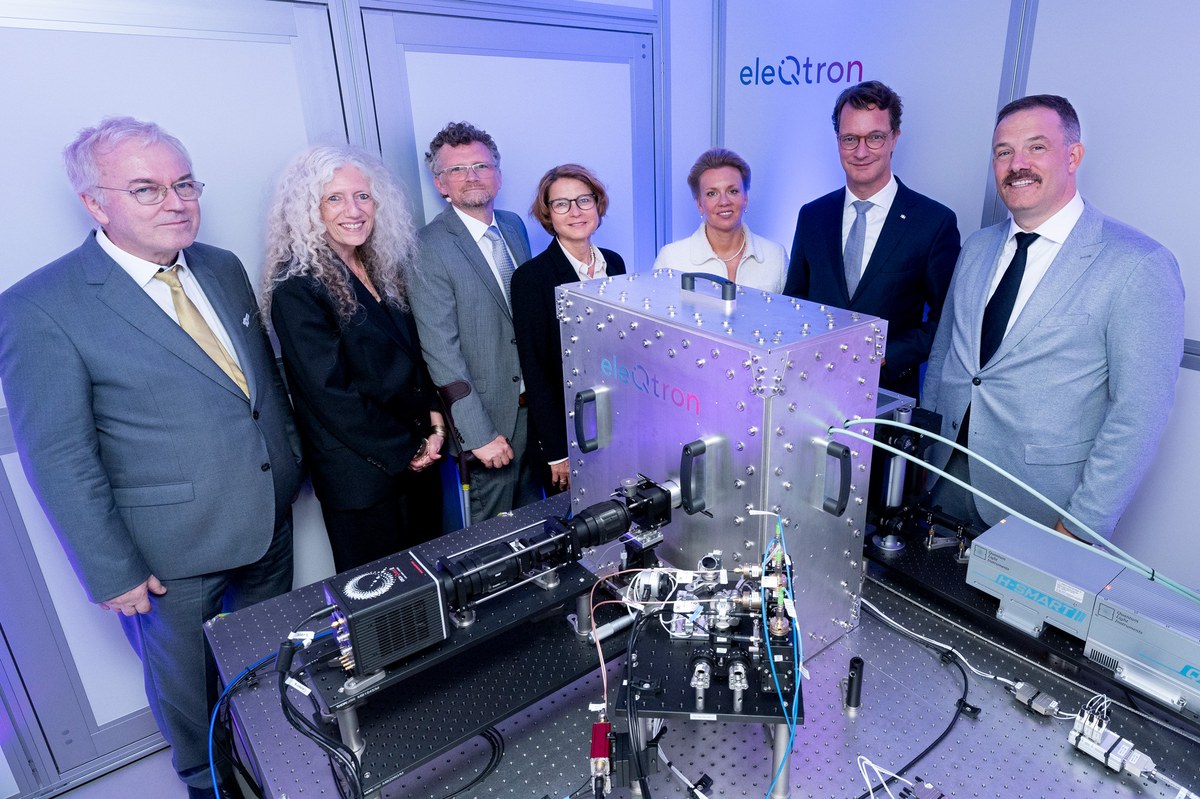
Forschungszentrum Jülich and Siegen-based startup eleQtron officially inaugurated JION, a trapped-ion quantum computer, on September 3 at the Jülich Supercomputing Centre in North Rhine-Westphalia. The machine is the first fully operational quantum system integrated into the JUNIQ user infrastructure, connecting quantum operations directly to Jülich's classical HPC estate, including JUPITER, Europe's most powerful supercomputer.
Ytterbium ions controlled with microwaves, not lasers
JION – short for Jülich trapped-ION – is a digital, gate-based ion-trap quantum computer. Its qubits are ionised ytterbium atoms held in a vacuum by electromagnetic fields. Instead of lasers or dilution refrigerators, the system uses eleQtron's Magnetic Gradient Induced Coupling (MAGIC) technology, developed at the University of Siegen. Microwaves and precisely tuned magnetic gradients let operators address each qubit individually, and the qubits do not need cryogenic cooling. eleQtron says the pilot system supports up to 30 trapped-ion qubits and is designed to simplify the path to larger, chip-scale devices.
Built inside the EPIQ project with €21 million NRW backing
JION is the flagship deliverable of the EPIQ development partnership for ion-trap quantum computers in NRW, funded with roughly €21 million from the state's Ministry of Culture and Science across four-and-a-half years. NRW Minister-President Hendrik Wüst and Science Minister Ina Brandes attended the ceremony and used the launch to announce two follow-on programs: SQALING, which puts up to €25 million from EU ERDF/JTF funds into eleQtron's push toward chip-based, scalable ion-trap platforms, and Q-STAR.NRW, a matching €25 million investment to procure and integrate a semiconductor quantum computer with up to 200 qubits into JUNIQ.
Hybrid HPC-quantum workflows from day one
Because JION plugs into JUNIQ, researchers and companies can offload specific tasks to the ion-trap system while running the rest of a workload on Jülich's classical clusters. Prof. Kristel Michielsen, head of the Jülich Supercomputing Centre, said the platform now lets users compare multiple quantum architectures side by side on real problems in optimisation, chemistry, materials science, machine learning, medicine and cyber security. eleQtron CEO Jan Henrik Leisse called JION the first industrial-grade deployment of the MAGIC stack inside a European user infrastructure.
Why it matters
Trapped-ion machines have longer coherence times than superconducting qubits and higher gate fidelities than most photonic systems, but have historically been harder to scale. eleQtron's microwave-controlled approach is one of the more credible answers to that scaling problem, and it now has a live user platform to prove itself on – alongside Quantinuum's Helios, Quanta Computer's manufacturing push and Japan's fast-growing quantum ecosystem. For Germany, JION also gives Berlin and Brussels a tangible answer to arguments that Europe's quantum program lacks deployed systems rather than just papers.
Reporting based on coverage from Forschungszentrum Jülich, eleQtron and the Ministry of Culture and Science of North Rhine-Westphalia.