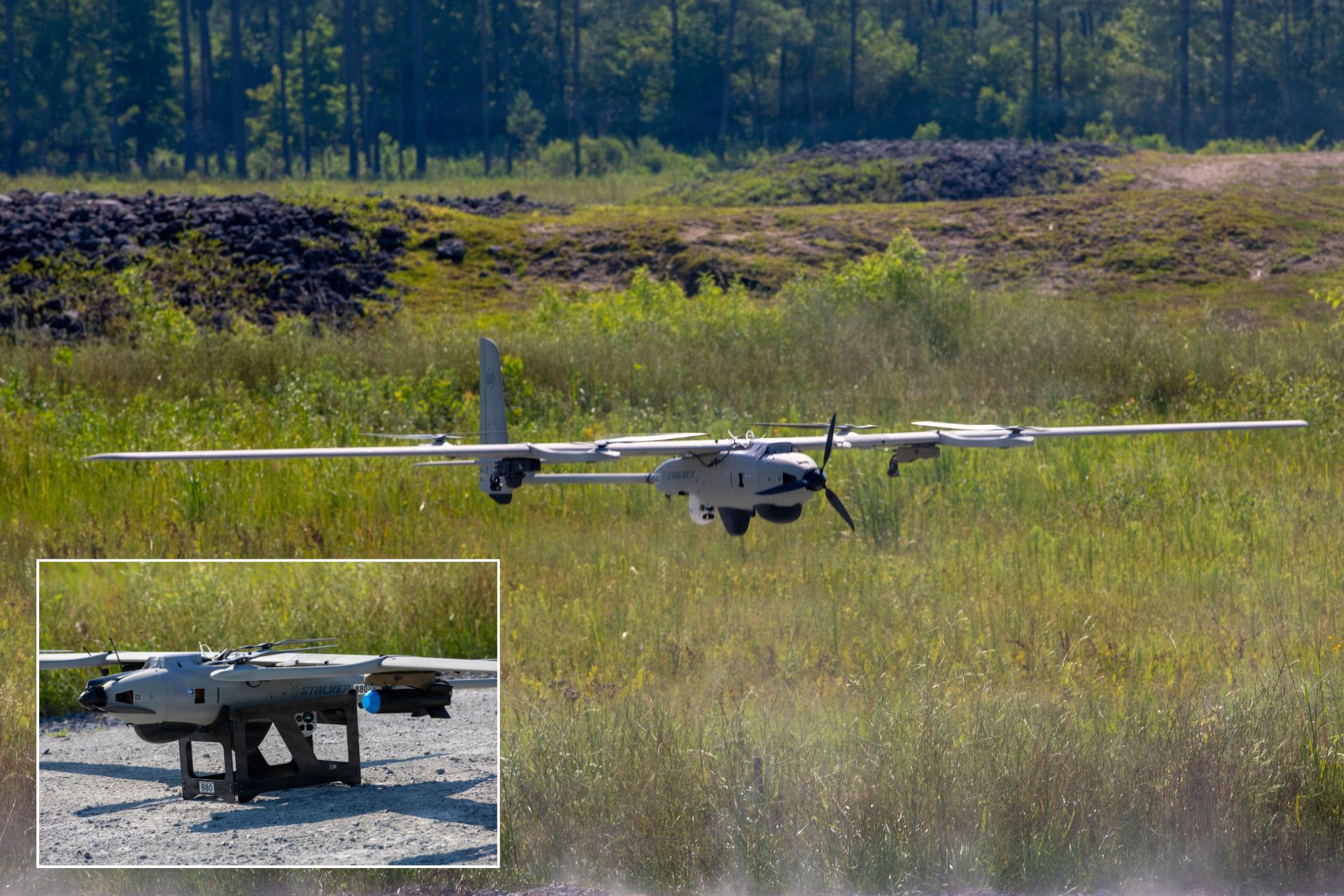
The U.S. Marine Corps has moved the FPV-drone playbook another step forward, using a VXE30 Stalker fixed-wing UAS as a flying release truck for Neros Technologies' Archer FPV attack drone during a live-fire test at Camp Lejeune, North Carolina. The Small Unmanned Aircraft School exercise, conducted on July 9, 2026 and disclosed on August 11, pairs long-endurance overwatch with expendable precision strike in one integrated kill chain.
Stalker Carries, Archer Kills
The Stalker is a fixed-wing VTOL UAS with a 4.88 m wingspan, 8-hour endurance on its propane fuel cell + hybrid battery configuration and roughly 433 km still-air range. It normally carries retractable EO/IR turrets, but in this test it also released a Neros Archer FPV mid-flight. That handoff moves the FPV's launch point off the ground, letting the drone reserve its finite battery for the terminal dive rather than the transit — and pushing effective FPV strike range well past the ~20 km organic reach Archer already delivers from a ground launch.

Pacific Fingerprints
The concept has obvious Indo-Pacific applications. Marines dispersed across island chains rarely have artillery or aviation on call, and Ukrainian FPV work has shown that terminal engagement quality collapses when jamming eats into the effector's own transit. Carrying an armed FPV inside a Stalker preserves link budget, keeps the operator further back, and lets the Stalker double as a comms relay after the drop — a piece with the same Drone Dominance push that stood up the Naval Academy YP NEXT block and the South Korea FPV live-fire drills.
Where Neros Fits
Neros has been on a tear — fresh off a $250M Series C at $2.5B to scale Archer and its Bandit AI stack — and the VXE30 test is a live proof of the company's Crossbow control architecture, which was engineered to keep FPVs on-mission under jamming. The Marines are also planning to acquire thousands of FPVs within the same effort, so the Stalker-plus-Archer pairing is likely to move quickly from schoolhouse test to fielded tactic.
Reporting based on coverage from Army Recognition and U.S. DoD releases.