
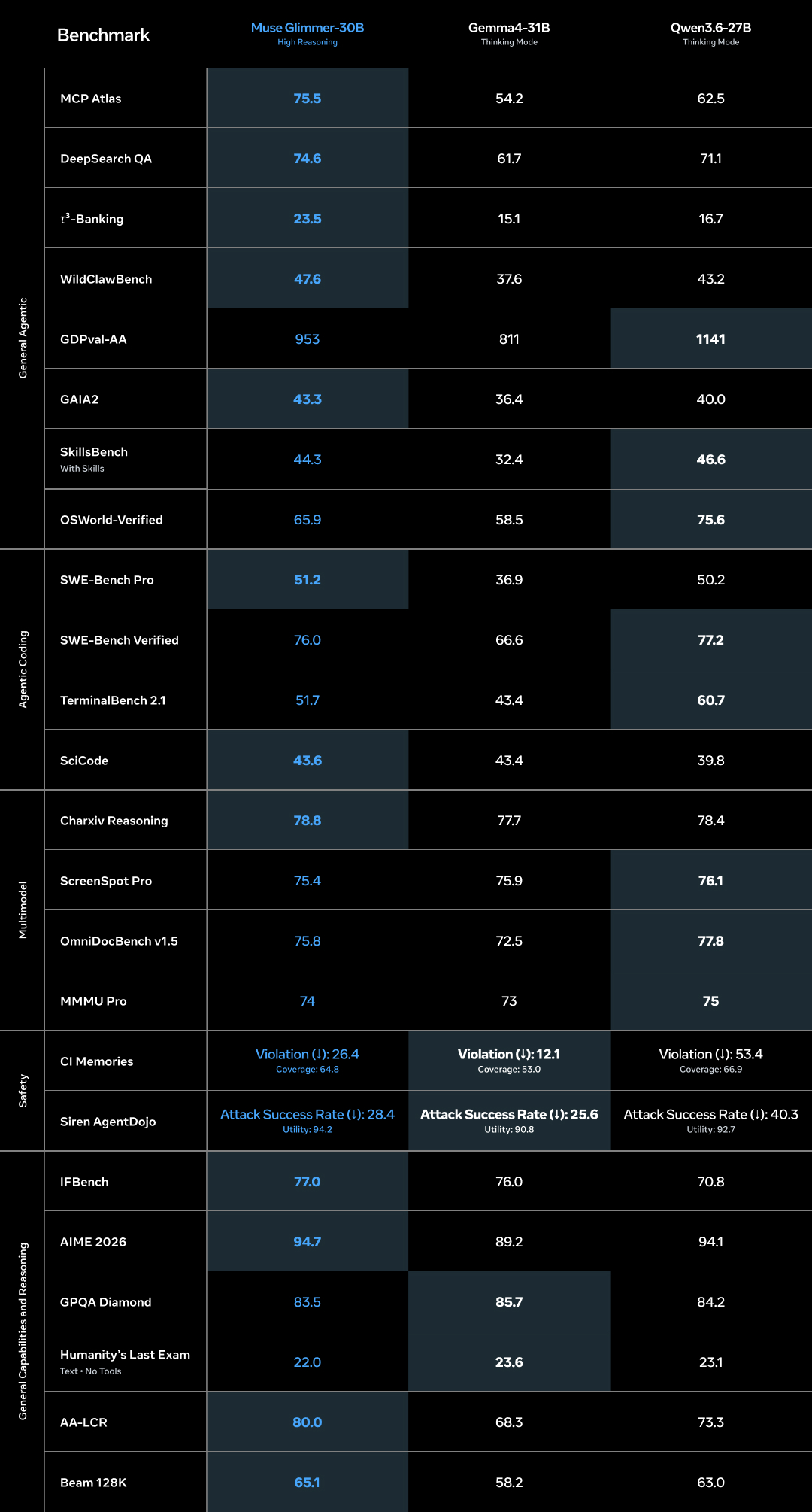
Meta Superintelligence Labs on Monday released Muse Glimmer, a 30-billion-parameter open-weight agentic model that runs on a single consumer GPU. Published under the Apache 2.0 license on Hugging Face, Glimmer is Meta's first purpose-built local agent model and lands alongside a 6,500-word essay from CEO Mark Zuckerberg arguing that superintelligence should not be concentrated in a handful of labs.
An Open Model Sized For Your Laptop
Glimmer is optimized for always-on local workflows — coding, function calling, working with files and screenshots, LLM-as-a-judge evaluation — and works with text and images across more than 100 languages. Meta distilled Muse Spark's agentic reasoning into Glimmer using a novel logit-distillation recipe and paired that with 4-bit quantization to shrink the model below 20 GB, leaving headroom for the KV cache, perception encoder and a speculative-decoding drafter inside a 24 GB or 32 GB envelope.
Speed Through DFlash Speculative Decoding
Meta ships Glimmer with a lightweight DFlash drafter that proposes blocks of tokens the main model then verifies in parallel. On the numbers Meta reports, speculative decoding pushes decode speed up 3.1x on an RTX 5090, 1.8x on an M5 Max and 1.5x on an M4 Max — enough, Meta says, for "fluid conversation and real-time agent interaction, all running entirely on your device." Optimized integrations with llama.cpp, MLX and ExecuTorch are landing over the coming days, with vLLM and SGLang serving at scale.
Zuckerberg's Open Bet
Muse Glimmer arrives four months after Muse Spark, the closed frontier model it distills from, and days after Meta open-sourced the smaller Muse Spark 1.2. Zuckerberg's accompanying essay — "The Future is for Everyone" — pushes back against what he called a natural drift toward concentration, arguing openness is the only way to keep superintelligence useful for the many rather than the few. That framing puts Meta in a distinct lane from Anthropic's $10B Volta compute deal, NVIDIA's $5B bet on Safe Superintelligence and OpenAI's Astra model. Whether openness wins the agent era or not, developers now have a competitive 30B model they can pull down for free — and Meta's AMD, Arm, Dell, Intel and NVIDIA partners have already been briefed to make it run.
Reporting based on coverage from Meta AI Research, Bloomberg, TechCrunch, Engadget, CNBC and Techtimes.