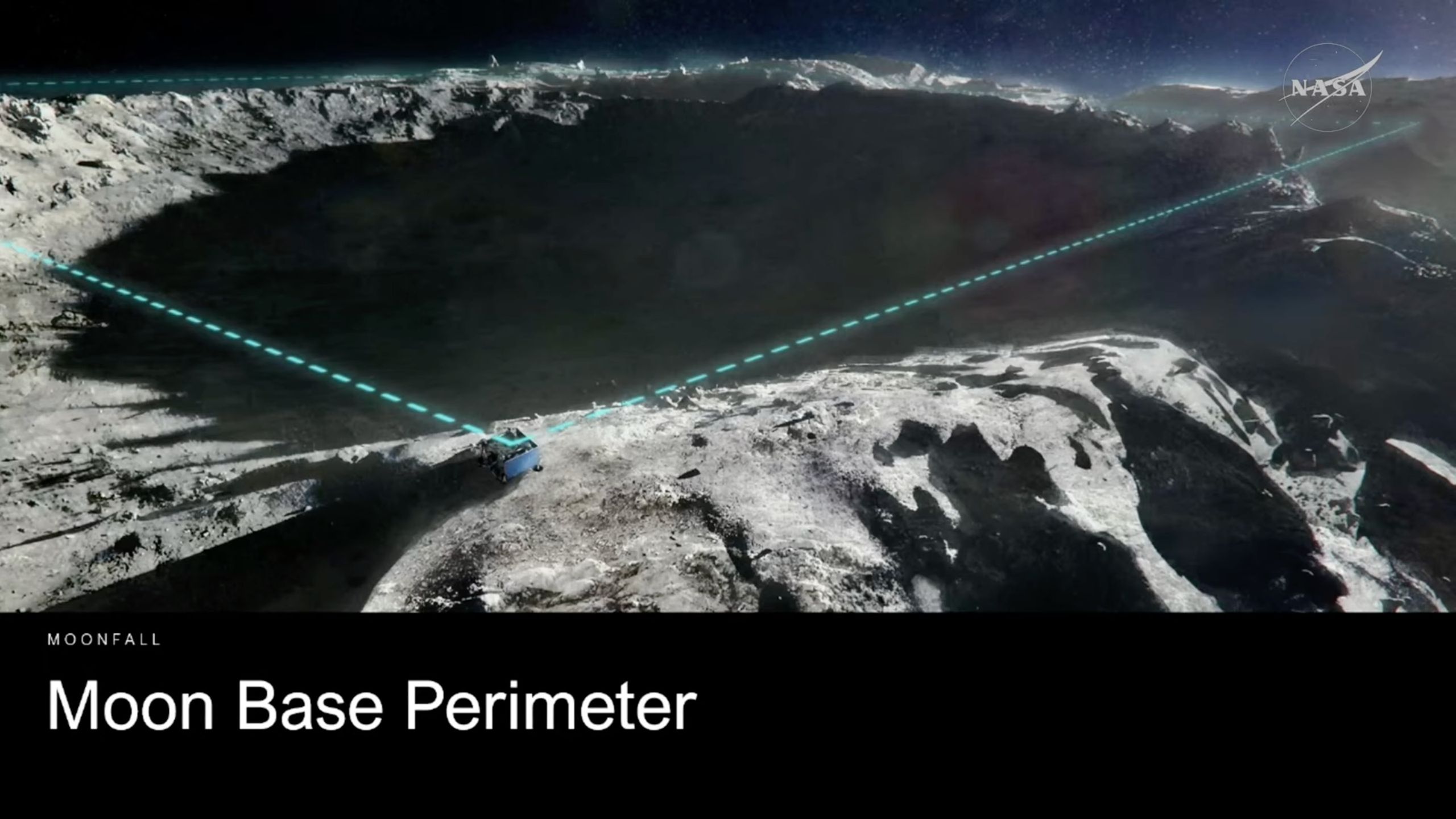
NASA on Tuesday laid out the most detailed picture yet of its planned lunar outpost, telling reporters at agency headquarters in Washington, D.C., that the Moon Base could eventually sprawl across "hundreds of square miles" near the lunar south pole. The May 26 briefing doubled as a procurement milestone: the agency awarded roughly $1 billion in contracts to begin building the outpost and the robotic vehicles that will support it.
A Moon Base the size of a city
"We envision the moon base to be hundreds of square miles, with different assets all building up to the objective of permanent lunar presence on the moon," said Carlos Garcia-Galan, manager of NASA's Moon Base program. Chief architect Nujoud Merancy said the footprint grew naturally from the mix of science, habitation and power needs: habitats would sit atop sunlit hills, while nuclear power systems would be placed a kilometer or more away for radiation protection. "All of these things, when you start putting them together, end up sprawling a little bit more like a city as you start building it out," she said.
The south pole was chosen because its permanently shadowed craters are thought to hold billions of years' worth of water ice, a resource NASA hopes to tap for life support and propellant.
$1 billion in rover, lander and drone contracts
The centerpiece of the event was the contract awards. NASA is paying California's Astrolab $219 million and Colorado's Lunar Outpost $220 million to build crewed lunar terrain vehicles (LTVs), large rovers capable of autonomous operation that can land ahead of astronauts and be driven remotely from Earth. Both rovers will be delivered to the surface by Blue Origin's Blue Moon lander under two contracts worth $234 million apiece. Firefly Aerospace separately won a $75 million subcontract to fly the first batch of "MoonFall" scout drones, small hopping robots that will survey the south pole and help mark the base's perimeter, on a lander targeted for 2028.
The heavy reliance on autonomous rovers and robotic scouts mirrors the broader push to put machines on other worlds before crews arrive, echoing efforts like Redwire's MANUS lunar robotic arm for ESA and DARPA's robotic satellite-servicing mission.
Artemis 3 reframed as an Earth-orbit test
Administrator Jared Isaacman confirmed that Artemis 3, now targeted for mid-2027, will be a docking test in Earth orbit between NASA's Orion capsule and the program's privately built crewed landers, Blue Moon and SpaceX's Starship. The first crewed landing near the south pole is not expected until Artemis 4 in late 2028, and NASA wants at least one LTV on the surface before then.
A three-phase race to the south pole
NASA framed the program in three phases: securing reliable access through 2029, reaching "initial operating capability" between 2029 and 2032, and building toward a "semi-permanent crew presence" beyond 2032. Officials repeatedly stressed urgency, noting that China is aiming to land its own astronauts on the moon by 2030. "I think it's important for us to get there first," Isaacman said, while pledging to respect the Outer Space Treaty. He called the outpost "America's and humanity's first outpost on another celestial world."
Reporting based on coverage from Space.com and Spaceflight Now.