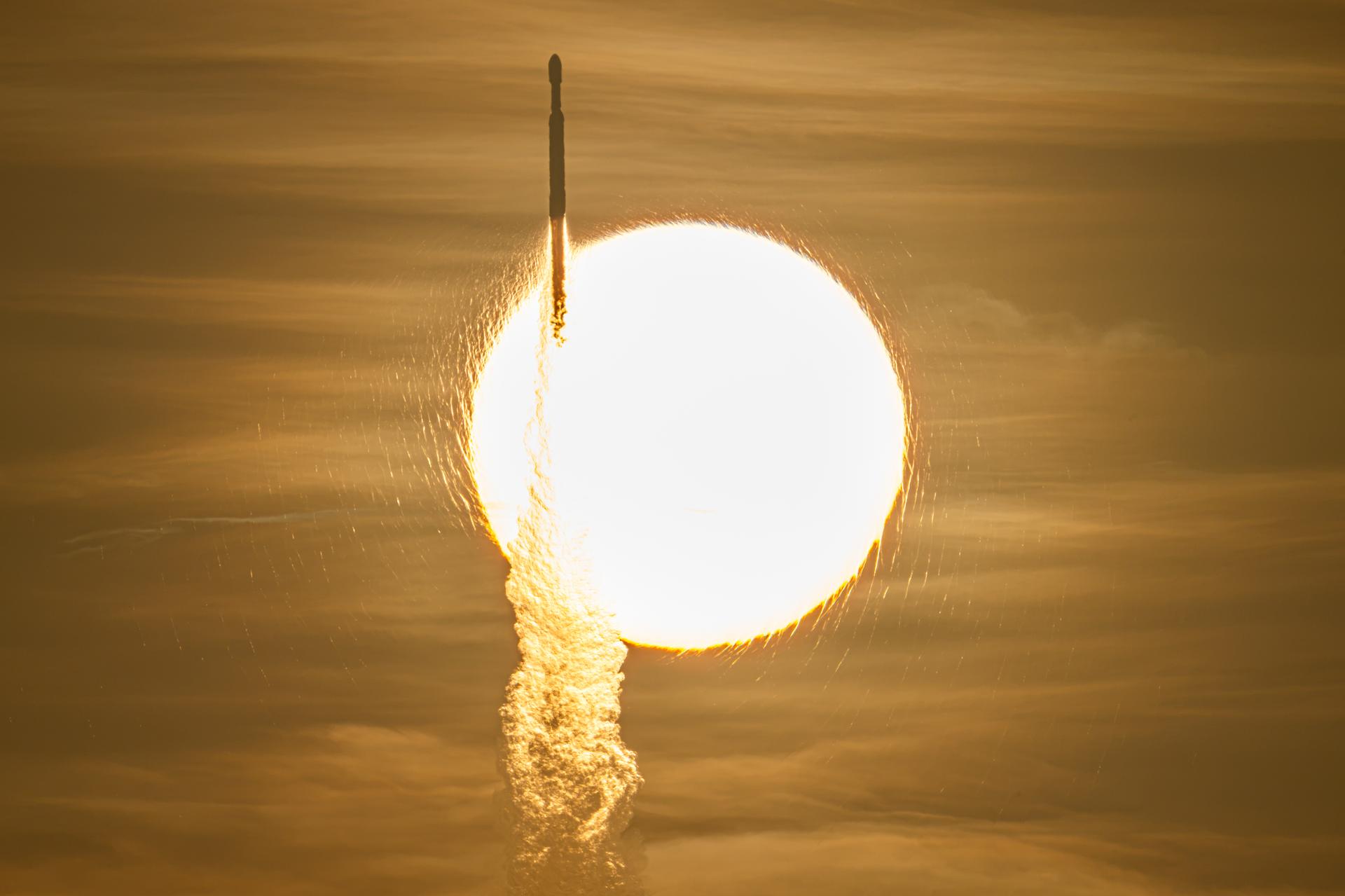
NASA's flagship Nancy Grace Roman Space Telescope lifted off at 7:26 a.m. EDT on Sunday, August 30, 2026 aboard a SpaceX Falcon Heavy rocket from Launch Complex 39A at the agency's Kennedy Space Center in Florida, beginning a three-month, million-mile journey to the second Sun-Earth Lagrange point (L2) to hunt for dark matter, dark energy and exoplanets.
A pristine ride on Falcon Heavy
The Falcon Heavy performed as expected, separating from the observatory 31 minutes after liftoff, with the rocket's side boosters returning safely to the launch site for refurbishment. NASA's ground control team at Goddard Space Flight Center in Greenbelt, Maryland, began receiving Roman's telemetry seven minutes after launch, and the Deep Space Network took over communications about 70 minutes into the flight through the Canberra ground station in Australia. Roman is the fourth primary NASA mission to launch on a Falcon Heavy, and the agency's Launch Services Program worked with SpaceX to pull the launch date forward after the observatory was completed ahead of schedule.
A discovery machine for the dark universe
Roman pairs a Hubble-class 2.4-meter mirror with a 300-megapixel Wide Field Instrument built around 18 4K infrared detectors, each about the size of a saltine cracker, giving it a field of view roughly 100 times larger than Hubble's. NASA says the telescope is designed to survey the sky about a thousand times faster than Hubble and will beam back around 1.4 terabytes of data per day, the highest data rate of any NASA astrophysics mission to date. Machine learning, artificial intelligence and citizen scientists will help sift the flood of pixels for candidate exoplanets, transient sources and cosmic structures worth deeper follow-up.

Commissioning, coronagraph and first images
Within roughly 90 minutes of launch, controllers confirmed successful deployment of Roman's solar panels and lower instrument sun shade. Over the following days the high-gain antenna and visor-like deployable aperture cover will unfold, the first of two mid-course corrections will fire, and the Coronagraph Instrument will power on — a technology demonstration for future direct-imaging missions like NASA's Habitable Worlds Observatory concept. The primary Wide Field Instrument activates a few weeks into the cruise, and NASA anticipates releasing Roman's first science images by early 2027 after a three-month commissioning campaign.
An industry-heavy build
The Roman mission is managed at NASA Goddard with contributions from JPL, Caltech/IPAC, and the Space Telescope Science Institute in Baltimore. Primary industrial partners are BAE Systems Inc., L3Harris Technologies and Teledyne Scientific & Imaging, with additional contributions from ESA, JAXA, France's CNES and Germany's Max Planck Institute for Astronomy. "Roman will be a discovery machine that will bring us closer than ever before to answering humanity's most profound questions about our cosmic history," said Nicky Fox, associate administrator for NASA's Science Mission Directorate.
The successful launch caps the priority sweep The Robotics Media flagged in early August when NASA confirmed the August 30 target, and adds Roman to the SpaceX flight log the day after SpaceX crossed its 100th orbital launch of 2026. Roman also lands in the middle of a busy month for European launch: ESA recently awarded €544M in European Launcher Challenge contracts to Isar, RFA and PLD Space.
Reporting based on coverage from NASA, Space.com and NPR.