North American companies ordered 10,989 industrial robots worth $723.5 million in the third quarter of 2026, according to the Association for Advancing Automation. That is a 24.8% jump in units and a 26.1% jump in value compared with the same quarter last year, making it the strongest quarter of 2026 so far.
Which industries are actually driving the growth?
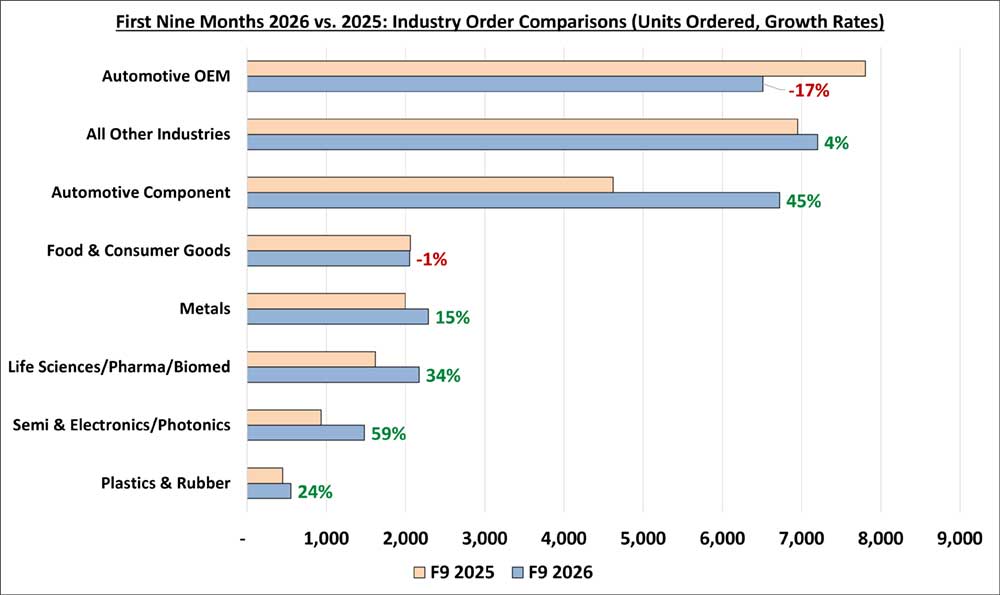
The gains are broad, not concentrated in one sector. Semiconductor, electronics and photonics orders rose 97.6% in units year over year, the single biggest jump of any category. Automotive component manufacturers nearly doubled their orders too, up 90.4%, while plastics and rubber climbed 67.7%, life sciences, pharma and biomedical rose 38.7%, and metals increased 37.0%.
Not every sector is up. Food and consumer goods orders fell 23.7% in the quarter, and the broad "all other industries" bucket grew just 0.5%. A3 executive vice president Alex Shikany said what stands out "is not simply the magnitude of growth, but how broadly distributed across industries" the demand has become, pointing to chip fabs, battery plants and life sciences facilities all buying automation at once.
How big a role are collaborative robots playing?
North American companies ordered 1,831 collaborative robots in the quarter, worth $63.8 million, up about 56% year over year. Cobots now account for 43.8% of all life sciences and pharma orders and 36.9% of semiconductor and electronics orders, showing they have moved well past small pilot programs into mainstream production lines in regulated, high-mix industries.
For the first nine months of 2026, collaborative robots totaled 4,605 units worth roughly $178 million, which is 15.9% of all robot units ordered and 9.4% of total value. That gap between unit share and value share reflects their lower price point relative to large traditional industrial arms, but it also means cobots are now a meaningful slice of the market rather than a niche.
How does this compare to the rest of 2026?
The nine-month total for 2026 stands at 28,984 robots worth about $1.89 billion, up 9.6% in units and 13.3% in value over the same period in 2025. That means Q3's 24.8% growth rate ran well ahead of the year's pace to date, suggesting orders accelerated through the summer rather than staying flat.
The semiconductor spike lines up with a broader wave of chip fabrication investment across North America tied to reshoring and AI data center buildout, which has pulled robotics demand along with it. Automotive's swing is notable too: OEM orders rose a modest 7.5%, but orders for automotive components, the parts and subsystems that feed those assembly lines, nearly doubled, hinting that suppliers are automating faster than the carmakers themselves right now.
What should buyers and robot makers watch next?
If semiconductor and battery investment keeps expanding, A3's numbers suggest robot integrators serving those sectors have a multi-quarter tailwind rather than a one-off spike. The weak spot is food and consumer goods, where a 23.7% order decline could reflect either market saturation after earlier automation waves or simply softer capital spending in that sector. Either way, Q3's data points to a robotics market where growth is no longer just an automotive story.